RARE BLUE STARTER: We all know what comes out of the bottom of thunderstorms: lightning bolts. But on Oct. 20th, Thomas Ashcraft of New Mexico saw something coming out of the top. "I captured a form of a transient luminous event called a 'blue starter' shooting up from the top of a thunderstorm cloud," he says. "Blue starters are rarely captured from ground level and there are hardly any specimens on the internet."
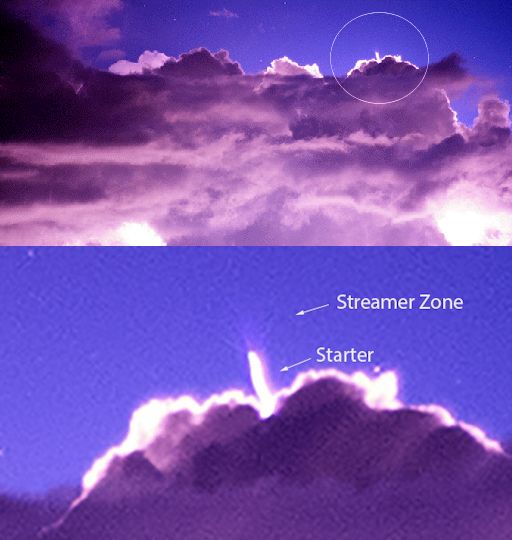
Lightning scientist Oscar van der Velde explains this phenomenon: "A blue starter is an electric streamer discharge coming out of the top of a thundercloud, fanning out and reaching up to the stratosphere as high as 26 km altitude. First reported by UAF scientists Wescott and Sentman in 1995/1996, they were found to be different from blue jets, which reach 35-40 km height."
"Since then, there have been very few reports of blue starters," continues van der Velde. "It seems that unusual physical circumstances may be required to produce them. Also, geometry can prevent people from seeing blue starters when a cloud is nearby because the underbody of the cloud can block their view. At larger distances the blue/violet light does not make it to the observer due to scattering."
Blue starters and blue jets are cousins of sprites, another form of exotic lightning that shoots up instead of down. Sprites, however, are more frequently observed. Check them out in the realtime photo gallery:
CME IMPACT SPARKS NO STORMS: Arriving earlier than expected, a coronal mass ejection (CME) hit Earth's magnetic field on Oct. 24th at approximately 1900 UT. NASA's ACE spacecraft, located at the L1 point 1.5 million km upstream from Earth, detected the CME's leading edge about a half hour before it reached Earth:

Solar wind speeds abruptly jumped to more than 500 km/s as the CME passed by. The shockwave rattled Earth's magnetic field and caused electrical currents to flow through the ground of Norway's Lofoten islands: data. However, that's about all that happened. A full-fledged geomagnetic storm did not erupt, and few auroras have been reported. Why was the CME so ineffective? Its internal magnetic field did not connect to Earth's magnetic field; the mismatch mitigated the CME's impact. Aurora alerts: text or voice
MORNING PLANET SHOW: Set your alarm for dawn. Venus, Jupiter and Mars are gathering for a three-way close encounter in the early morning sky. Yesterday, Kouji Ohnishi woke up early and photographed the convergence from Iiyama, Nagano, Japan. He calls this composition Reverie in Autumn:
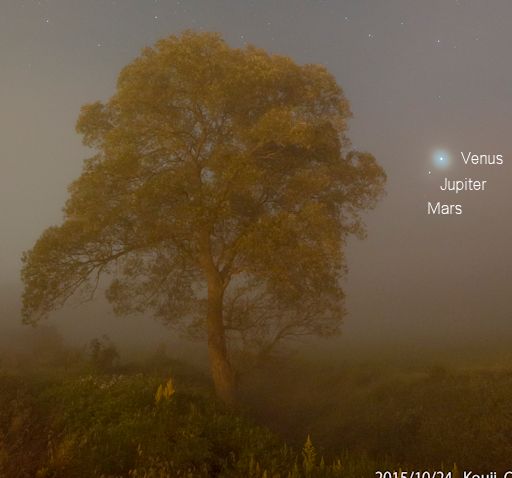
"I could see the planets even through deep fog," says Ohnishi. "It was a wonderful morning."
The next five mornings will be equally wonderful. From Oct. 25th to Oct. 29th Venus, Jupiter and Mars will fit together inside a circle only 5o wide (sky maps: #1, #2, #3, #4, #5). Super-bright Venus and Jupiter are visible even after the black pre-dawn sky turns cobalt blue. Once you find them, you will have little trouble locating the dimmer red planet Mars. Enjoy the show!


