SOLAR SECTOR BOUNDARY CROSSING: High-latitude auroras are possible on Oct. 29th when Earth crosses through a fold in the heliospheric current sheet. This is called a "solar sector boundary crossing," and NOAA forecasters estimate a 30% chance of polar geomagnetic storms when it occurs. Aurora alerts: text or voice
HALLOWEEN FIREBALLS THIS WEEKEND? Ten years ago, in late Oct. 2005, Earth ran into an unusually dense stream of debris from Comet Encke, source of the annual Taurid meteor shower. The result was a display of bright fireballs widely observed from Oct. 28th through Nov. 10th. Astronomers called them the "Halloween Fireballs," and they looked like this:

Hiroyuki Iida took the picture on Oct. 28, 2005, from Toyama, Japan. To get a sense of the fireball's luminosity, look just above it. That is Sirius, the brightest star in the sky. The fireball was at least as bright.
Astronomer David Asher, who correctly predicted the 2005 "Taurid swarm," thinks Earth might run into another filament of debris from Comet Encke this weekend. If so, the encounter would spark a renewed display of Halloween fireballs. The best time to look is during the hours around midnight when the constellation Taurus is high in the sky. If the shower materializes, observers could see a meteor explode every few hours.
Taurid fireballs come from a swarm of particles bigger than normal comet dust. They're about the size of pebbles or small stones. The rocky swarm moves within the greater Encke dust stream, sometimes hitting Earth, sometimes not. Will this Halloween be a hit? Stay tuned.
HALLOWEEN ASTEROID: An asteroid the size of a battleship will fly past the Earth-Moon system on Oct. 31st. There's no danger of a collision. Asteroid 2015 TB145 will be 300,000 miles away from Earth at closest approach on Halloween. That's too far for goosebumps, but close enough for a good view. NASA radar astronomers plan to make high-resolution maps of the passing space rock.
At the moment, 2015 TB145 is still a dim speck in the southern constellation Eridanus. Amateur astronomer Marian Urbanik photographed it on Oct. 26th using a remotely controlled 0.43 meter telescope in Siding Springs, Australia:
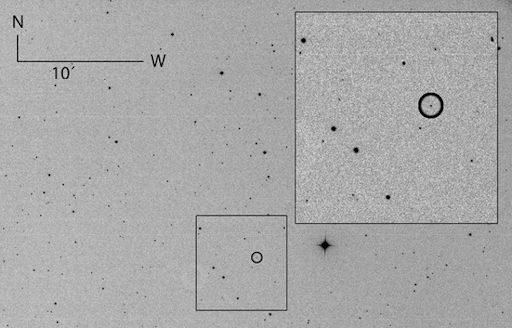
When Urbanik took the picture, the asteroid was shining like a 16th magnitude star. By the time it reaches the Earth-Moon system on Halloween, it will have brightened 250-fold to 10th magnitude. That's too dim for the naked eye, but an easy target for experienced astronomers with mid-sized backyard telecopes. An article from Sky & Telescope discusses the asteroid's visibility.
2015 TB145 is about 400 meters wide. According to the Minor Planet Center, this is the closest known approach by an object this large until asteroid 1999 AN10 (800 meters wide) approaches Earth at a distance of 238,000 miles in August 2027.
Lance Benner, a radar astronomer at JPL, has raised the intriguing possibility that 2015 TB145 is not an asteroid. "The asteroid's orbit is very oblong with a high inclination to below the plane of the solar system," said Benner. "Such a unique orbit, along with its high encounter velocity -- about 35 kilometers or 22 miles per second -- raises the question of whether it may be some type of comet. If so, then this would be the first time that the Goldstone radar has imaged a comet from such a close distance."
Realtime Space Weather Photo Gallery
LONG RANGE AURORA FORECAST: On Oct. 7th and 8th, a high-speed stream of solar wind hit Earth's magnetic field, sparking strong geomagnetic storms and auroras. On Nov. 2nd - 5th, it could happen again. The same solar wind stream that caused the October storms is set to return during the first week of November. It is flowing from this hole in the sun's atmosphere:

Image credit: NASA/Solar Dynamics Observatory. Oct. 29, 2015.
The dark circled region, called a "coronal hole," is where the sun's magnetic field has opened up, allowing solar wind to escape. The last time this particular coronal hole turned toward Earth, in early October, it lashed our planet's magnetic field with an 800 km/s solar wind stream. Now it is turning toward Earth again. Aurora fans, mark your calendar for the first week of November. You might see something like this. Aurora alerts: text or voice