HALLOWEEN ASTEROID... NASA radars are swiveling to track 2015 TB145, an asteroid the size of a battleship that is passing by the Earth-Moon system today. There's no danger of a collision. At closest approach the space rock will be 300,000 miles away--too far for goosebumps, but close enough for a good view in backyard telescopes: image gallery. Update: There is growing evidence that the Halloween asteroid is actually a dead comet.
... AND HALLOWEEN FIREBALLS: The "Halloween asteroid" is going to miss Earth. The "Halloween fireballs" might not. If forecasters are correct, gravelly debris from Comet Encke could strike our planet's atmosphere this weekend, producing a display of fireballs like this one:
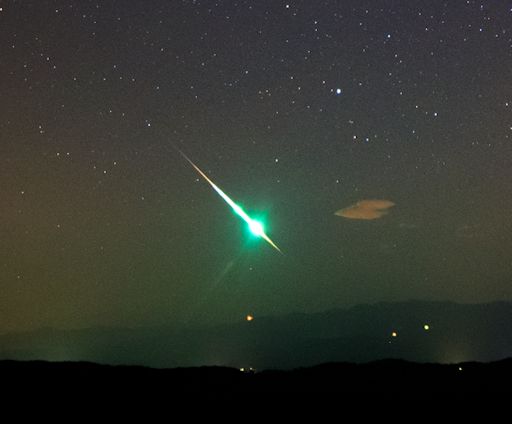
Marko Korosec took the picture last night in Artvize, Slovenia: "This spectacular meteor had two bright flashes," he says. "It caught me a bit unprepared as I was looking in other direction, saw first flash then looked up and--bam!--the second flash was so bright it lit up the ground."
Korosec says the fireball came from the constellation Taurus, which marks it as a meteoroid from Comet Encke. Most debris from Comet Encke is small, dusty and fragile, yielding meteors of ordinary brightness. Taurid fireballs come from a swarm of particles much larger than normal comet dust. They're about the size of pebbles or small stones. The rocky swarm moves within the greater Encke dust stream, sometimes hitting Earth, sometimes not. Will this Halloween be a hit? Korosec's fireball is an encouraging sign. Stay tuned.
CME MISSES EARTH, AURORAS APPEAR ANYWAY: A CME expected to deliver a glancing blow to Earth's magnetic field on Oct. 30th did not. It missed. Sky watchers around the Arctic Circle saw auroras anyway. Anne Birgitte Fyhn sends this picture from Kvaløya island, Tromsø, Norway:
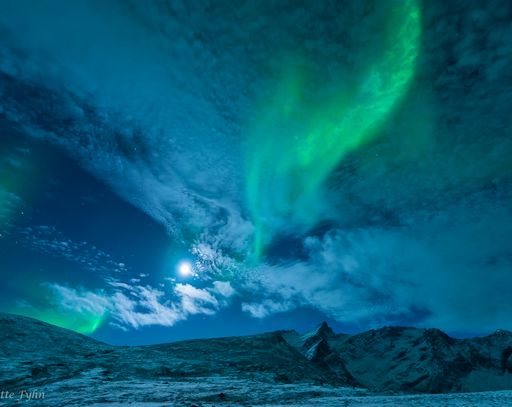
"The partly cloudy weather made this evening extra exciting," says Fyhn. "I was lucky to witness a beautiful show where the auroras and the appearing clouds competed covering the stars."
Tromsø is just above the Arctic Circle where even gentle gusts of solar wind can spark Northern Lights--no CME required. More lights could be in the offing. NOAA forecasters say Earth is going to cross a fold in the heliospheric current sheet on Halloween (Oct. 31st), a crossing which could scare up some spooky auroras. Aurora alerts: text or voice
Realtime Space Weather Photo Gallery