SOLAR WIND BRINGS AURORAS: As predicted, a high-speed stream of solar wind has reached Earth and is buffeting our planet's magnetic field. So far, however, there has been only mild geomagnetic storming. Magnetic fields inside the solar wind stream are not well-connected to Earth's magnetic field, and that mismatch is mitigating its impact.
Despite the mismatch, sky watchers are still seeing some beautiful auroras. Rocky Raybell photographed this display--split down the middle by a Taurid fireball--from Keller, Washington, during the early hours of Nov. 3rd:

"The auroras were not as strong as I expected," he says, "but the fireball made up for any shortcomings." Elsewhere in the United States, auroras were sighted in Michigan, Wisconsin, Montana, and even Ohio.
More auroras are possible tonight, especially around the Arctic Circle, as the solar wind continues to blow. NOAA forecasters estimate an 85% chance of polar geomagnetic storms on Nov. 3rd, waning to 70% on Nov. 4th. Aurora alerts: text or voice
VOLCANIC LIGHTNING IN MEXICO: In southern Mexico, the Colima volcano has been in a state of near-constant activity since 1994. It's not unusual for several explosions to occur in a single day, throwing plumes of ash 2 or 3 kilometers into the sky. On Oct. 28th, Spaceweather.com reader Thorsten Boeckel was on hand for one of those eruptions--a nighttime blast--and he photographed a violent display of volcanic lightning:

"This mighty stroke illuminated the ash discharge, which rose up over the crater of the 3860m high Colima Volcano," he says. "Pure fascination!"
Researchers have long known that volcanic eruptions produce strong lightning. Findings published in a 2012 Eos article reveal that the largest volcanic storms can rival massive supercell thunderstorms in the American midwest. But why? Volcanic lightning is not well understood.
Lightning is nature's way of correcting an imbalance of electric charge. In ordinary thunderstorms, one part of a thundercloud becomes positively charged, and another part becomes negatively charged. This charge comes from collisions between particles. Droplets of water and crystals of ice rub together, creating static electricity in much the same way as woolen socks rubbed against carpet. Lightning arcs between charge-separated regions.
Something similar must be happening inside volcanic plumes. One hypothesis holds that catapulting magma bubbles or volcanic ash are themselves electrically charged, and by their motion create charge-separated areas. Another possibility is that particles of volcanic ash collide with each other and become charged through triboelectric rubbing. In short, no one knows. It is a beautiful (and terrifying) mystery.
GIANT SUNSPOT HIDES SPACESHIP: Sunspot AR2443 is so big, it is attracting the attention of astrophotographers around the world. Yesterday when Peter Rosén of Stockholm, Sweden, photographed the sprawling complex, he found a spaceship hiding among its dark cores. Seriously. Take a close look at the image below:
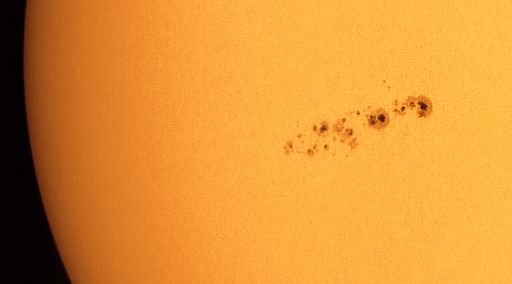
Can't find the spaceship? Click here and here. "It is the International Space Station," explains Rosén. "I caught it making a split-second transit of the giant sunspot."


Indeed, AR244 is huge. From end to end it measures almost 200,000 km. Many of the dark cores are as large as terrestrial continents--and a couple are as large as Earth itself. These dimensions make it an easy target for backyard solar telecopes.
Of greater interest is the sunspot's potential for explosive activity. The spotty complex has a 'beta-delta' magnetic field that harbors energy for strong M-class solar flares. Any such explosions will be geoeffective as the sunspot turns squarely toward Earth in the days ahead. Solar flare alerts: text or voice
Realtime Space Weather Photo Gallery