CME SPARKS GEOMAGNETIC STORM: Arriving almost a full day earlier than expected, a CME struck Earth's magnetic field on Nov. 6th at 18:00 UT. At first, the impact had little effect. As Earth moved deeper into the CME's wake, however, a G2-class geomagnetic storm broke out. Nikolay Alfertiev photographed the auroras over Russia's Kola peninsula:

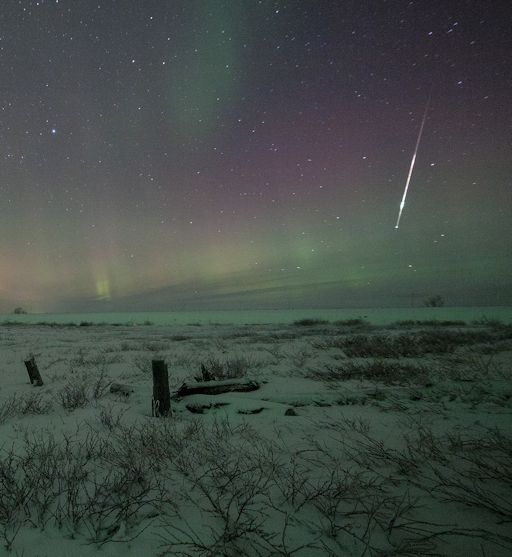
"A Taurid fireball cut through the auroras as I took this picture before sunrise on Nov. 7th," says Alfertiev.
NOAA forecasters estimate a 50% to 60% chance of continued geomagnetic storms on Nov. 7-8. Auroras could descend to northern-tier US states such as Washington, Michigan, and Maine. Aurora alerts: text or voice
EXPLODING METEOR CREATES ICE HALO: Around the world, observers are reporting bright fireballs in the midnight sky. The source of the display is Comet Encke, parent of the annual Taurid meteor shower. How bright is a Taurid fireball? This one exploded over Victoria, BC, in a flash of light almost as luminous as a full Moon:
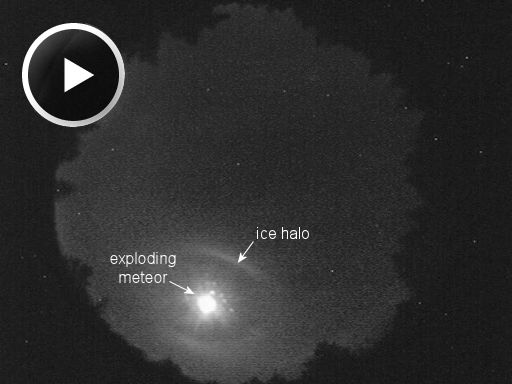
"This movie was captured by a SkySentinal meteor camera on Nov. 4th," says Dwayne Free, Director of Space Coast Intelligent Solutions. "We run a network of meteor cameras 10 times larger than NASA's," he says, "and we have been recording 100s of Taurid fireballs."
The Taurid pictured above did something usually reserved for the sun or Moon. It made an ice halo. Bright light from the exploding meteoroid illuminated six-sided ice crystals in clouds ~10 km above Earth's surface. The result was type of ice halo called a "circumscribed halo." Although the meteor itself may appear to be "punching through the cloud deck," it was in fact much higher--about 50 km above the icy clouds it illuminated.
Earth runs unto the debris zone of Comet Encke every year around this time. Usually, the encounter produces a minor meteor shower, but 2015 is different. "This is higher than usual activity," says meteor expert Peter Brown of the University of Western Ontario. "The Canadian Meteor Orbit Radar (CMOR) is seeing stronger Taurid activity than any of the last few years. Our Southern Ontario Meteor Network cameras caught 54 Taurid fireballs from Oct 31 - Nov 4 alone, compared to 22, 18, and 32 Taurids for the entire month of November in 2014, 2013 and 2012 respectively."
These extra fireballs are coming from a "swarm" of gravelly meteoroids that weaves in and out of Comet Encke's dusty debris zone. In some years, Earth hits the swarm; in other years it misses. 2015 appears to be a hit.
MILITARY SATELLITE RE-ENTRY: The Taurid meteor shower is active, but not every fireball is a Taurid. Paul Nelson was watching the auroras over Marquette, Michigan, on Nov. 4th when he saw strange lights overhead. "There were between 10 and 20 objects of some type flying slowly across the sky from West to East and burning up upon entering the atmosphere," says Nelson. "Fortunately one of my cameras captured it."

"It was one of the strangest things I've ever witnessed," he adds.
Observers in Minnesota, Wisconsin and other parts of Michigan witnessed a similar display. Satellite expert Ted Molczan explains what they saw: "The passage of the trail through the bowl of the Big Dipper in Nelson's photo closely matches my estimate of the re-entry trajectory of NFIRE, a military satellite that decayed on Nov. 4th."
NFIRE, short for the Near-Field Infrared Experiment, was launched in 2007 aboard a Minotaur rocket from Wallops Island, Virginia. Its mission for the U.S. Missile Defense Agency was to monitor missile launches and collect data on exhaust plumes from rockets. Originally, NFIRE was supposed to carry a demonstration kill vehicle for anti-missile defense. Before launch, however, that aspect of the mission was abandoned and NFIRE went to space without a projectile experiment. NFIRE was retired in August 2015 after more than 8 years in space.
Realtime Space Weather Photo Gallery