CME MISSES EARTH... A CME expected to hit Earth's magnetic field on Nov. 12th did not. The solar storm cloud apparently missed our planet. Or maybe the CME is moving much more slowly than expected, which would mitigate its impact when it eventually arrives. Either way, the chance of a geomagnetic storm today is low. Aurora alerts: text or voice
...BUT MYSTERY OBJECT HITS: A research aircraft organized by the UAE Space Agency and the International Astronomy Center is reporting the first images of WT1190F disintegrating off the coast of Sri Lanka on Friday the 13th. Click to view a movie of the fireball:

As predicted by the European Space Agency, the fireball was easy to see in the blue noon sky over the Indian Ocean--but only at aviation altitudes. Many observers on the ground could not see the fireball through widespread cloud cover. It was actually raining in Sri Lanka when the re-entry occured.
WT1190F is a piece of space junk discovered by the Catalina Sky Survey on Oct. 3rd. Before the impact, astrophysicist Jonathan McDowell told Nature that "the object is only 1 to 2 metres in size, and its trajectory shows that it has a low density, and is perhaps hollow. That suggests an artificial object, 'a lost piece of space history that's come back to haunt us." The translunar orbit of WT1190F is a clue to its origin: probably an old Moon mission. It could be a spent rocket stage or lunar module from the Apollo program.
The research aircraft was staffed, in part, by a group of experienced observers from NASA and the Seti Institute who have recorded many previous re-entries. According to their web site, "we have incredible imaging data and also succeeded in doing quality spectroscopy at blue and red wavelengths, which is a first for us in daytime conditions." Perhaps these data will provide clues to the origin of WT1190F. Stay tuned.
Realtime Space Weather Photo Gallery
GREAT CIRCLE OF MAGNETISM: A dark filament of magnetism in the sun's southern hemisphere has curled upon itself to form a circle of gargantuan porportions. The circumference of the ring is almost a million kilometers--dimensions that make it an easy target for backyard solar telescopes. Amateur astronomer Peter Desypris sends this picture from Athens, Greece:

"I could not fit the entire ring in my telescope's field of view," says . "This is a mosaic of two images."
Bushy magnetic filaments are often unstable, and they have a tendency to collapse. Filaments crashing to the surface of the sun can cause of a type of explosion called a Hyder flare. Any flare from this filament could be extra-energetic as it releases the tension stored in its million-km coil. Amateur astronomers are encouraged to monitor the structure for possible developments. Solar flare alerts: text or voice
Realtime Space Weather Photo Gallery
NOBEL ART EXHIBIT AT THE EDGE OF SPACE: In Barcelona, Spain, the 2015 World Summit of Nobel Peace Laureates is about to begin. From Nov. 13th through 15th, dozens of Nobel Prize winners will gather to promote global peace and freedom. As they work, the laureates will be surrounded by hundreds of peace-themed paintings by young people. A preview of this unique exhibit was recently seen ... at the edge of space:
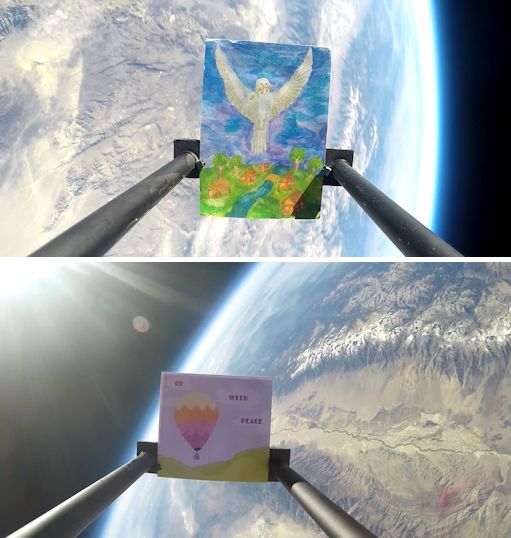
The top frame shows Dove of Peace, a painting by Aleksandra Manafova, 11, of St. Petersburg, Russia. The bottom frame displays Up with Peace, by Pace Academy freshman Caelan Corbally, 15, of Atlanta, Georgia. Both were flown to the stratosphere in October onboard an Earth to Sky Calculus research balloon.
Linden Longino, CEO of International Paint Pals, is organizing the Nobel Art exhibit, and he arranged to have these samples sent to the stratosphere.
"One hundred countries were invited to have children participate in the exhibition, and 83 said 'yes'--a phenomenal response," says Longino. "Out of 2,000 works of art we received, the best 166 (two from each country) were chosen to be displayed at the Nobel Summit. Of those, two were further selected for the Earth to Sky 'space exhibit' because of their relevance to flight and their 'uplifting' nature."
Longino's donation of $1000 to Earth to Sky Calculus not only propelled two fine pieces of art to the edge of space, but also allowed the students of Earth to Sky to continue their ongoing measurements of cosmic radiation in the stratosphere with two space weather balloon flights in October. Thank you, Linden!