THE SUN IS FLAT LINING: With no sunspots actively flaring, the sun's X-ray output has flat-lined. NOAA forecasters say the chance of an M- or X-class flare this weekend is no more than 1%. Aurora alerts: text or voice

TRANSCONTINENTAL SPACE WEATHER BALLOON LAUNCH: The students of Earth to Sky Calculus, Spaceweather.com, and physicists from the University of New Hampshire are preparing their second transcontinental launch of space weather balloons. On Saturday morning, Nov. 21st, two identical balloons equipped with radiation detectors will lift off from opposite sides of the USA. The goal of the experiment is to explore how cosmic rays affect Earth's atmosphere on continental scales.
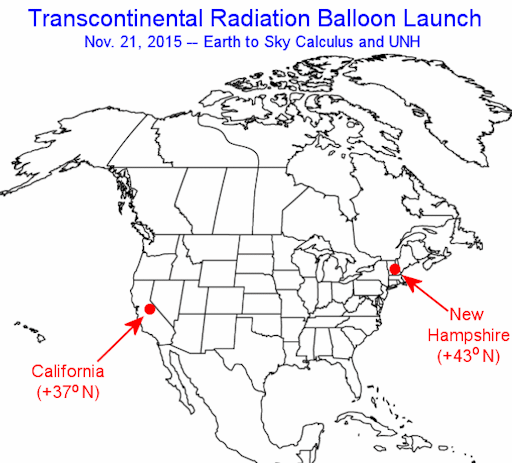
Flying simultaneously, the balloons will ascend all the way to the stratosphere, sampling X-rays and gamma-rays at altitudes of interest to aviation, space tourism, and climate science. The last time the teams did this, on July 20, 2015, they discovered an interesting difference between California and New Hampshire: Radiation levels above New Hampshire were more than 25% higher, a surprisingly wide gap considering their relatively small difference in latitude. The Nov. 21st flight will confirm and expand upon these findings.
Here are what the data looked like from the previous transcontinental flight:

The graph shows how radiation levels over California changed as the balloon ascended toward the stratosphere, then parachuted back to Earth. A California vs. New Hampshire plot highlights the extra radiation over the Granite State. Is it still there? Stay tuned!

CROWD-FUNDED SCIENCE: The research of Earth to Sky Calculus is funded not by big government grants, but rather by individual donations from regular people and small businesses. This gives us the freedom to go wherever our curiosity leads, finding things that grant proposals might not even allow us to look for. We need a sponsor for Transcontinental Launch next weekend. If you would like to help, please contact Dr. Tony Phillips for details.
MYSTERY OBJECT HITS EARTH: A research aircraft organized by the UAE Space Agency and the International Astronomy Center is reporting the first images of WT1190F disintegrating off the coast of Sri Lanka on Friday the 13th. Click to view a movie of the fireball:

As predicted by the European Space Agency, the fireball was easy to see in the blue noon sky over the Indian Ocean--but only at aviation altitudes. Many observers on the ground could not see the fireball through widespread cloud cover. It was actually raining in Sri Lanka when the re-entry occured.
WT1190F is a piece of space junk discovered by the Catalina Sky Survey on Oct. 3rd. Before the impact, astrophysicist Jonathan McDowell told Nature that "the object is only 1 to 2 metres in size, and its trajectory shows that it has a low density, and is perhaps hollow. That suggests an artificial object, 'a lost piece of space history that's come back to haunt us." The translunar orbit of WT1190F is a clue to its origin: probably an old Moon mission. It could be a spent rocket stage or lunar module from the Apollo program.
The research aircraft was staffed, in part, by a group of experienced observers from NASA and the Seti Institute who have recorded many previous re-entries. According to their web site, "we have incredible imaging data and also succeeded in doing quality spectroscopy at blue and red wavelengths, which is a first for us in daytime conditions." Perhaps these data will provide clues to the origin of WT1190F. Stay tuned.
Realtime Space Weather Photo Gallery
GREAT CIRCLE OF MAGNETISM: A dark filament of magnetism in the sun's southern hemisphere has curled upon itself to form a circle of gargantuan porportions. The circumference of the ring is almost a million kilometers--dimensions that make it an easy target for backyard solar telescopes. Amateur astronomer Peter Desypris sends this picture from Athens, Greece:

"I could not fit the entire ring in my telescope's field of view," says . "This is a mosaic of two images."
Bushy magnetic filaments are often unstable, and they have a tendency to collapse. Filaments crashing to the surface of the sun can cause of a type of explosion called a Hyder flare. Any flare from this filament could be extra-energetic as it releases the tension stored in its million-km coil. Amateur astronomers are encouraged to monitor the structure for possible developments. Solar flare alerts: text or voice
Realtime Space Weather Photo Gallery