CO-ROTATING INTERACTION REGION: NOAA forecasters estimate a 35% chance of polar geomagnetic storms on Nov. 18th when a co-rotating interaction region (CIR) is expected to hit Earth's magnetic field. CIRs are transition zones between fast- and slow-moving solar wind streams. Solar wind plasma piles up in these regions, producing density gradients and shock waves that do a good job of sparking auroras. Aurora alerts: text or voice
CIRCULAR FILAMENT ERUPTION and CANYON OF FIRE: For days, astronomers have been monitoring a remarkable circular filament of magnetism on the sun. On Nov. 15th it erupted. This movie from NASA's Solar Dynamics Observatory shows the filament slicing through the sun's atmosphere, producing a 'canyon of fire':

The glowing walls of the canyon trace the original channel where the filament was suspended by magnetic forces above the sun's surface. From end to end, the structure stretches more than 300,000 km--a real Grand Canyon.
Inky-black fragments of the filament (must-see movie) flew away from the blast site and formed the core of a CME. It is too soon to say whether the storm cloud is heading for Earth. We will know more in the hours ahead as coronagraph images of the CME become available. Stay tuned. Aurora alerts: text or voice
Realtime Space Weather Photo Gallery
TRANSCONTINENTAL SPACE WEATHER BALLOON LAUNCH: The students of Earth to Sky Calculus, Spaceweather.com, and physicists from the University of New Hampshire are preparing their second transcontinental launch of space weather balloons. On Saturday morning, Nov. 21st, two identical balloons equipped with radiation detectors will lift off from opposite sides of the USA. The goal of the experiment is to explore how cosmic rays affect Earth's atmosphere on continental scales.
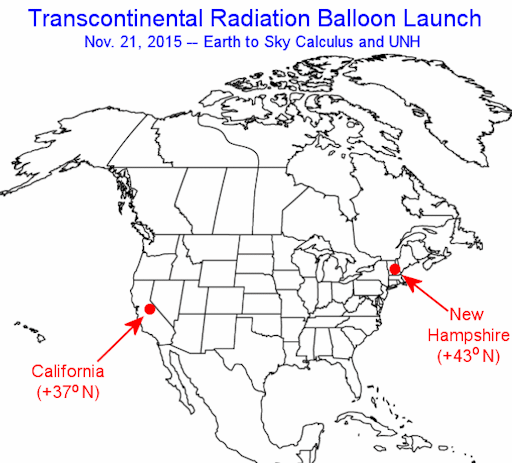
Flying simultaneously, the balloons will ascend all the way to the stratosphere, sampling X-rays and gamma-rays at altitudes of interest to aviation, space tourism, and climate science. The last time the teams did this, on July 20, 2015, they discovered an interesting difference between California and New Hampshire: Radiation levels above New Hampshire were more than 25% higher, a surprisingly wide gap considering their relatively small difference in latitude. The Nov. 21st flight will confirm and expand upon these findings.
Here are what the data looked like from the previous transcontinental flight:

The graph shows how radiation levels over California changed as the balloon ascended toward the stratosphere, then parachuted back to Earth. A California vs. New Hampshire plot highlights the extra radiation over the Granite State. Is it still there? Stay tuned!

CROWD-FUNDED SCIENCE: The research of Earth to Sky Calculus is funded not by big government grants, but rather by individual donations from regular people and small businesses. This gives us the freedom to go wherever our curiosity leads, finding things that grant proposals might not even allow us to look for. We need a sponsor for Transcontinental Launch next weekend. If you would like to help, please contact Dr. Tony Phillips for details.