LEONID METEOR SHOWER: Today and tomorrow, Earth will pass through a stream of dusty debris from Comet 55P/Tempel-Tuttle, source of the annual Leonid meteor shower. This is not a storm year for the Leonids. Forecasters expect a mild display of no more than 15 or 20 meteors per hour best seen during the dark hours before sunrise. Got clouds? You can listen to Leonid radar echoes on Space Weather Radio.
GLANCING-BLOW CME EXPECTED THIS WEEK: A magnetic filament on the sun erupted during the late hours of Nov. 15th, hurling inky-black fragments of itself into space. Shortly thereafter, a CME was observed racing away from the sun:

Storm track models from NOAA suggest that the CME will deliver a glancing blow to Earth's magnetic field on Nov. 18th or 19th. There is a 70% chance of polar geomagnetic storms when the CME arrives.
Actually, the arrival of the CME could be the second strike. A co-rotating interaction region (CIR) is also expected to hit Earth's magnetic field on Nov. 18th. CIRs are transition zones between fast- and slow-moving solar wind streams. Solar wind plasma piles up in these regions, producing density gradients and shock waves that do a good job of sparking auroras.
The double impact, CIR followed by CME, could produce a G1 or G2-class geomagnetic storm and bright auroras around the Arctic Circle. Observers in northern-tier US states from Maine to Washington should be alert for colorful lights in the midnight sky. Aurora alerts: text or voice


TRANSCONTINENTAL SPACE WEATHER BALLOON LAUNCH: The students of Earth to Sky Calculus, Spaceweather.com, and physicists from the University of New Hampshire are preparing their second transcontinental launch of space weather balloons. On Saturday morning, Nov. 21st, two identical balloons equipped with radiation detectors will lift off from opposite sides of the USA. The goal of the experiment is to explore how cosmic rays affect Earth's atmosphere on continental scales.
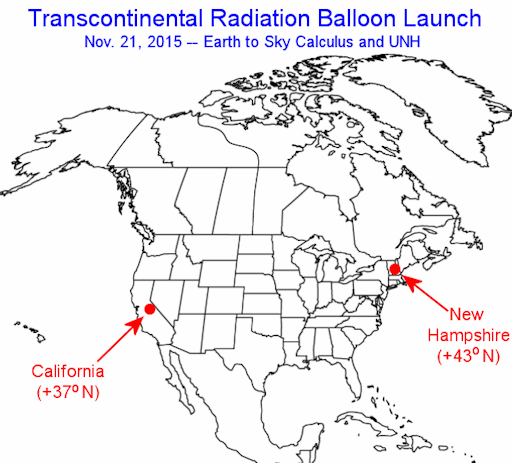
Flying simultaneously, the balloons will ascend all the way to the stratosphere, sampling X-rays and gamma-rays at altitudes of interest to aviation, space tourism, and climate science. The last time the teams did this, on July 20, 2015, they discovered an interesting difference between California and New Hampshire: Radiation levels above New Hampshire were more than 25% higher, a surprisingly wide gap considering their relatively small difference in latitude. The Nov. 21st flight will confirm and expand upon these findings.
Here are what the data looked like from the previous transcontinental flight:

The graph shows how radiation levels over California changed as the balloon ascended toward the stratosphere, then parachuted back to Earth. A California vs. New Hampshire plot highlights the extra radiation over the Granite State. Is it still there? Stay tuned!

Realtime Space Weather Photo Gallery