MOSTLY QUIET WITH A CHANCE OF FLARES: Solar activity remains low. However, this could change if sunspot AR2454 continues to grow as it has done for the past two days. The active region is beginning to crackle with C-class solar flares, minor explosions that could intensify if the sunspot's expansion continues apace. Solar flare alerts: text or voice
TRANSCONTINENTAL SPACE WEATHER BALLOON FLIGHT: This morning, Nov. 21st, the students of Earth to Sky Calculus, in collaboration with Spaceweather.com and the University of New Hampshire, launched a pair of space weather balloons from opposite sides of the USA. Using cell phones to conduct a transcontinental countdown, they released the balloons at the same moment from California and New Hampshire:

Flying simultaneously, the balloons will ascend all the way to the stratosphere, sampling X-rays and gamma-rays at altitudes of interest to aviation, space tourism, and climate science. The goal of the experiment is to investigate a curious difference in radiation, which the group discovered during a previous transcontinental flight in July 2015. During the summer, radiation levels in the stratosphere above New Hampshire were more than 25% higher than California, a surprisingly wide gap considering the relatively small difference in latitude. The Nov. 21st flight will confirm and expand upon the findings from July.
The payloads will land later today. Stay tuned for updates.
Realtime Space Weather Photo Gallery
WAITING FOR NOCTILUCENT CLOUDS: Summer is the season for noctilucent clouds (NLCs)--icy wisps of electric-blue that float at the edge of space. This means NLCs should be appearing soon over Antarctica, where summer is nigh. NASA's AIM spacecraft has started monitoring the south pole, but so far the maps are blank:
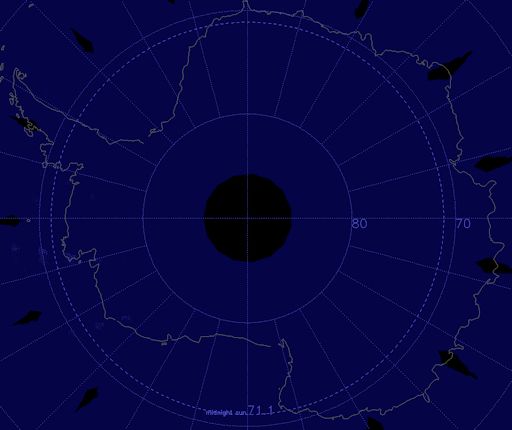
"Since AIM was launched, previous seasons in the southern hemisphere have started anywhere from Nov. 17th to Dec. 16th," says Cora Randall, a member of the AIM science team and the chair of the Department of Atmospheric and Oceanic Sciences at the University of Colorado. "It seems to depend on when winds in the southern stratosphere shift to their summerly state. This year the polar vortex in the lower stratosphere is very large, which suggests that the season will have a late start."
Researchers will be watching with interest. Last year's season for southern NLCs was unusual. The clouds varied strangely and they completely disappeared for a few weeks after the solstice when they are normally most abundant.
What does this mean? Research shows that NLCs are a sensitive indicator of long-range teleconnections in Earth's atmosphere, which link weather and climate across hemispheres. The strange behavior of noctilucent clouds in 2014-2015 could be a sign of previously unknown linkages.
Are these linkages still at work? Will the southern NLCs of 2015-2016 "misbehave" again? Answers will be revealed in data from the AIM spacecraft, which has been studying NLCs from Earth orbit since 2007. You can monitor the latest images right here on Spaceweather.com.

Realtime Noctilucent Cloud Photo Gallery
NORTHERN LIGHTS: Astronomers have discovered a planet with white trees and green skies. It's Earth. Sacha Layos photographed the strange landscape last night in Fairbanks, Alaska:

The auroras appeared on Nov. 19th after a CME sideswiped Earth's magnetic field, turning skies green over Alaska, Iceland, Scotland, and Sweden.
There was one more color: blue--as in "blue fingertips." Layos explains: "The temperature bottomed out at -25F where I was. Despite the extreme cold, however, it was a great show. What a welcome sight!"
CME effects are subsiding on Nov. 20th, and NOAA forecasters have downgraded the chance of a geomagnetic storm today to only 25%. Aurora alerts: text or voice