SLIGHT UPTICK IN SOLAR ACTIVITY: Solar activity has been very low for more than a week. Growing sunspot AR2454 is breaking the quiet--but only a little. The active region is crackling with minor C-class solar flares. The explosions could intensify if the sunspot continues to grow. Solar flare alerts: text or voice
FLY ME TO THE MOON: Observers of America's space program have often lamented that the International Space Station cannot go to the Moon. On Nov. 21st, it looks like it finally made the trip. Dennis Simmons sends this picture from Brisbane, Qld, Australia:
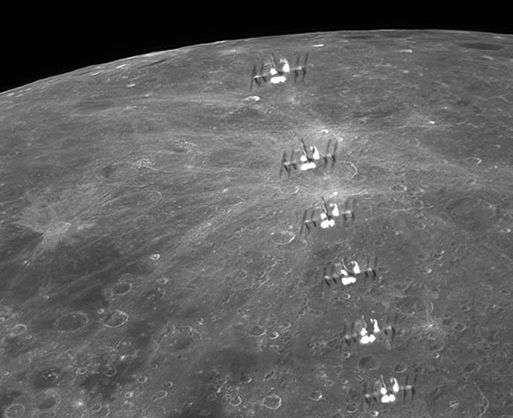
Unfortunately, it only looks like the ISS has re-traced the steps of Apollo. The giant spaceship is still in Earth orbit. It did, however, pass in front of the Moon as seen by observers in parts of Australia.
"The transit lasted just 0.49 seconds," says Simmons, who used a video camera to record the split-second passage. "This is a composite of video frames taken through a C9.25 telescope."
Elsewhere in Brisbane, astrophotographer Tom Harradine also took a spectacular picture of the transit. "I caught the ISS passing by the crater Copernicus," he says.
At the time of the transit, the ISS was 400 km from Earth and almost 400 thousand km from the Moon. So it still has a ways to go. For now, lunar transits are the next best thing to being there.
Realtime Space Weather Photo Gallery
AURORAS, FOR NO PARTICULAR REASON: Nov. 21st was a day of quiet space weather. There were no intense solar flares, no CMEs, and no geomagnetic storms. The auroras appeared anyway. Liselotte Kahns saw them over Sweden's Abisko National Park:
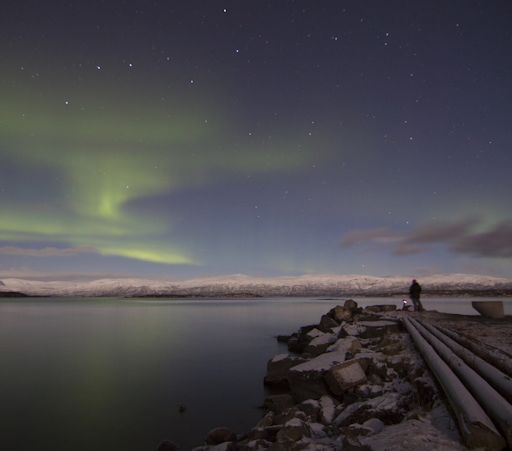
"Despite the extremely low level of solar activity, Abisko's clear sky demonstrated a nice aurora display tonight," says Kahns. "[It's] a good illustration of why this place is rated as one of the best places on Earth to see auroras."
Indeed, it is not unusual for auroras to appear over Abisko even when the forecast calls for no magnetic activity. Aurora tour guides and photographers naturally gravitate toward the Park because of its frequently-green skies. The reason is Abisko's location beneath Earth's persistent auroral oval. A gentle rain of solar wind electrons, guided to Earth by our planet's curved magnetic field, creates a polar ring of Northern Lights that intersects the latitude of Abisko, more often than not. Browse the realtime gallery for more sightings:
TRANSCONTINENTAL SPACE WEATHER BALLOON FLIGHT: On Nov. 21st, the students of Earth to Sky Calculus, in collaboration with Spaceweather.com and the University of New Hampshire, launched a pair of space weather balloons from opposite sides of the USA. Using cell phones to conduct a transcontinental countdown, they released the balloons at the same moment from California and New Hampshire:

Flying simultaneously, the balloons ascended to the stratosphere, sampling X-rays and gamma-rays at altitudes of interest to aviation, space tourism, and climate science. The goal of the experiment is to investigate a curious difference in radiation, which the group discovered during a previous transcontinental flight in July 2015. During the summer, radiation levels in the stratosphere above New Hampshire were more than 25% higher than California, a surprisingly wide gap considering the relatively small difference in latitude between the two launch sites. The Nov. 21st flight will confirm and expand upon the findings from July.
Update: Both payloads have parachuted back to Earth. The New Hampshire payload landed in Maine, and has since been recovered from the branches of a tall tree. The California payload landed in the Saline Valley, a desert area not far from Death Valley National Park. It will be recovered on Nov. 22nd. Stay tuned for results from the flight.
Realtime Space Weather Photo Gallery
Realtime Noctilucent Cloud Photo Gallery