CHANCE OF MINOR STORMS: NOAA forecasters estimate a 40% chance of minor geomagnetic storms on Nov. 25th when a solar wind stream is expected to hiy Earth's magnetic field. High-latitude sky watchers could see auroras through the glare of the waxing full Moon. Aurora alerts: text or voice
JAPANESE ROCKET SURPRISES SKY WATCHERS: Unbeknownst to most people in North America this morning, Japan launched an H-2A rocket carrying the Telstar 12 Vantage communications satellite. The resulting display surprised sky watchers in at least half a dozen states. "I was observing Comet Catalina before sunrise, when I noticed this thing halfway up towards Venus," reports Glen Wurden of Los Alamos, New Mexico:
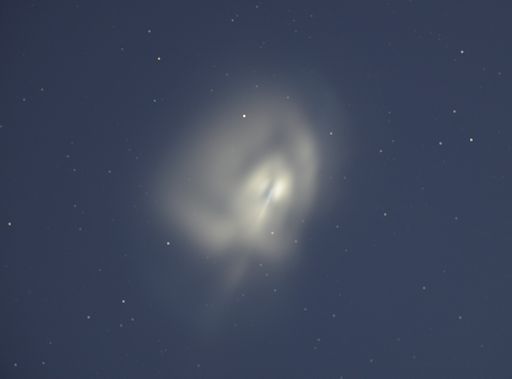
"It lasted for at least a half an hour after 5:40 AM," he adds. "It was huge, easily naked eye, and kind of scary!"
The cloud was a fuel dump from one of the rocket's booster stages. Lingering high in the pre-dawn sky until sunrise wiped it away, it was seen from Nevada, Arizona, New Mexico and neighboring states.
SUNRISE COMET CATALINA: Discovered in 2013 by the Catalina Sky Survey, Comet Catalina (C/2013 US10) is making a one-time trip through the inner solar system. It swung around the sun on Nov. 15th and is now emerging in the dawn skies of the northern hemisphere. Peter Rosén photographed the comet over Stockholm, Sweden, on Nov. 23rd:

"I woke up very early this morning to catch a first glimpse of comet Catalina," says Rosén. "While I waited for the comet to appear in the sunrise twilight, I spent my time observing Venus and Jupiter. As so often happens in Stockholm, the clouds rolled in and started covering the sky. I thought about giving up, but I noticed that there was still a strip of clear sky at the eastern horizon. Patience payed off and Comet Catalina even showed a thin tail at less than 3° above the horizon."
Technically, Comet Catalina is a 6th magnitude object visible to the unaided eye. In practice, morning twilight overwhelms the comet's faint glow. You need a telescope to see it. "The inset is shot with a Canon Eos5D through my WilliamOptics FLT-110 at prime focus," says Rosén. Sky maps and observing tips are available from Sky & Telescope.
This is Comet Catalina's first visit to the inner solar system--and its last. The comet's close encounter with the sun in mid-November has placed it on a slingshot trajectory toward interstellar space. It will become easier to see in the weeks ahead as it recedes from the sun, possibly brightening to 5th magnitude in December. A date of special interest is Dec. 7th when the comet pairs up with the planet Venus and the waning crescent Moon in the early morning sky. Catalina will be about 4o degrees away from the Venus-Moon combo. Stay tuned for more information about that, and meanwhile browse the realtime comet gallery for more sightings.
AURORAS, FOR NO PARTICULAR REASON: Nov. 21st was a day of quiet space weather. There were no intense solar flares, no CMEs, and no geomagnetic storms. The auroras appeared anyway. Liselotte Kahns saw them over Sweden's Abisko National Park:
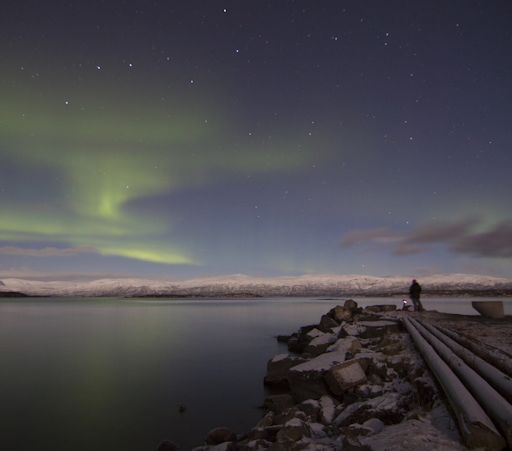
"Despite the extremely low level of solar activity, Abisko's clear sky demonstrated a nice aurora display tonight," says Kahns. "[It's] a good illustration of why this place is rated as one of the best places on Earth to see auroras."
Indeed, it is not unusual for auroras to appear over Abisko even when the forecast calls for no magnetic activity. Aurora tour guides and photographers naturally gravitate toward the Park because of its frequently-green skies. The reason is Abisko's location beneath Earth's persistent auroral oval. A gentle rain of solar wind electrons, guided to Earth by our planet's curved magnetic field, creates a polar ring of Northern Lights that intersects the latitude of Abisko, more often than not. Browse the realtime gallery for more sightings:
Realtime Space Weather Photo Gallery
Realtime Noctilucent Cloud Photo Gallery