THE SUN IS FLATLINING: With no sunspots actively flaring, the sun's X-ray output has flatlined. The quiet is likely to continue for at least another 24 hours. NOAA forecasters say there is no more than a 1% chance of M- or X-class solar flares on Nov. 28th. Solar flare alerts: text or voice

SOLAR PROMINENCE, POISED TO ERUPT? The face of the sun may be quiet, but the edge of the sun is not. A gigantic arch of plasma is dancing along the sun's southwestern limb. Shahrin Ahmad of Sri Damansara, Malaysia, photographed the structure on Nov. 28th:
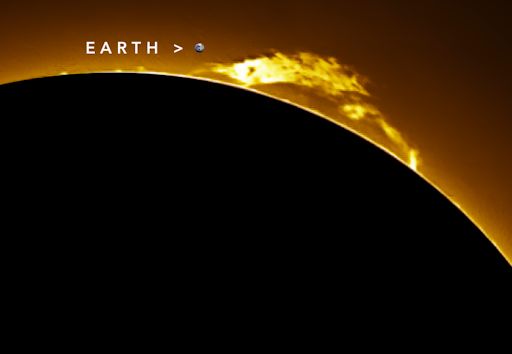
Ahmad inserted a picture of Earth for scale. The plasma-filed prominence stretches more than 150,000 km from end to end--dimensions that make it an easy target for backyard solar telescopes. Monitoring is encouraged. Magnetic fields holding the plasma aloft are twisted, tangled, and prone to explosive magnetic reconnection. An eruption could occur at any moment. Solar flare alerts: text or voice
Realtime Space Weather Photo Gallery
MOONLIT AURORAS: For the past few nights, auroras have been difficult to see through the glare of the full Frosty Moon. On Nov. 27th, a splash of green penetrated the moonlight over Iceland:
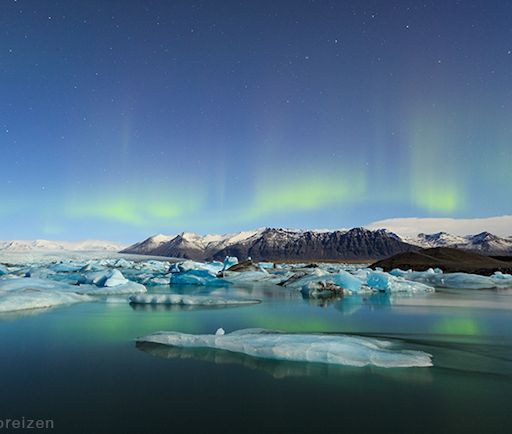
"The moon lit the icebergs on lake Jökulsárlón in Iceland and made it almost look like daytime," reports photographer Madelon Dielen. "The auroras were there for a few minutes--just enough to give some extra color to this beautiful scene. "
The green could intensify in the nights ahead. NOAA forecasters estimate a 45% chance of G1-class geomagnetic storms by Dec. 1st when a high-speed stream of solar wind is expected to hit Earth's magnetic field. Aurora alerts: text or voice

THE MOLTEN FROSTY MOON: According to folklore, this week's full Moon is the "Frosty Moon," named after the ground frosts of northern autumn, which sparkle so beautifully in full moonlight. When John Stetson of Cape Elizabeth, Maine, watched the moonrise on Nov. 25th, however, the Frosty Moon appeared to be melting:

"Earth's atmosphere, acting as a lens, bent the light on the horizon to create this effect," explains Stetson. "It is called an Etruscan Vase moonrise."
This phenomenon is most often seen when the Moon is rising over a body of water. Stetson was watching from the shore of Casco Bay. The lower Moon (the base of the Etruscan Vase) is an inverted image of the upper Moon produced by refraction in a layer of warmer and less dense air close to the water's surface. "The temperature of water in the Bay was 51 degrees," says Stetson. "This created a layer of relatively warm air just above the water's surface. The ambient air temperature was much lower, only 41 degrees." In short, conditions were perfect for the mirage.
Browse the realtime photo gallery for more images of the Frosty Moon--molten and otherwise.
Realtime Space Weather Photo Gallery
Realtime Noctilucent Cloud Photo Gallery