INTERPLANETARY SPACECRAFT TO BUZZ EARTH ON DEC. 3RD: Japan's Hayabasa 2 spacecraft, on a six year mission to catch and sample an asteroid, will fly past Earth on Dec. 3rd. Earth's gravity will slingshot the spacecraft toward its target, 162173 Ryugu, which Hayabasa 2 is expected to reach in July 2018. This animation from JAXA (the Japanese space agency) previews the flyby:
Many readers have never heard of Hayabasa 2. It is an amazing mission. After the spacecraft reaches Ryugu in 2018, it will orbit the asteroid for a year and a half. During that time, Hayabasa 2 will deploy four landers and drop a copper impactor to blow a hole in the asteroid's side. Hayabasa 2 itself will touch down on the asteroid, briefly, at least once to collect samples excavated by the impactor. In Dec. 2019, the spacecraft will leave the asteroid and use its ion engines to return to Earth, carrying precious samples of Ryugu. Ambitious? Yes. But if Hayabasa 2 completes even a fraction if its mission, it will be a success.
The spacecraft is small (mass: 590 kg, dimensions: 2 x 1.6 x 1.25 meters), so when it flies by Earth it will not be very bright. A telescope will be required to see it.
Veteran satellite observer Rick Baldridge notes that "for the US west coast, the spacecraft gets barely 7 degrees above the western horizon at closest approach. Observers in Alaska, Hawaii and Japan are favored. Ephemerides for specific locations may be obtained on the JPL HORIZONS website." Additional charts, a ground track map, and data are available in Japanese at this URL.
OFFICE LIGHTS: Imagine walking into your place of work, flipping on the light switch, and the room is flooded with green. Welcome to the world of nature photographer Oliver Wright, who has pitched his tent in Sweden's Abisko National Park for the winter. "This is my office for the next 4 months," he explains:
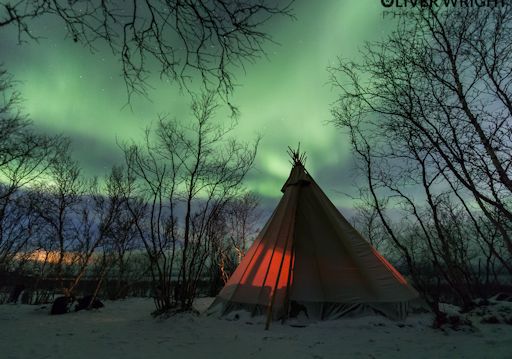
"Great aurora in Abisko last night," says Wright. "It was a really big display with green lights moving quite quickly and some red fringing at times."
The display was caused by a solar wind stream, which hit Earth's magnetic field on Nov. 30th. For several hours, a G1-class geomagnetic storm lit up the Arctic Circle from Scandinavia to Alaska. "I am looking forward to more big displays in the months ahead," he says.

How about tonight? NOAA forecasters estimate a 40% chance of polar geomagnetic storms on Dec. 1st as Earth slowly exits the solar wind stream. Aurora alerts: text or voice
(UPDATED) TWO CMEs, BOTH MISS EARTH: A pair of CMEs--one bright and one faint--billowed away from the sun on Nov. 29th. According to NOAA storm tracks, neither will hit Earth. Click to view a movie from the Solar and Heliospheric Observatory:

The bright CME (pictured above) will miss Earth; it came from an explosion on the far side of the sun and is not heading in our direction. The faint one, which appears later in the movie, was launched by a minor eruption in the magnetic canopy of sunspot AR2459. Although the sunspot was facing Earth, the CME sailed wide of our planet. Solar flare alerts: text or voice
Realtime Space Weather Photo Gallery
Realtime Noctilucent Cloud Photo Gallery