INTERPLANETARY SPACECRAFT TO BUZZ EARTH ON DEC. 3RD: Japan's Hayabasa 2 spacecraft, on a six year mission to catch and sample an asteroid, will fly past Earth on Dec. 3rd. Earth's gravity will slingshot the spacecraft toward its target, 162173 Ryugu, which Hayabasa 2 is expected to reach in July 2018. This animation from JAXA (the Japanese space agency) previews the flyby:
Many readers have never heard of Hayabasa 2. It is an amazing mission. After the spacecraft reaches Ryugu in 2018, it will orbit the asteroid for a year and a half. During that time, Hayabasa 2 will deploy four landers and drop a copper impactor to blow a hole in the asteroid's side. Hayabasa 2 itself will touch down on the asteroid, briefly, at least once to collect samples excavated by the impactor. In Dec. 2019, the spacecraft will leave the asteroid and use its ion engines to return to Earth, carrying precious samples of Ryugu. Ambitious? Yes. But if Hayabasa 2 completes even a fraction if its mission, it will be a success.
The spacecraft is small (mass: 590 kg, dimensions: 2 x 1.6 x 1.25 meters), so when it flies by Earth it will not be very bright--definitely invisible to the naked eye. "I expect it will be about 13th magnitude at best when it appears low in the west-northwest sky after evening twilight ends across the USA," says Richard Alan Keen of the University of Colorado, who observed a similar flyby of the Rosetta spacecraft in 2005, and bases his brightness estimate on that. Another experienced observer, Bill Gray of Project Pluto, estimates that the magnitude could reach +11. Either way, it is still very dim.
Observers with telescopes in Alaska, Hawaii and Japan are favored with the best views of the tiny spacecraft as it passes over the Pacific during closest approach. Ephemerides for specific locations may be obtained on the JPL HORIZONS website. Additional charts and a ground track are available in Japanese at this URL.
This just in: On Nov. 26th, at a distance of 3 million km, Hayabysa 2 took this picture of the Earth-Moon system:
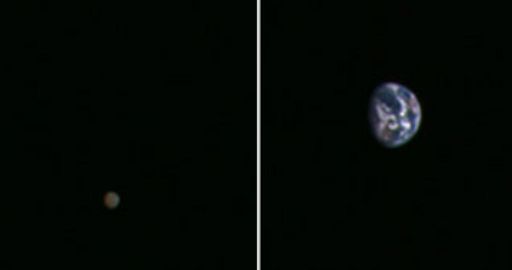
According to JAXA analysts, you can see the Australian continent on the right, the Eurasian continent covered by clouds on the left, and the white vertical areas between them are clouds over the equator. Better views are expected as Hayabusa approaches Earth in the hours ahead.
Realtime Space Weather Photo Gallery
SOUTHERN LIGHTS: It doen't feel like aurora season in New Zealand. "Summer is coming and it is getting warm," says southern photographer Taichi Nakamura. "Darker night hours are rapidly shrinking with only 5 hours at most between twilights." Nevertheless, during that narrow window of balmy darkness on Dec. 1, the auroras appeared:
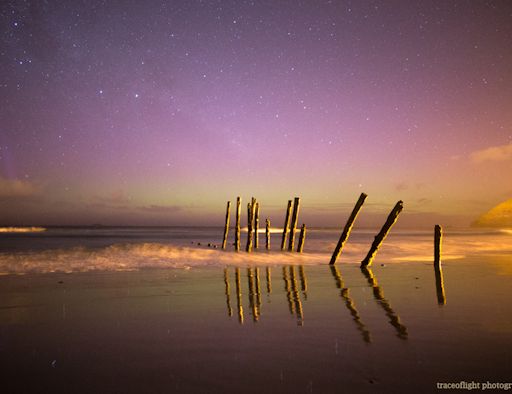
"The subtle glow of Southern Lights appeared at midnight during super low tide at St. Clair beach in Dunedin," says Nakamura. "The iconic pier at the beach got washed away by Mother Nature a while ago. What remains still stands strong."
The display was caused by a solar wind stream, which hit Earth's magnetic field on Nov. 30th. The impact caused a G1-class geomagnetic storm and auroras around both poles. NOAA forecasters estimate a waning 25% chance of polar geomagnetic storms on Dec. 2nd as Earth slowly exits the solar wind stream. Aurora alerts: text or voice

Realtime Noctilucent Cloud Photo Gallery