SIGMA HYDRID METEORS: Last night, Dec. 3-4, NASA's network of all-sky meteor cameras recorded 8 fireballs from the sigma Hydrid meteoroid stream. These meteoroids come from an unknown comet or asteroid. Earth passes through the sigma Hydrid stream every year in early- to mid- December. Typically, the shower produces no more than 1 or 2 faint meteors per hour. The detection of 8 bright fireballs in a single night suggests that sigma Hydrid activity could be higher than usual. Listen for sigma Hydrid echoes in the audio feed from our live meteor radar.
SPACECRAFT BUZZES EARTH, PROCEEDS TO ASTEROID: Japan's Hayabusa 2 spacecraft swung past Earth on Dec 3rd at 7:08 p.m. JST, passing over the Pacific Ocean around the Hawaiian islands at an altitude of about 3,090 km. JAXA (the Japanese space agency) has just released these images of our planet taken by the speeding probe:
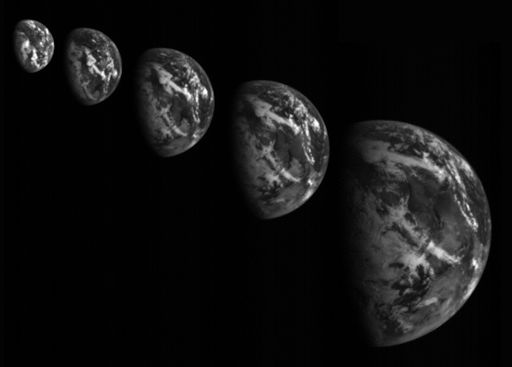
More images are available here with captions in Japanese.
The flyby was a slingshot maneuver designed to propel Hayabusa 2 toward asteroid Ryugu, the target of an ambitious sample return mission in 2018-2020. JAXA says the spacecraft is in good health following its close encounter with Earth. [press release]
DAWN COMET HAS TWO TAILS: Now that the morning Moon is waning in brightness, amateur astronomers are once again getting a good view of Comet Catalina. Images reveal not one, but two tails. Randy Carter sends this picture from Elkin, North Carolina, taken Dec. 4th:
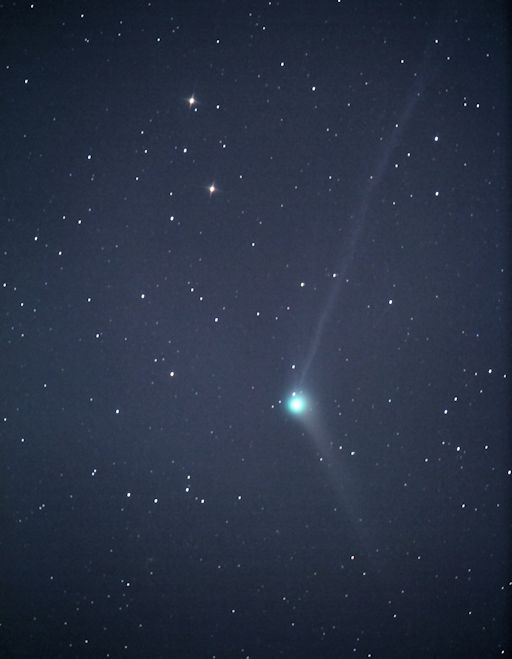
"This is a 420 second exposure through my 6-inch Celestron telescope," says Carter. "I estimate the magnitude of the comet to be approximately +7."
That means Comet Catalina is too dim to see with the unaided eye, but an easy target for backyard telescopes as it glides through the constellation Virgo in the predawn sky not far from the planet Venus. Sky maps and observing tips may be found in this article from Sky and Telescope.
Why does Comet Catalina have two tails? Almost all comets do. The sun-warmed nucleus of a comet spews a mixture of dust and gas into space. Quickly, the mixture separates into two distinct tails: The gaseous "ion tail" is pushed straight away from the sun by solar wind. The weightier dust tail resists solar wind pressure and aligns itself more or less with the comet's orbit. In Carter's picture of Comet Catalina, the ion tail points up; the dust tail points down.
This is Comet Catalina's first visit to the inner solar system--and its last. The comet's close encounter with the sun in mid-November has placed it on a slingshot trajectory toward interstellar space. It will become easier to see in the weeks ahead as it recedes from the sun, possibly brightening to 5th or 6th magnitude. A date of special interest is Dec. 7th when the comet pairs up with the planet Venus and the waning crescent Moon in the early morning sky. Catalina will be about 4o degrees away from the Venus-Moon combo. Stay tuned for more information about that, and meanwhile browse the realtime comet gallery for more sightings.
VAST HOLE OPENS IN SUN'S ATMOSPHERE: A vast hole in the sun's atmosphere--a "coronal hole"--has opened up in the sun's northern hemisphere, and it is spewing a broad stream of solar wind into space. NASA's Solar Dynamics Observatory photographed the coronal hole during the early hours of Dec. 3rd:

Coronal holes are places where the sun's magnetic field opens up and allows solar wind to escape. Hot plasma flows outward at speeds exceeding a million mph. In the extreme-ultraviolet image, above, the boundaries of the coronal hole are traced by dashed lines; arrows indicate the escape of hot plasma.
Solar wind flowing from this coronal hole will reach Earth beginning ~Dec. 6th, and our solar wind environment will be dominated the stream for days after first contact. High-latitude sky watchers should be alert for auroras. Aurora alerts: text or voice
GEMINID METEOR SHOWER: Earth is entering a stream of gravelly debris from "rock comet" 3200 Phaethon, source of the annual Geminid meteor shower. On the night of Dec. 2-3, NASA's network of all-sky cameras detected three Geminid fireballs over the USA. This specimen from the desert southwest was even brighter than a passing airplane:
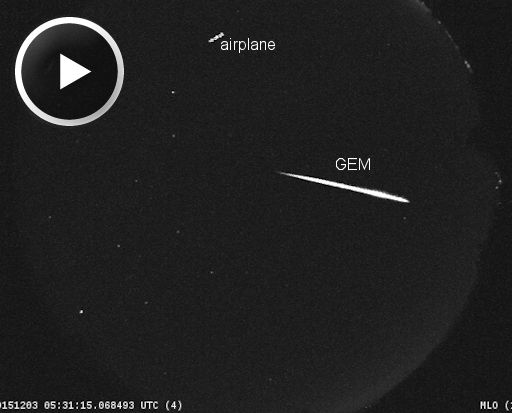
The Geminid hit Earth's atmosphere traveling 36 km/s (81 thousand mph) and disintegrated completely 47 km (29 miles) above Earth's surface. These values are typical of Geminids.
Meteor sightings will increase in the nights ahead as Earth plunges deeper into the debris stream. Forecasters expect peak rates to occur on Dec. 13-14, when dark-sky observers in both hemispheres could see as many as 120 meteors per hour. Observing conditions will be nearly ideal because the shower peaks just a few days after the New Moon. Stay tuned for updates and, meanwhile, listen for Geminid echoes in the audio feed from our live meteor radar.
Realtime Space Weather Photo Gallery
Realtime Noctilucent Cloud Photo Gallery