SIGMA HYDRID METEORS: On the nights of Dec. 3rd and 4th, NASA's network of all-sky meteor cameras recorded 16 fireballs from the sigma Hydrid meteoroid stream. Earth passes through the sigma Hydrid stream every year in early- to mid- December; the source of the debris is unknown. Typically, the shower produces no more than 1 or 2 faint meteors per hour. The detection of 16 bright fireballs in only a couple of nights suggests that sigma Hydrid activity could be higher than usual. Listen for sigma Hydrid echoes in the audio feed from our live meteor radar.
DAWN COMET HAS TWO TAILS: Now that the morning Moon is waning in brightness, amateur astronomers are once again getting a good view of Comet Catalina. Images reveal not one, but two tails. Akihiro Yamazaki sends this picture from Yamanashi, Japan, taken Dec. 4th:
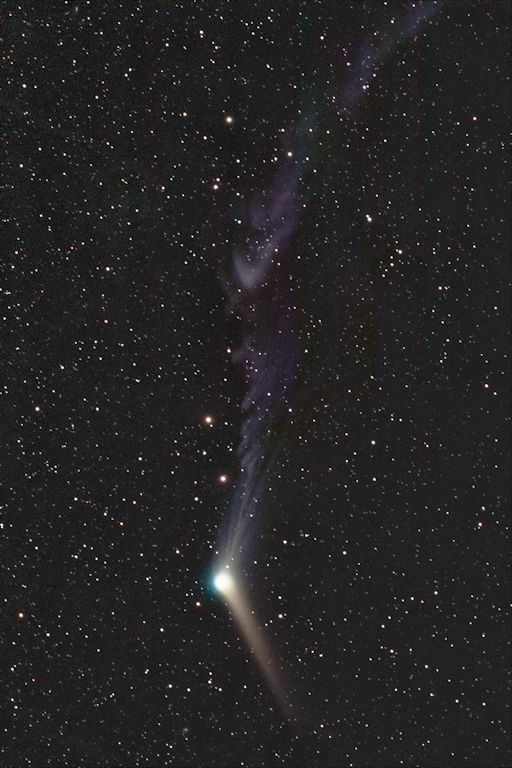
"This is a 36 x 30 second exposure through my 6-inch Astro-Physics telescope," says Yamazaki. "I used a SONY-A7S digital camera set at ISO 2500."
Why does Comet Catalina have two tails? Almost all comets do. The sun-warmed nucleus of a comet spews a mixture of dust and gas into space. Quickly, the mixture separates into two distinct tails: The gaseous "ion tail" is pushed straight away from the sun by solar wind. The weightier dust tail resists solar wind pressure and aligns itself more or less with the comet's orbit. In Yamazaki's picture of Comet Catalina, the ion tail points up; the dust tail points down.
This is Comet Catalina's first visit to the inner solar system--and its last. The comet's close encounter with the sun in mid-November has placed it on a slingshot trajectory toward interstellar space. Although the comet is leaving the solar system, it will become easier to see in the weeks ahead as it approaches Earth. At the moment the comet shines like a 7th magnitude star--invisible to the naked eye. It could brighten by one or two magnitude by mid-January. Sky maps and observing tips may be found in this article from Sky and Telescope.
A date of special interest is Dec. 7th when the comet pairs up with the planet Venus and the waning crescent Moon in the early morning sky. Catalina will be about 4o degrees away from the Venus-Moon combo. Stay tuned for more information about that, and meanwhile browse the realtime comet gallery for sightings. Backyard astronomy alerts: text or voice
SPACECRAFT BUZZES EARTH, PROCEEDS TO ASTEROID: Japan's Hayabusa 2 spacecraft swung past Earth on Dec 3rd at 7:08 p.m. JST, passing over the Pacific Ocean around the Hawaiian islands at an altitude of about 3,090 km. JAXA (the Japanese space agency) has just released these images of our planet taken by the speeding probe:
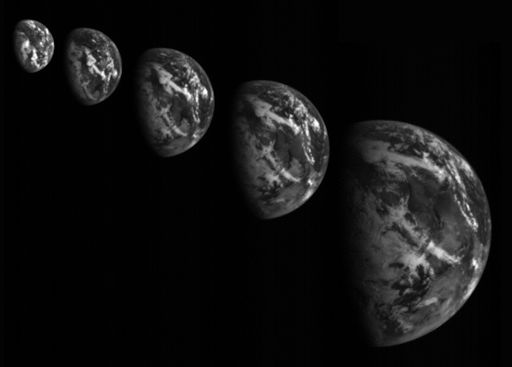
More images are available here with captions in Japanese.
The flyby was a slingshot maneuver designed to propel Hayabusa 2 toward asteroid Ryugu, the target of an ambitious sample return mission in 2018-2020. JAXA says the spacecraft is in good health following its close encounter with Earth. [press release]
Realtime Space Weather Photo Gallery
Realtime Noctilucent Cloud Photo Gallery