DAYTIME OCCULTATION OF VENUS: Set your alarm for dawn. On Monday, Dec. 7th, Venus and the crescent moon will have a beautiful close encounter in the eastern sky just before sunrise. The sight of Venus and the Moon in tight formation, framed by twilight blue, is a great way to start the day. [photo gallery]
For observers in North America, the show is not over at sunrise. The Moon is going to pass right in front of Venus in broad daylight. The occultation will look something like this:

Spaceweather.com reader Kerneels Mulder took these pictures on Sept. 11, 2010, when a similar occultation took place over South Africa.
The Dec. 7, 2015, occultation may be seen from almost all of North America: visibility map. On the west coast, Venus disappears behind the edge of the Moon around 8:00 a.m. Pacific Time (e.g., 7:53 a.m. in Seattle, 8:03 a.m. in Los Angeles). On the east coast, the event commences around 12:30 p.m. Eastern Time (e.g., 12:42 p.m. in Boston, 12:31 p.m. in Atlanta). Start watching at least a half hour early before Venus disappears. Venus is easy to see in broad daylight--if you know where to look--and on Dec. 7th the Moon will lead you right to it. More information about this event is available from Sky and Telescope
Realtime Space Weather Photo Gallery
SOLAR WIND SPARKS AURORAS: Earth is entering a stream of solar wind flowing from a broad coronal hole on the sun. First contact with the stream on Dec. 5th sparked bright auroras around the Arctic Circle. Chad Blakley sends this picture from Abisko National Park in Sweden:

"Last night I spent most of the evening helping our guides prepare for their Nightly Aurora Photo Tours in Abisko National Park," says Blakley. "After I finished helping the guides I could not resist the temptation to take my snowmobile out and play in the fresh layer of snow -- and I am glad I did! The clouds parted overhead, allowing Abisko to show its true colors with a magnificent display of auroras."
More auroras are in the offing. NOAA forecasters estimate a 55% chance of polar geomagnetic storms on Dec. 6th as Earth moves deeper into the stream of solar wind. Aurora alerts: text or voice
DAWN COMET HAS TWO TAILS: Now that the morning Moon is waning in brightness, amateur astronomers are once again getting a good view of Comet Catalina. Images reveal not one, but two tails. Akihiro Yamazaki sends this picture from Yamanashi, Japan, taken Dec. 4th:
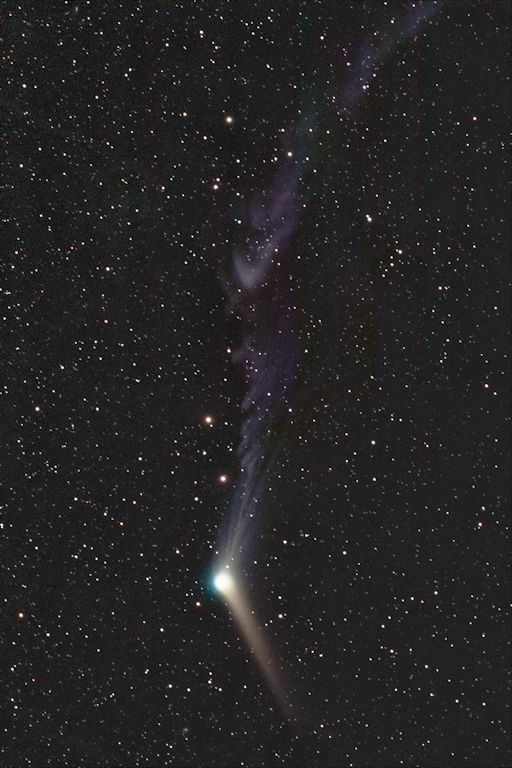
"This is a 36 x 30 second exposure through my 6-inch Astro-Physics telescope," says Yamazaki. "I used a SONY-A7S digital camera set at ISO 2500."
Why does Comet Catalina have two tails? Almost all comets do. The sun-warmed nucleus of a comet spews a mixture of dust and gas into space. Quickly, the mixture separates into two distinct tails: The gaseous "ion tail" is pushed straight away from the sun by solar wind. The weightier dust tail resists solar wind pressure and aligns itself more or less with the comet's orbit. In Yamazaki's picture of Comet Catalina, the ion tail points up; the dust tail points down.
This is Comet Catalina's first visit to the inner solar system--and its last. The comet's close encounter with the sun in mid-November has placed it on a slingshot trajectory toward interstellar space. Although the comet is leaving the solar system, it will become easier to see in the weeks ahead as it approaches Earth. At the moment the comet shines like a 7th magnitude star--invisible to the naked eye. It could brighten by one or two magnitude by mid-January. Sky maps and observing tips may be found in this article from Sky and Telescope.
A date of special interest is Dec. 7th when the comet pairs up with the planet Venus and the waning crescent Moon in the early morning sky. Catalina will be about 4o degrees away from the Venus-Moon combo. Stay tuned for more information about that, and meanwhile browse the realtime comet gallery for sightings.
SIGMA HYDRID METEORS: Since Friday, NASA's network of all-sky meteor cameras recorded more than 24 fireballs from the sigma Hydrid meteoroid stream. Earth passes through the sigma Hydrid stream every year in early- to mid- December; the source of the debris is unknown. Typically, the shower produces no more than 1 or 2 faint meteors per hour. The detection of dozens of bright fireballs in only a few nights suggests that sigma Hydrid activity could be higher than usual. Listen for sigma Hydrid echoes in the audio feed from our live meteor radar.
Realtime Noctilucent Cloud Photo Gallery