POLAR GEOMAGNETIC STORMS: NOAA forecasters estimate a 55% chance of polar geomagnetic storms on Dec. 7th as Earth moves through a stream of fast solar wind. High-latitude sky watchers should be alert for colorful auroras after nightfall. Aurora alerts: text or voice
DAYTIME OCCULTATION OF VENUS: Today, people in North America saw something remarkable in the daytime sky: the crescent Moon passed directly in front of Venus and covered it. Moments before the second planet disappeared, David Pinsky of West Hollywood CA took this picture:
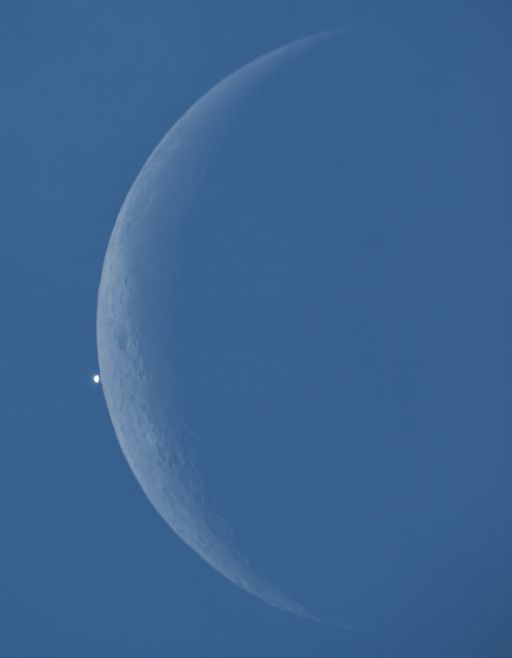
"This was the view through my Canon Rebel T3i digital camera placed at the prime focus of a Celestron 5 inch Maksutov telescope," says Pinsky.
Venus remained behind the Moon for more than an hour, then popped into view again on the opposite lunar limb. The convergence of the Moon and Venus were plainly visible to the unaided eye from Canada, Mexico, and 49 of 50 US States. Only Hawaii was left out. Browse the gallery for more beautiful views from the occultation zone:
Realtime Space Weather Photo Gallery
ROCKET SIGHTINGS: On Sunday afternoon, 4:45 pm EST, Orbital ATK's Cygnus spacecraft launched from Cape Canaveral on a re-supply mission to the International Space Station. The ascending spacecraft and the booster stages of its Atlas V rocket were visible up and down the eastern seaboard of North America. In Halifax, Nova Scotia, Michael Boschat reports seeing "two fireball-like pieces moving parallel to each other, breaking up in the SSW at 5:57pm. The brighter one passing behind the trees was at least magnitude -12!"

"Both of the fireballs had fragments falling off the front," he continues. "The brighter one was reddish in color; the dimmer one was blue. They took me by surprise."
According to veteran satellite observer and orbits expert Ted Molczan, Boschat likely witnessed the re-entry of the 1st stage of the Atlas V rocket. "This map shows the NOTAM (Notice to Airmen) region where Stage 1 was intended to re-enter," says Molczan. "Facing SSW, as reported, Boschat would have been looking toward the south end of the region."

NASA says the Cygnus spacecraft itself is in orbit and heading toward the station. It is carrying more than 7,000 pounds of science experiments and supplies, including Christmas presents for the crew, equipment for spacewalks and air tanks for the station's atmosphere. Browse the gallery for more sightings:
Realtime Space Weather Photo Gallery
Realtime Noctilucent Cloud Photo Gallery