SUNDIVING COMET: By the time you finish reading this news item, the solar system could have one less comet. Yesterday, Dec. 7th, the Solar and Heliospheric Observatory (SOHO) spotted a comet diving toward the sun. Today, Dec. 8th, it is vaporizing furiously in the solar corona:
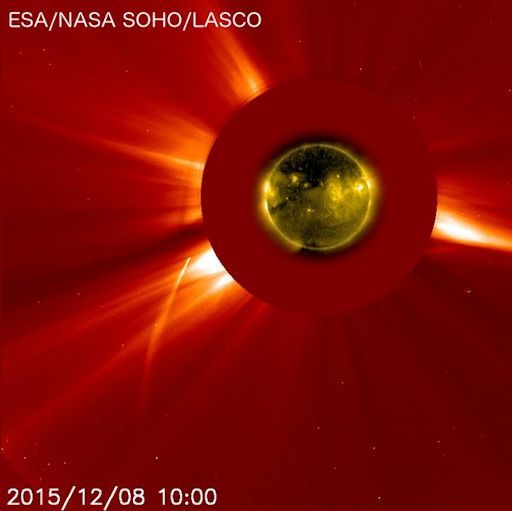
The comet is a member of the Kreutz family--fragments from the breakup of a single giant comet many centuries ago. They get their name from 19th century German astronomer Heinrich Kreutz, who studied them in detail. Several Kreutz fragments pass by the sun and disintegrate every day. Most, measuring less than a few meters across, are too small to see, but occasionally a bigger fragment like this one (~10 m to 50 m) attracts attention.
The comet was first noticed in SOHO images by Polish amateur astronomer Szymon Liwo. Judging from the latest SOHO images, his discovery won't last much longer. In fact, the comet's nucleus may have already disintegrated, leaving only a disembodied tail.
Because of their common parentage, sungrazers often come in clusters. For this reason, it wouldn't be surprising to find yet another one in the offing. Monitor Karl Battam's Sungrazing Comet twitter feed for more sightings.
POLAR GEOMAGNETIC STORMS: Earth is moving through a broad stream of solar wind flowing from a coronal hole on the sun. As a result, auroras are dancing around the Arctic Circle. Photographer Ruslan Merzlyakov saw the show, last night, from the window seat of an airplane flying over the Barents Sea:
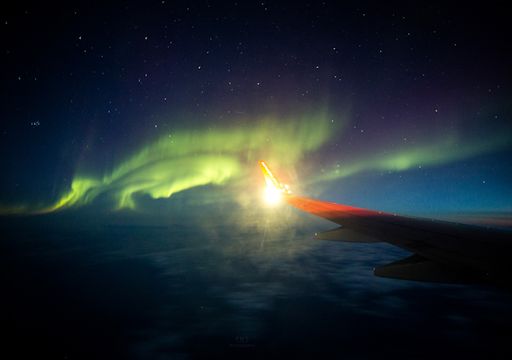
"We were just south of Svalbard when the auroras appeared," says Merzlyakov. "It was the best flight ever."
Earth will remain under the influence of this solar wind stream for the next two or three days. During that time, polar geomagnetic storm probabilities are as high as 50%, according to NOAA. If you're flying at high latitudes this week, be sure to grab a window seat. Aurora alerts: text or voice
DAYTIME OCCULTATION OF VENUS: On Monday, Dec. 7th, people in North America saw something remarkable in the daytime sky: the crescent Moon passed directly in front of Venus and covered it. Moments before the second planet disappeared, David Pinsky of West Hollywood CA took this picture:
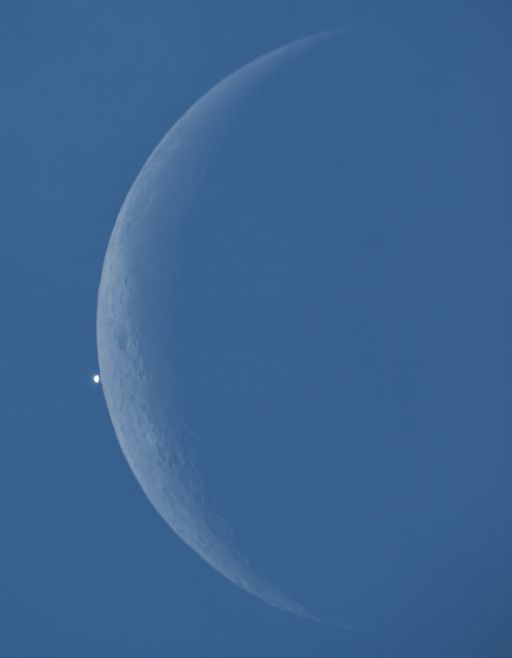
"This was the view through my Canon Rebel T3i digital camera placed at the prime focus of a Celestron 5 inch Maksutov telescope," says Pinsky.
Venus remained behind the Moon for more than an hour, then popped into view again on the opposite lunar limb. The convergence of the Moon and Venus were plainly visible to the unaided eye from Canada, Mexico, and 49 of 50 US States. Only Hawaii was left out. Browse the gallery for more beautiful views from the occultation zone:
Realtime Space Weather Photo Gallery
Realtime Noctilucent Cloud Photo Gallery