CO-ROTATING INTERACTION REGION: NOAA forecasters estimate a 55% chance of polar geomagnetic storms on Dec. 10th when a co-rotating interaction region (CIR) is expected to hit Earth's magnetic field. CIRs are transition zones between fast- and slow-moving solar wind streams. Solar wind plasma piles up in these regions, producing density gradients and shock waves that do a good job of sparking auroras. Aurora alerts: text or voice
THE GEMINID METEOR SHOWER IS UNDERWAY: Canada's Meteor Orbit Radar (CMOR) is picking up echoes from the constellation Gemini. It's a sign that the annual Geminid meteor shower is underway. The bright pink "hot spot" in this CMOR sky map shows where Geminid meteoroids are hitting the atmosphere:
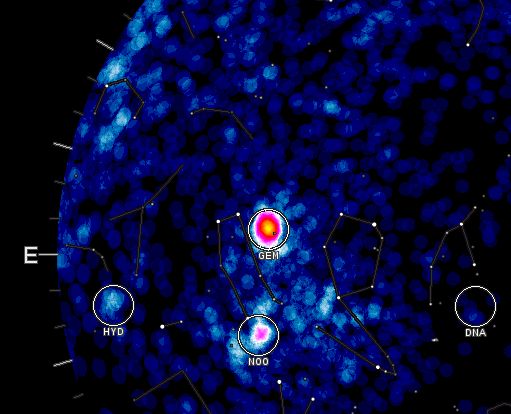
Geminid meteoroids are gravelly debris from "rock comet" 3200 Phaethon. They hit Earth's atmosphere traveling ~35 km/s (78,000 mph) and typically disintegrate about 80 km (50 miles) above Earth's surface. While many Geminids are faint, bright fireballs are not unusual. Indeed, NASA's all-sky network of meteor cameras recorded 10 Geminid fireballs over the USA just last night.
Hakan Bayindir captured this Geminid over Uludag, Bursa, Turkey, on Dec. 8th:
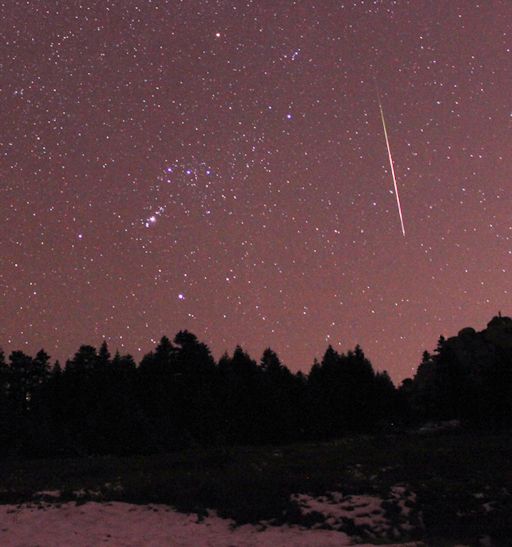
"This is a 15 second exposure I made using my Canon EOS 600D digital camera set at ISO 1600."
Photographers should take note of those settings because many more Geminids are in the offing. Meteor sightings will increase in the nights ahead as Earth plunges deeper into the debris zone of 3200 Phaethon. Forecasters expect peak rates to occur on Dec. 13-14, when dark-sky observers in both hemispheres could see as many as 120 meteors per hour during the hours after local midnight. Observing conditions will be nearly ideal because the shower peaks just a few days after the New Moon.
Stay tuned for updates and, meanwhile, listen for Geminid echoes in the audio feed from our live meteor radar.
LOCATING COMET CATALINA: How do you find Comet Catalina? Just go to Venus and turn left. Fritz Helmut Hemmerich photographed the pair from Tenerife, Canary Islands, on Dec. 9th:

Comet Catalina is passing by Venus in the morning sky this week, with only a few degrees separating the two. So let Venus be your guide. Wake up before sunrise, locate the Goddess of Love, and scan the surrounding sky using binoculars. Voilà--a comet! Detailed sky maps may be found in this article from Sky and Telescope.
Why does Comet Catalina have two tails? Almost all comets do. The sun-warmed nucleus of a comet spews a mixture of dust and gas into space. Quickly, the mixture separates into two distinct tails: The gaseous "ion tail" is pushed straight away from the sun by solar wind. The weightier dust tail resists solar wind pressure and aligns itself more or less with the comet's orbit. In Hemmerich's picture of Comet Catalina, the ion tail points up; the dust tail points down.
This is Comet Catalina's first visit to the inner solar system--and its last. The comet's close encounter with the sun in mid-November has placed it on a slingshot trajectory toward interstellar space. It will become easier to see in the weeks ahead as it approaches Earth, possibly brightening to 5th magnitude--barely visible to the naked eye and an easy target for backyard telescopes. Resources: 3D orbit, ephemerides.
Realtime Space Weather Photo Gallery