QUIET WITH A SLIGHT CHANCE OF FLARES: With no sunspots actively flaring, solar activity is low. One sunspot could break the quiet: AR2470 is large and has a magnetic field that harbors energy for significant explosions. NOAA forecasters estimate a 15% chance of M-class flares on Dec. 15th. Solar flare alerts: text or voice
GEMINID METEOR UPDATE: Last night, Dec. 14-15, NASA's network of all-sky meteor cameras detected 148 Geminid fireballs over the USA. The shower was supposed to peak on Dec. 13-14. These data suggest, however, that the Geminids are still active. Earth remains inside a stream of gravelly debris from "rock comet" 3200 Phaethon, the shower's source. Jeff Dai caught this Geminid disintegrating over Bhaktapur Durbar Square in Nepal on Dec. 15th:
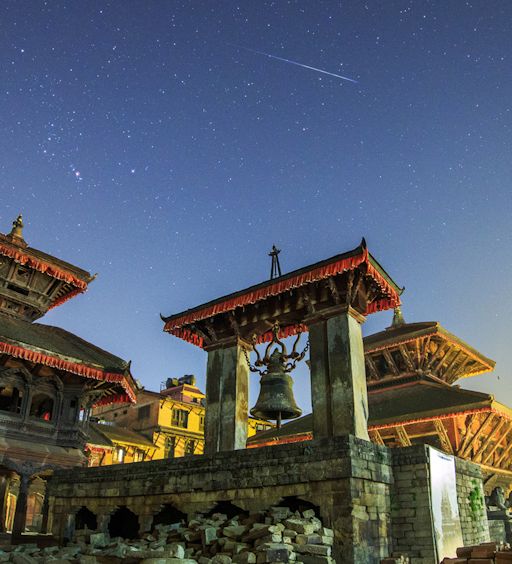
"The Geminids were so bright and active that I could see them through the lights of the city," says Dai. "Bhaktapur Durbar Square is the plaza in front of the royal palace of the old Bhaktapur Kingdom. It is one of three Durbar Squares in the Kathmandu Valley in Nepal, all of which are UNESCO World Heritage Sites."
Worldwide observers have reported meteor rates as high as 100 per hour in dark-sky locations. Counts should decline tonight, Dec. 15-16, as Earth begins to leave the debris stream. For now, though, the Geminids remain active. The best time to look is during the dark hours between local midnight and dawn.
POLAR STRATOSPHERIC CLOUDS: An outbreak of polar stratospheric clouds (PMCs) is underway around the Arctic Circle. Unlike normal grey-white clouds, which hug Earth's surface at altitudes of only 5 to 10 km, PMCs float through the stratosphere (25 km) and they are fantastically colorful. Sarah Skinner saw this specimen high above Abisko, Sweden:
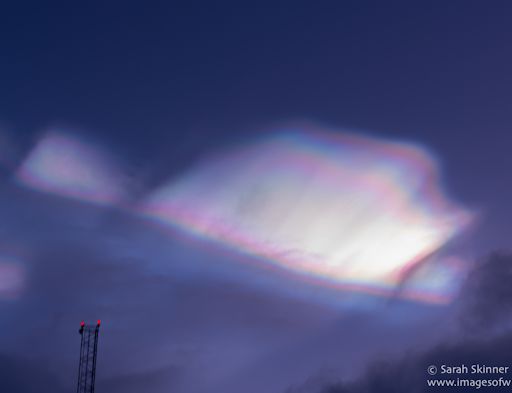
"Just as I was heading out to de-ice the car on Dec. 14th, I looked up and noticed the most incredible cloud formation," says Skinner. "At the same time, an excited text came through from my boss, aurora tour guide Chad Blakley, who having lived here for many years has seen this only once or twice and explained to an Arctic newbie like me how rare these formations really are."
Also known as "nacreous" or "mother of pearl" clouds, the icy structures form in the lower stratosphere when temperatures drop to around minus 85ºC. Sunlight shining through tiny ice particles ~10µm across produce the characteristic bright iridescent colors by diffraction and interference. Once thought to be mere curiosities, some PMCs are now known to be associated with the destruction of ozone.
"Nacreous clouds far outshine and have much more vivid colours than ordinary iridescent clouds, which are very much poor relations and seen frequently all over the world," writes atmospheric optics expert Les Cowley. "Once seen they are never forgotten."
Realtime Space Weather Photo Gallery
GEOMAGNETIC STORMS: A co-rotating interaction region (CIR) struck Earth's magnetic field on Dec. 14th, followed shortly thereafter by a high-speed stream of solar wind. The double jolt sparked almost 9 hours of G1-class geomagnetic storms and auroras around the Arctic Circle. Brian Whittaker saw the display from the cockpit of an airplane 35,000 feet above Northern Manitoba, Canada:

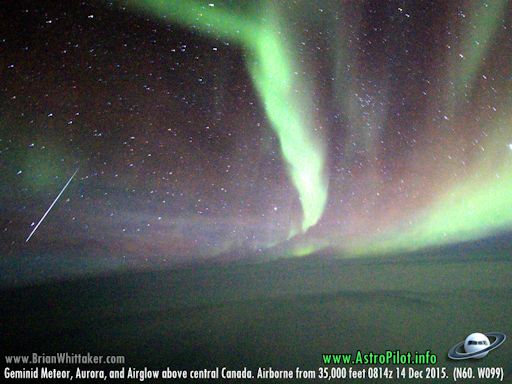
"In addition to the auroras, the Geminid meteor shower was very active," says Whittaker.
More auroras are in the offing on Dec. 15th. NOAA forecasters estimate a 60% chance of continued storming as the solar wind continues to blow. Aurora alerts: text or voice