SUBSIDING GEMINID METEOR SHOWER: The Geminid meteor shower is subsiding. NASA's network of all-sky meteor cameras detected "only" 58 Geminid fireballs last night, compared to 148 fireballs the night before. This is a sign that Earth is exiting the gravelly debris stream of rock comet 3200 Phaethon. Sky watchers can expect to see some Geminid meteors tonight, Dec. 16-17, but at numbers which are greatly reduced from the shower's peak. Meteor alerts: text or voice
METEOR BALLOON IN THE STRATOSPHERE: When the Geminid meteor shower peaked on Dec. 14th, a snowstorm was in progress over the mountains of central California. No stars? No problem. Using a helium balloon, the students of Earth to Sky Calculus launched a low-light camera to photograph the shower high above the obscuring clouds. Their experimental payload ascended to 91,000 feet where the night sky looked like this:
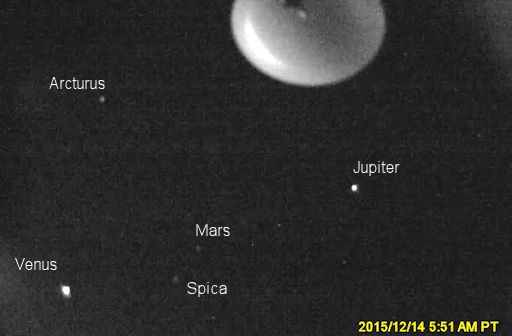
The big white object at the top of the frame is the balloon, surrounded by some of the bright stars and planets of the pre-dawn sky. From the lower stratosphere, the freezing camera was able to see stars as dim as 2nd magnitude. This wasn't as sensitive as the students had hoped, but it was good enough to record several Geminid fireballs. Here are a couple of movies showing Geminids emerging from behind the balloon: fireball #1, fireball #2. In the movies, stars and planets move in a lazy circle around the balloon--a result of the payload's gentle spin--while Geminids streak in straight lines. The camera also recorded the balloon exploding at the apex of the flight, and the payload parachuting back to Earth.
The students plan to observe more meteor showers in the future with even better results. They believe they can boost the sensitivity of the camera by, e.g., warming the payload bay during the flight and improving the camera's focus, pre-launch. If their improvements succeed, they could establish ballooning as a practical and fun way to monitor meteor showers in all kinds of weather. Stay tuned for updates.
POLAR STRATOSPHERIC CLOUDS--UPDATE: For the second day in a row, sky watchers are reporting an outbreak of polar stratospheric clouds (PSCs) around the Arctic Circle. Unlike normal grey-white clouds, which hug Earth's surface at altitudes of only 5 to 10 km, PSCs float through the stratosphere (25 km) and they are fantastically colorful. Truls Tiller photographed these over Tromsø, Norway, on Dec. 16th:
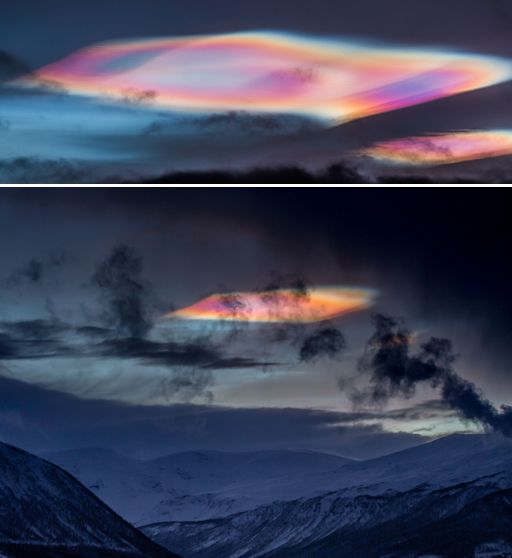
"Here the sun is gone for now," says Tiller, "but this beautiful view makes the winter darkness nice to be in as well. The picture was taken at 10.30 am, in the middle of the 'day.'"
Also known as "nacreous" or "mother of pearl" clouds, the icy structures form in the lower stratosphere when temperatures drop to around minus 85ºC. High-altitude sunlight shining through tiny ice particles ~10µm across produce the characteristic bright iridescent colors by diffraction and interference. Once thought to be mere curiosities, some PSCs are now known to be associated with the destruction of ozone.
"Nacreous clouds far outshine and have much more vivid colours than ordinary iridescent clouds, which are very much poor relations and seen frequently all over the world," writes atmospheric optics expert Les Cowley. "Once seen they are never forgotten."
Realtime Nacreous Clouds Photo Gallery
GEOMAGNETIC STORMS: A co-rotating interaction region (CIR) struck Earth's magnetic field on Dec. 14th, followed shortly thereafter by a high-speed stream of solar wind. The double jolt sparked almost 9 hours of G1-class geomagnetic storms and auroras around the Arctic Circle. Brian Whittaker saw the display from the cockpit of an airplane 35,000 feet above Northern Manitoba, Canada:

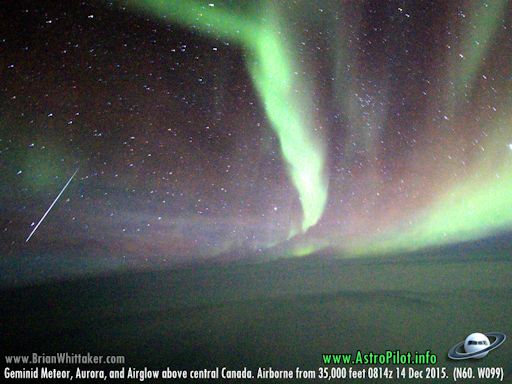
"In addition to the auroras, the Geminid meteor shower was very active," says Whittaker.
More auroras are in the offing on Dec. 16th. NOAA forecasters estimate a 25% chance of continued storming as the solar wind continues to blow. Aurora alerts: text or voice