AURORAS LIKELY THIS WEEK: 2015 could end with an outburst of auroras. NOAA forecasters say there is a 60% chance of polar geomagnetic storms on Dec. 30th when a CME (described below) is expected to hit Earth's magnetic field. There is an equal 60% chance that the storms will spill over into Dec. 31st, New Year's Eve. Aurora alerts: text or voice
SUNSPOT ERUPTS, HURLS CME TOWARD EARTH: After several days of pent-up quiet, big sunspot AR2473 erupted on Dec. 28th (12:49 UT), producing a slow but powerful M1.9-class solar flare. NASA's Solar Dynamics Observatory recorded the blast's extreme ultraviolet glow:

For more than an hour, UV radiation from the flare bathed the top of Earth's atmosphere, ionizing atoms and molecules. This, in turn, disrupted the normal propagation of shortwave radio signals on the dayside of our planet. A NOAA blackout map shows the affected area. Ham radio operators, mariners and aviators in South America, Africa and the south Atlantic Ocean may have noticed fades and blackouts of transmissions below 20 MHz.

The slow explosion also produced a coronal mass ejection (CME). Images from the Solar and Heliospheric Obseratory (SOHO) show a ragged, full-halo CME heading almost directly toward Earth:

NOAA analysts have modeled this CME, and they say it could reach Earth as early as Dec. 30th, with a 60% chance of polar geomagnetic storms when the CME arrives. Maximum storm levels are expected to be in the range G1 to G2.


Sunspot AR2473 has an unstable 'beta-delta' magnetic field that could explode again in the hours ahead. NOAA forecasters estimate a 50% chance of additional M-class flares and a 10% chance of X-flares on Dec. 29th. Solar flare alerts: text or voice
Realtime Spaceweather Photo Gallery
POLAR STRATOSPHERIC CLOUDS: Yesterday evening, Dec. 28th, Marcus Åhlund was whale watching with Explore the Arctic off the coast of Tromsö, Norway, when the darkening sky suddenly lit up with color. It wasn't the aurora borealis. It was a polar stratospheric cloud:

"Look carefully at the picture," says Åhlund. "The whale is there, too!"
Lately, Arctic sky watchers have been seeing a lot of PSCs. Also known as "nacreous" or "mother of pearl" clouds, icy PSCs form in the lower stratosphere when temperatures drop to around minus 85ºC. That's how cold it has to be for ice to crystalize in the stratosphere. High-altitude sunlight shining through tiny ice particles ~10µm across produce the characteristic bright iridescent colors by diffraction and interference. Once thought to be mere curiosities, some PSCs are now known to be associated with the destruction of ozone.
"Polar stratospheric clouds far outshine and have much more vivid colours than ordinary iridescent clouds, which are very much poor relations and seen frequently all over the world," writes atmospheric optics expert Les Cowley. "Once seen they are never forgotten."
The best time to look for PSCs is just before sunrise or right after sunset, when the ground is dark but the upper atmosphere is still illuminated by sunlight. Or, you can see them any time in the realtime photo gallery:
ARMY OF GREEN MEN -- IN SPACE: On Dec. 20th, Spaceweather.com and the students of Earth to Sky Calculus launched their weekly helium balloon to measure cosmic radiation in Earth's atmosphere. This time, there were 56 hitchikers--a platoon of green army men:
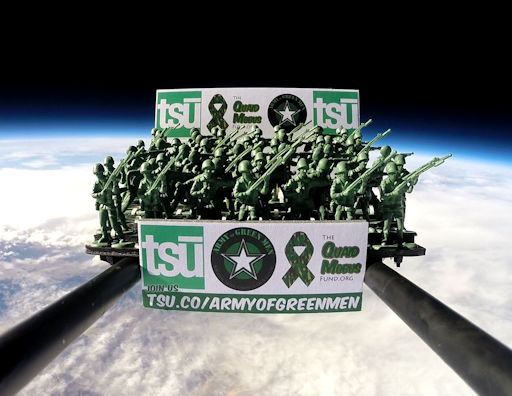
Their mission: to raise awareness of spinal cord injuries. #QuaidsArmy sponsored the flight. On September 20th, 2013, twenty-four year old Quaid Mobus of Warren NJ was in a near fatal ATV accident the night before his sister's wedding. Quaid was left paralyzed, requiring extensive lifelong medical attention. Since then, the Army of Green Men have been traveling far and wide to support Quaid and others like him. Dec. 20th marked their first trip to the stratosphere. Learn more at http://www.armyofgreenmen.com/