WAITING FOR THE CME (UPDATED): A CME hurled toward Earth on Dec. 28th by an explosion in the magnetic canopy of sunspot AR2473 is still en route. Forecasters expect the storm cloud to arrive during the late hours of Dec. 30th. According to NOAA, there is a 90% chance of geomagnetic activity in the wake of the CME's impact. New Year's Eve auroras are in the offing. Aurora alerts: text or voice
DECAYING SUNSPOT: Big sunspot AR2473, the source of the incoming CME, is no longer as potent as it was earlier this week. Philippe Tosi of Nîmes, France, photographed the sunspot's decaying core on Dec. 30th:

Tosi inserted a picture of Earth for scale. Even in decay, the sunspot is an awesome thing, with dark condensations and filaments of magnetism that dwarf the largest continents of our planet. Terrifying appearances notwithstanding, the sunspot's overall magnetic field has decayed and no longer poses a threat for very strong flares. A stretch of quiet is in the offing. Aurora alerts: text or voice
Realtime Spaceweather Photo Gallery
POLAR STRATOSPHERIC CLOUDS: Earth's stratosphere is *not* a cloudy place. Nevertheless, on rare occasions during the coldest weeks of northern winter, tiny crystals of ice in the stratosphere gather themselves into swarms called "PSCs"--polar stratospheric clouds. On Dec. 29th, Frank Olsen photographed a rare PSC floating over Sortland, Norway:
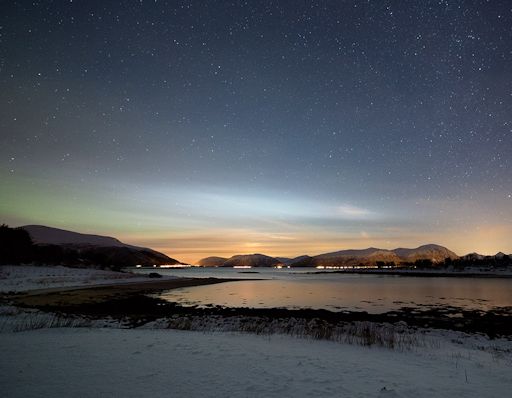
"The pastel-colored clouds appeared alongside some faint green auroras," says Olsen. "I have never seen PSCs and auroras together before."
Also known as "nacreous" or "mother of pearl" clouds, PSCs form in the lower stratosphere when temperatures drop to around minus 85ºC. That's how cold it has to be for ice to crystalize in the dry stratosphere.
"I took the picture around 6 PM, long after sunset," continues Olsen. "This makes me wonder if the rising moon, just below the horizon, is what illuminated the PSCs."
High-altitude sunlight--or, in this case, moonlight--shining through tiny ice particles ~10µm across produce the characteristic bright iridescent colors of PSCs. "Polar stratospheric clouds far outshine and have much more vivid colours than ordinary iridescent clouds, which are very much poor relations and seen frequently all over the world," writes atmospheric optics expert Les Cowley. "Once seen they are never forgotten."
ARMY OF GREEN MEN -- IN SPACE: On Dec. 20th, Spaceweather.com and the students of Earth to Sky Calculus launched their weekly helium balloon to measure cosmic radiation in Earth's atmosphere. This time, there were 56 hitchikers--a platoon of green army men:
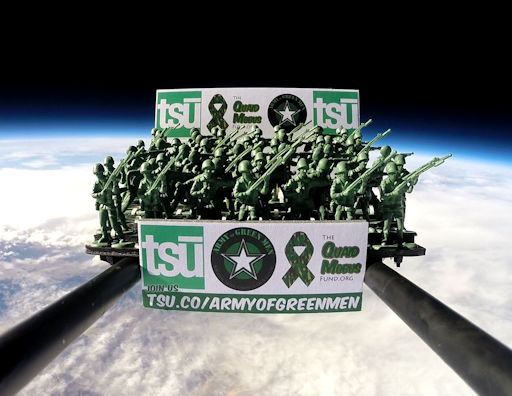
Their mission: to raise awareness of spinal cord injuries. #QuaidsArmy sponsored the flight. On September 20th, 2013, twenty-four year old Quaid Mobus of Warren NJ was in a near fatal ATV accident the night before his sister's wedding. Quaid was left paralyzed, requiring extensive lifelong medical attention. Since then, the Army of Green Men have been traveling far and wide to support Quaid and others like him. Dec. 20th marked their first trip to the stratosphere. Learn more at http://www.armyofgreenmen.com/