QUADRANTID METEOR SHOWER: Earth is about to pass through a narrow stream of debris from shattered comet 2003 EH1, source of the annual Quadrantid meteor shower. According to the International Meteor Organization, the shower will peak on Monday morning, Jan. 4th, during the hours around 0800 UT (3 a.m. ET). The timing favors observers in North America who could see dozens of meteors per hour flowing from a radiant near the North Star. Too cold to go outside? Cozy up by the fire and listen to Quadrantid radar echoes on Space Weather Radio.
UN-DEAD SUNSPOT EXPLODES AGAIN: Sunspot AR2473, the source of the New Year's geomagnetic storm, appears to be in a state of advanced decay. It's not dead yet, though. During the early hours of Jan. 2nd it unleashed a strong M2-class solar flare. NASA's Solar Dynamics Observatory recorded the explosion:

Now play the movie again and note the tornado of plasma that briefly rises up and falls back to the sun's surface. The twister was wider than our entire planet.
This explosion hurled a coronal mass ejection (CME) into space: movie. It does not appear to be heading for Earth. Stay tuned, however, for analysis of the possibility that the CME might deliver a glancing blow to our planet's magnetic field in the days ahead. Solar flare alerts: text or voice

Realtime Spaceweather Photo Gallery
NEW YEAR'S GEOMAGNETIC STORM: 2016 began with an explosion--not only of fireworks, but also auroras. On Jan. 1st, a G2-class geomagnetic storm sparked bright lights around the poles as revelers around the world were ringing in the New Year. In Glenfarg, Scotland, fireworks crackled against a backdrop of green:


"Our neighbours let off some fireworks for the New Year," says photographer Stuart Walker. "They were modest compared to the organized display in Edinburgh, but looked great alongside the ongoing aurora."
The storm was the result of a CME strike on New Year's Eve (Dec. 31 @ 00:30 UT). At first the CME's impact had little effect. Indeed, we initially ruled it a "dud." But as Earth moved deeper into the CME's wake, solar wind conditions shifted to favor geomagnetic activity.
The very first sighting of auroras in 2016 may have come from Taichi Nakamura, across the International Date Line in Dunedin, New Zealand:
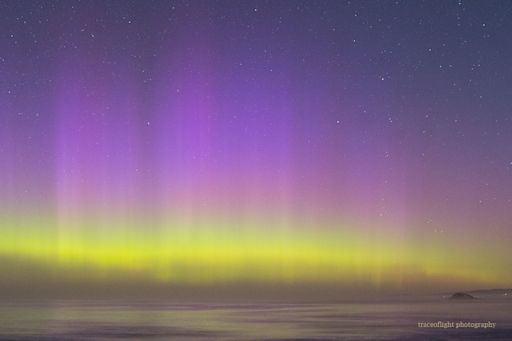
"It was a beautiful treat to see the auroras kick off the New Year," says Nakamura. "The display began after midnight and kept glowing with waves and beams until morning twilight painted light over the aurora. It is summer now in New Zealand and my four year old son was delighted to come with me as it is warm even at night." Aurora alerts: text or voice
GREEN COMET MEETS ORANGE STAR: On Jan. 1st, Comet Catalina had a close encounter with Arcturus in the early morning sky. Chris Schur of Payson AZ woke up before dawn to photograph the green comet beside the orange star:

"A really nice photo-op this morning, with the 6th magnitude comet nearly on top of Arcturus," says Schur. "Fortunately, the comet's tail pointed away from the all too brilliant star, and made for a stunning portrait."
Arcturus is an orange giant star 37 light years from Earth. Comet Catalina is much closer, only 0.00001 light years from Earth. The comet gets its green color from the gases in its atmosphere--especially diatomic carbon (C2), which glows green when illuminated by sunlight in the near-vacuum of space.
Comet Catalina will remain in the neighborhood of Arcturus for the next couple of nights as it glides through the constellation Bootes. Observing tips and sky maps may be found in this article from Sky and Telescope.