CHANCE OF STORMS: NOAA forecasters estimate a 60% chance of minor G1-class geomagnetic storms today as Earth passes through a stream of high-speed solar wind. Arctic sky watchers should be alert for auroras. Aurora alerts: text or voice

DIAMOND DUST ICE HALOS: As winter deepens in the northern hemisphere, the Arctic atmosphere is filling with crystals of ice. This is producing some beautiful ice halos. They form not only around the sun during the day, but also around headlights at night. Pekka Lähteenmäki photographed samples of both in Jalasjärvi, Finland:
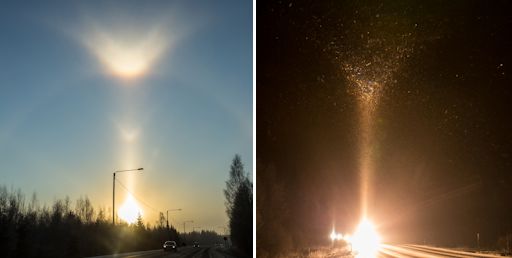
These luminous shapes are caused by light shining through jewel-like crystals called "diamond dust.' Lähteenmäki notes that "You can see individual ice crystals glinting in my photos--especially the night shot."
Atmospheric optics expert Les Cowley has seen halos like these before. He finds the night halos most interesting: "Artificial light halos can have strange forms compared with those made by the sun or moon. The difference is because, unlike sun rays, those from nearby lights are not parallel. The equivalents of sundogs become long streaks. There are even super sundogs. The trumpet-shaped night halo Lähteenmäki photographed was made by hexagonal column crystals floating nearby with their long axes horizontal. It is a cousin of the familiar upper tangent arc--similar, but not the same. Look out at night for a whole new world of halos!"
Realtime Spaceweather Photo Gallery
QUADRANTID METEOR BALLOON: When the annual Quadrantid meteor shower peaked on Jan. 4th, the skies of Spain were cloudy, and rain was falling on astronomers at the Universidad Complutense de Madrid (UCM). Determined to see the shower no matter what, they launched a helium balloon to the stratosphere where the sky was clear. "For the first time ever," reports UCM astronomy postdoc Alejandro Sánchez de Miguel, "we have photographed Quadrantid meteors from the stratosphere--in color and HD." Their video captured as many as half-a-dozen Quadrantids:
The Quadrantids are notoriously difficult to photograph. The meteors are typically faint; moreover, the shower peaks in early January when winter weather often blocks the view of northern skies. The UCM group's successful capture of Quadrantids high above the clouds is a significant accomplishment.
According to Sánchez, there are three good reasons to observe meteor showers using balloons:
"First, the stratosphere is a place where we can avoid bad weather. Lately we have been having terrible weather in Spain!"
"Second, the stratosphere is so transparent. That means we can point our cameras at the horizon and sample a large volume of atmosphere, and capture the maximum number of meteors."
"Third, the stratosphere gives us a new point of view that we can use to calculate meteoroid orbits with higher precision."
Spaceweather.com and Earth to Sky Calculus recently observed the Geminid meteor shower from the stratosphere using a helium balloon of their own: full story. Perhaps a transcontinental collaboration is in the offing. Stay tuned for more pictures from the edge of space.