CHANCE OF STORMS: NOAA forecasters estimate a 40% chance of minor G1-class geomagnetic storms today as Earth passes through a stream of high-speed solar wind. Arctic sky watchers should be alert for auroras. Aurora alerts: text or voice

PLANETS AT DAWN: Waking up before sunrise can be hard to do. For the next two mornings, it's easy. One look at the dawn sky will bring you to full attention thanks to a beautiful conjunction of Venus and Saturn. Alan Dyer caught the two planets converging over Gleichen, Alberta, on Jan. 6th:

"This was the scene on a very cool (-20 C) January morning in southern Alberta," says Dyer, who took the shot from his back deck.
The view will improve in the mornings ahead. On Friday morning, Jan. 8th, the two planets will be about 1° apart--twice the width of a full Moon. On Saturday morning, the 9th, the distance will shrink to less than 1/2°--a tight pair that you can hide behind your pinky fingertip held at arm's length. They'll be at their very closest, a mere 0.1° apart, around 04:00 UT excellent timing for observers Europe who will see the two planets practically touching. This is the closest conjunction of two planets since March of 2013.
So set your alarm for dawn and look east. It's a great way to start the day.
Realtime Spaceweather Photo Gallery
DIAMOND DUST ICE HALOS: As winter deepens in the northern hemisphere, the Arctic atmosphere is filling with crystals of ice. This is producing some beautiful ice halos. They form not only around the sun during the day, but also around headlights at night. Pekka Lähteenmäki photographed samples of both in Jalasjärvi, Finland:
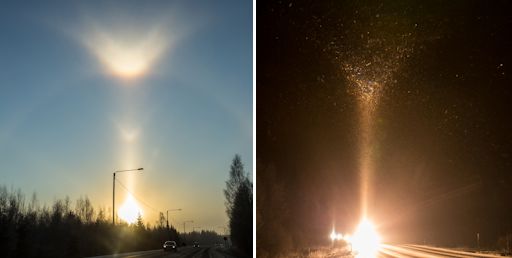
These luminous shapes are caused by light shining through jewel-like crystals called "diamond dust.' Lähteenmäki notes that "You can see individual ice crystals glinting in my photos--especially the night shot."
Atmospheric optics expert Les Cowley has seen halos like these before. He finds the night halos most interesting: "Artificial light halos can have strange forms compared with those made by the sun or moon. The difference is because, unlike sun rays, those from nearby lights are not parallel. The equivalents of sundogs become long streaks. There are even super sundogs. The trumpet-shaped night halo Lähteenmäki photographed was made by hexagonal column crystals floating nearby with their long axes horizontal. It is a cousin of the familiar upper tangent arc--similar, but not the same. Look out at night for a whole new world of halos!"