VENUS AND SATURN CONVERGE: Set your alarm for dawn. On Saturday morning, Jan. 9th, Venus and Saturn will converge before sunrise in the eastern sky for a take-your-breath-away conjunction. As seen from Europe, the two planets will be mere 0.1° apart. The view from North America will be almost as good. No telescope is required to view this event. [photo gallery]
SOLAR WIND SPARKS BIG AURORAS: Last night, Jan. 7-8, a display of auroras appeared over Kvaløya, Norway. It was so large, photographer Anne Birgitte Fyhn had to take 8 pictures to capture the whole thing. Click to view the complete panorama:
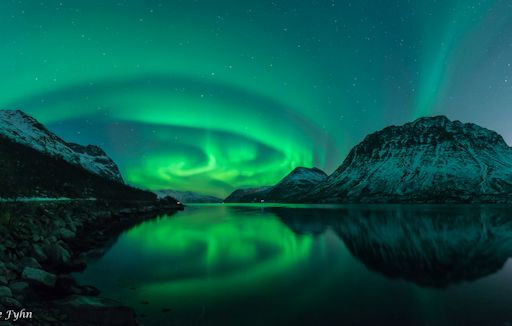
"The coldest day this winter gave us an evening with clear skies and magnificent auroras," says Fyhn. "The show was worth my cold toes."
The display was caused by a high-speed stream of solar wind, now buffeting Earth's magnetic field. Earth will probably remain inside the stream for another ~24 hours, so more auroras are in the offing. Monitor the realtime photo gallery for sightings. Aurora alerts: text or voice
'VENETIAN BLIND' SHADOWS IN THE MIST: This week, photographer Mark Marquette got up before sunrise--not to see the planets, but rather to observe the surface of the Colorado river near Austin, Texas. The attraction was the spooky mist that rises from the water when the first rays of warming sunlight arrive after a long, cool winter's night. However, Marquette saw something he didn't expect: 'venetian blind' shadows cutting through the fog:

"What causes this?" he asks. "My guess is light reflected from ripples in the river cast shadows upward in the dancing mist."
Essentially, that is correct. A careful look at the waters' surface reveals organized ripples reflecting the glow of the rising sun:

Sheets of light bouncing off those ripples lanced through the mist to create bands of light and dark. Atmospheric optics expert Les Cowley says the phenomenon is related to caustics--sharp and thin sheets of light produced by reflection from a wavy surface. Here is an example of caustics criss-crossing the hull of a fishing boat. "Waves and ripples on water usually produce caustic patterns," says Cowley. "Although themselves highly structured, caustics are not regular bands. So I am surprised that the shadows Marquette saw were so regular."
Venetian blind shadows: beautiful and a little mysterious. Look for them the next time you encounter a spooky mist!
Realtime Spaceweather Photo Gallery
DIAMOND DUST ICE HALOS: As winter deepens in the northern hemisphere, the Arctic atmosphere is filling with crystals of ice. This is producing some beautiful ice halos. They form not only around the sun during the day, but also around headlights at night. Pekka Lähteenmäki photographed samples of both in Jalasjärvi, Finland:
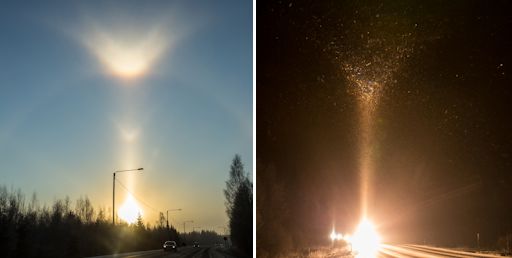
These luminous shapes are caused by light shining through jewel-like crystals called "diamond dust.' Lähteenmäki notes that "You can see individual ice crystals glinting in my photos--especially the night shot."
Atmospheric optics expert Les Cowley has seen halos like these before. He finds the night halos most interesting: "Artificial light halos can have strange forms compared with those made by the sun or moon. The difference is because, unlike sun rays, those from nearby lights are not parallel. The equivalents of sundogs become long streaks. There are even super sundogs. The trumpet-shaped night halo Lähteenmäki photographed was made by hexagonal column crystals floating nearby with their long axes horizontal. It is a cousin of the familiar upper tangent arc--similar, but not the same. Look out at night for a whole new world of halos!"
Realtime Spaceweather Photo Gallery