QUIET SUN: With no sunspots actively flaring, the sun's X-ray output has flatlined. Solar activity is very low and likely to remain so throughout the weekend. NOAA forecasters estimate a slight 10% chance of M-class solar flares on Jan. 9th and 10th. Solar flare alerts: text or voice

VENUS AND SATURN CONVERGE: This morning, Jan. 9th, Venus and Saturn converged in the dawn sky for a take-your-breath-away conjunction. At closest approach the two planets were a mere 0.1° apart--only 1/5th the diameter of the full Moon. G. Brammer sends this picture from Cerro Paranal in the Region de Antofagasta of Chile:

"I took this picture from the site of the ESO/VLT at Cerro Paranal in Chile," says Brammer. "The sign indicates a safe meeting point in case of earthquakes. The mountain peak at lower left in the full-sized image is Cerro Armazones, the future home of the European Extremely Large Telescope (E-ELT)."
Realtime Spaceweather Photo Gallery
'VENETIAN BLIND' SHADOWS IN THE MIST: This week, photographer Mark Marquette got up before sunrise--not to see the planets, but rather to observe the surface of the Colorado river near Austin, Texas. The attraction was the spooky mist that rises from the water when the first rays of warming sunlight arrive after a long, cool winter's night. However, Marquette saw something he didn't expect: 'venetian blind' shadows cutting through the fog:

"What causes this?" he asks. "My guess is light reflected from ripples in the river cast shadows upward in the dancing mist."
Essentially, that is correct. A careful look at the waters' surface reveals organized ripples reflecting the glow of the rising sun:

Sheets of light bouncing off those ripples lanced through the mist to create bands of light and dark. Atmospheric optics expert Les Cowley says the phenomenon is related to caustics--sharp and thin sheets of light produced by reflection from a wavy surface. Here is an example of caustics criss-crossing the hull of a fishing boat. "Waves and ripples on water usually produce caustic patterns," says Cowley. "Although themselves highly structured, caustics are not regular bands. So I am surprised that the shadows Marquette saw were so regular."
Venetian blind shadows: beautiful and a little mysterious. Look for them the next time you encounter a spooky mist!
Realtime Spaceweather Photo Gallery
SOLAR WIND SPARKS BIG AURORAS: On Jan. 8th, a display of auroras appeared over Kvaløya, Norway. It was so large, photographer Anne Birgitte Fyhn had to take 8 pictures to capture the whole thing. Click to view the complete panorama:
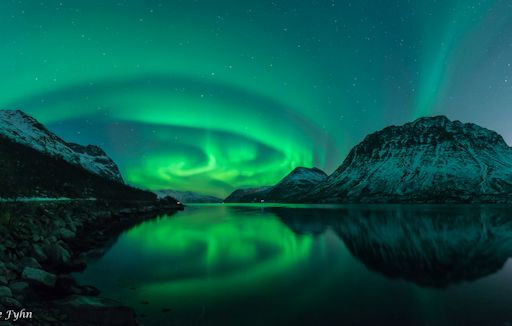
"The coldest day this winter gave us an evening with clear skies and magnificent auroras," says Fyhn. "The show was worth my cold toes."
The display was caused by a high-speed stream of solar wind, now buffeting Earth's magnetic field. Earth will probably remain inside the stream for another ~12 hours, so more auroras are in the offing. Monitor the realtime photo gallery for sightings.