CONTINUED QUIET: Solar activity is very low and likely to remain so for the next 24 hours. NOAA forecasters estimate a 5% chance of M-flares and no more than a 1% chance of X-flares on Jan. 13th. Solar flare alerts: text or voice.
AURORAS VISIBLE FROM SPACE: For the third day in a row, a stream of high-speed solar wind is buffeting Earth's magnetic field. This is sparking a light show visible from Earth orbit. Dramatic images from the US Defense Meteorological Satellite Program (DMSP) show auroras over the polar regions north of Russia, Alaska, and Canada:
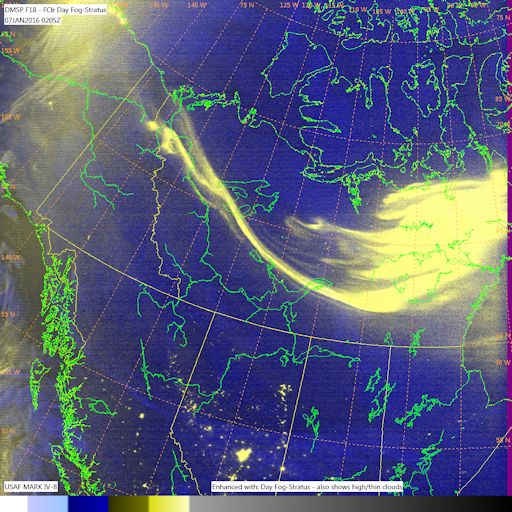
"These images of brilliant aurora borealis use both nighttime visual and infrared data from the Suomi NPP and DMSP F14, F18, & F19 polar orbiting satellites," reports says Paul McCrone of the Fleet Numerical Meteorology and Oceanography Center in Monterey, California. He processed the data on Jan. 11, 2016.
DMSP satellites carry low light cameras for nightime monitoring of moonlit clouds, city lights and auroras. Some of the auroras recorded by the fleet on Jan. 11th were as bright as the city lights underneath.
"This imagery was generated from the Operational Linescan System (OLS) on the DMSP spacecraft, revealing the sinuous path of these energetic particles entering Earth's upper atmosphere," adds McCrone.
More auroras like these are possible on Jan. 13th. NOAA forecasters estimate a 50% chence of polar geomagnetic storms during the next 24 hours as the solar wind continues to blow. Aurora alerts: text or voice.
AURORAS VS. LIGHT PILLARS: Last night in Muonio, Finland, Antti Pietikäinen hiked out onto the frozen surface of the River Muonio to get away from glaring city lights. "I was trying to get a better view of the auroras," he says. Turns out, he got a great view of both:
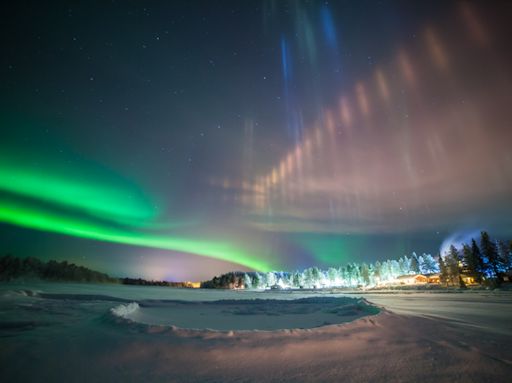
"I had a rare shot with auroras and light pillars in the same image," says Pietikäinen.
Light pillars are a common sight around northern cities in winter. Urban lights bounce off ice crystals in the air, producing tall luminous columns sometimes mistaken for auroras.
"The night air was filled with ice crystals as the temperature dropped to -35 C," he says. "This created stunning light pillars on top of the Hotel Harriniva. The funny crater in the foreground is because the ice has frozen unevenly in the river, creating a small pond that overflows water regularly. Water with slush freezes on top heightening the crater walls."
"It's quite nice to live in the aurora zone," says Pietikäinen, "every evening is different."
Realtime Spaceweather Photo Gallery
LEAPING SUNDOGS: At this time of year, when northern skies fill with crystals of ice, it is not unusual to see rainbow-colored splashes of light to the left and right of the sun. These are sundogs, formed by the action of ice on sunlight. Yesterday, the daughter of photographer Robert Snache saw a sundog ... and leaped:
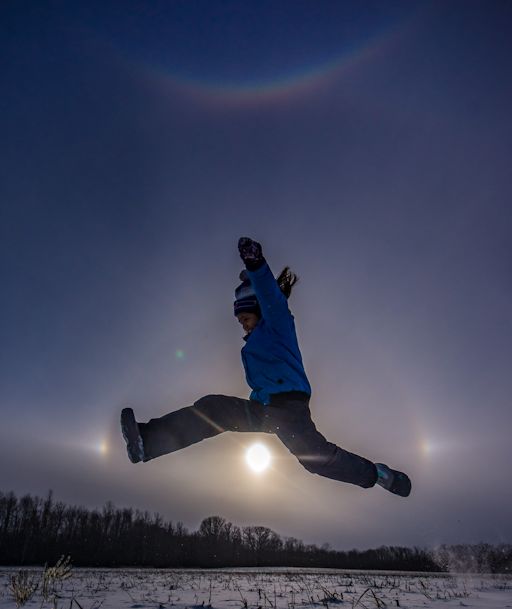
"We had snow squalls in the late afternoon--hence the ice crystals," says Snache, who took the picture from Rama First Nation, Ontario, Canada. "The same crystals formed a smiling rainbow (circumzenithal arc) overhead and a faint 22° halo around the sun. It was a beautiful display of ice halos."
More ice halos are in the offing as northern winter deepens. Browse the gallery for sightings.