AURORA ALERT: Delayed imagery from SOHO has revealed a CME that left the sun on Jan. 15, propelled by the eruption of a magnetic filament. NOAA storm tracks suggest that the CME could deliver a weak glancing blow to Earth's magnetic field on Jan. 19th. Arctic sky watchers should be alert for auroras after nightfall on Tuesday. Solar flare alerts: text or voice.
STREET MAPS IN THE SKY: Winter is unfolding around the northern hemisphere and, as temperatures drop, pillars of light are springing up from ground. Urban lights bounce off ice crystals in the air, producing luminous columns that reach into the heavens. Such "light pillars" are a common sight around northern cities in winter. On Jan. 12th, however, Mia Heikkilä looked up from her hometown in Eura, Finland, and saw something uncommon. "There was a street map of Kauttua painted in the sky!" she says. Heikkilä took this picture of the apparition:
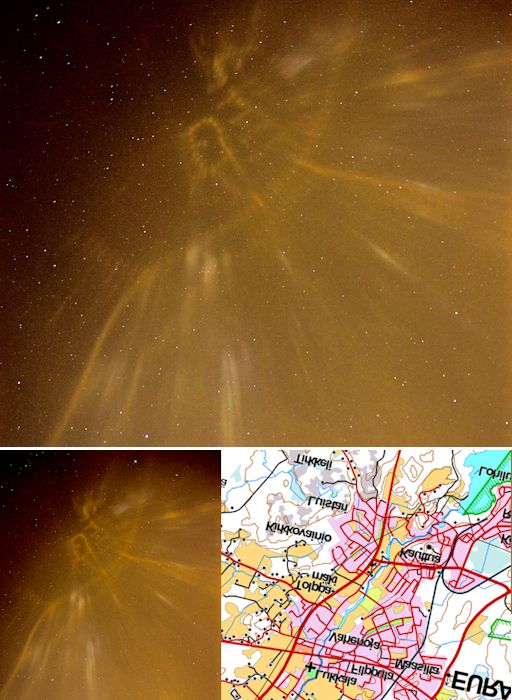
"It was an exact reversed light map of Kauttua, Eura, created by light pillars," Heikkilä explains.
Most people see pillars from the side, where they look like luminous towers, but not Heikkilä. She was located inside a nest of pillars rising from the center of town. Looking up, she saw the tips of the pillars tracing the illuminated streets of Kauttua. In fact, the sky map was even better than the printed map Heikkilä used for comparison, because it traced the most recent changes to the cityscape. "Now I call it #LuxEura," she says.
Note: These observations were first published in Tähdet ja avaruus magazine.
Realtime Spaceweather Photo Gallery
MIND-ALTERING AURORAS, SUBSIDING: All week long, a stream of solar wind has gently buffeted Earth's magnetic field, sparking bright auroras around the Arctic Circle. In Yellowknife, Canada, "the display was mind-altering," reports Ryan Fisher, who took this picture on Jan. 14th:
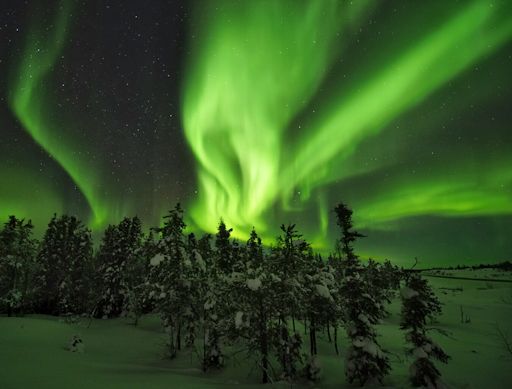
"It was 4 hours of crazy amazement!" he says.
Earth is slowly exiting the stream of solar wind. As a result, NOAA forecasters have downgraded the chance of polar geomagnetic storms on Jan. 15th to only 20%. On the bright side, that could still produce 4 x 20% = 0.8 hours of "crazy amazement." Arctic sky watchers are advised to remain alert for auroras.. Aurora alerts: text or voice.