CHANCE OF STORMS: On Jan. 15th, a magnetic filament in the sun's southern hemisphere exploded. Debris from the blast formed a CME that could sideswipe Earth's magnetic on Jan. 19. NOAA forecasters say there is a 45% chance of minor geomagnetic storms when the storm cloud arrives. Arctic sky watchers should be alert for auroras on Monday and Tuesday nights. Aurora alerts: text or voice.
SOLAR ECLIPSE BALLOON NETWORK: Spaceweather.com and the students of Earth to Sky Calculus have developed a balloon payload that can photograph solar eclipses from the stratosphere. This sets the stage for a one-of-a-kind photography experiment: On August 21, 2017, the Moon will pass in front of the sun over the USA, producing a total eclipse visible from coast to coast. We will launch balloons to record the event from a dozen points along the path of totality:

Floating more than 100,000 feet above the clouds, the balloons will have an unobstructed view of the eclipse. From each of a dozen payloads, one camera will point up to record the sun's ghostly corona while another camera points down to record the passage of the Moon's dark shadow across the landscape and cloudtops below. When the eclipse is finished, we will combine the footage to create a unique video portrait of an eclipse sweeping across the American continent. The finished product will be a one-of-a-kind synthesis of art, technology and science.
The payload has already photographed a partial solar eclipse in Oct. 2014: images. To test the payload under conditions of totality, a team of students and parents from Earth to Sky Calculus will travel to Indonesia six weeks from now to observe the March 9, 2016, total eclipse: animated map. Stay tuned for news from their expedition!
Readers, would you like to join the Solar Eclipse Balloon Network? Starting now we are recruiting teams of citizen scientists who we will train in the art of high-altitude ballooning to become members of the solar eclipse launch crews. Schools, scout troops, home school families and others are welcome to apply. This is a great way for novices to learn ballooning and to participate in authentic science. We will also be seeking sponsors for the 12 payloads. Contact Dr. Tony Phillips to register your interest.
COMET CATALINA CLOSEST APPROACH TO EARTH: Discovered in 2013 by the Catalina Sky Survey, Comet Catalina (C/2013 US10) is making a one-time trip through the inner solar system. It swung around the sun last November and is now making its closest approach to Earth: 67 million miles away on Jan. 17-18. Yasushi Aoshima sends this picture from Shizuoka, Japan:

"I caught the comet just as it was passing Pinwheel Galaxy M101," says Aoshima. The full-sized image also shows the double star system Mizar and Alcor in the handle of the Big Dipper. Aoshima notes a discontinuity in the comet's gaseous ion tail, labeled here. "That is a drastic change since my last imaging session," says Aoshima. It is probably a sign that the tail is being buffeted and deformed by irregularities in the solar wind.

The 6th magnitude comet is too dim for the naked eye, but it is an easy target for backyard telescopes and digital cameras. (Aoshima used a Canon EOS 6D digital camera set at 12800 ISO for a 51x30sec exposure.) An ephemeris from the Minor Planet Center shows where to point your optics.
This is Comet Catalina's first visit to the inner solar system--and its last. The comet's close encounter with the sun in mid-November has placed it on a slingshot trajectory toward interstellar space. Enjoy it now. Once it recedes from Earth, we may never see it again. Browse the realtime comet gallery for more sightings.
STREET MAPS IN THE SKY: Winter is unfolding around the northern hemisphere and, as temperatures drop, pillars of light are springing up from ground. Urban lights bounce off ice crystals in the air, producing luminous columns that reach into the heavens. Such "light pillars" are a common sight around northern cities in winter. On Jan. 12th, however, Mia Heikkilä looked up from her hometown in Eura, Finland, and saw something uncommon. "There was a street map of Kauttua painted in the sky!" she says. Heikkilä took this picture of the apparition:
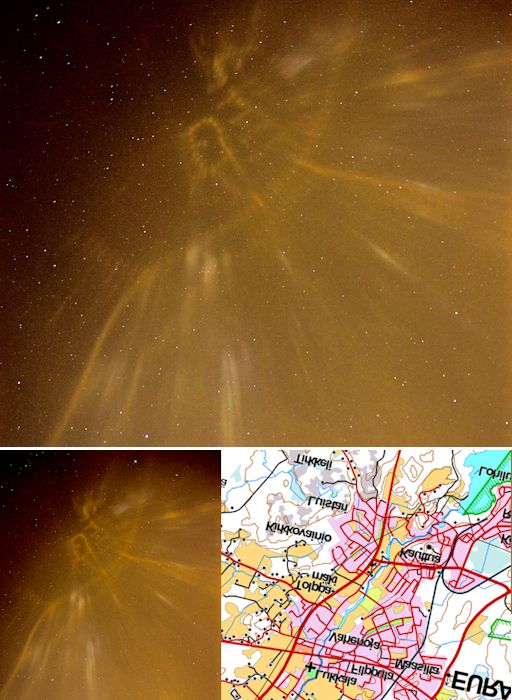
"It was an exact reversed light map of Kauttua, Eura, created by light pillars," Heikkilä explains.
Most people see pillars from the side, where they look like luminous towers, but not Heikkilä. She was located inside a nest of pillars rising from the center of town. Looking up, she saw the tips of the pillars tracing the illuminated streets of Kauttua. In fact, the sky map was even better than the printed map Heikkilä used for comparison, because it traced the most recent changes to the cityscape. "Now I call it #LuxEura," she says.
Note: These observations were first published in Tähdet ja avaruus magazine.
Realtime Spaceweather Photo Gallery