A NEW 9TH PLANET BEYOND PLUTO? Today, planetary scientists, Konstantin Batygin and Mike Brown of Caltech announced intriguing evidence for a Neptune-sized planet orbiting the sun beyond Pluto. Sedna and five other objects in the outer solar system are grouped together as if they are being shepherded by a larger body. That body, say Batygin and Brown, is a planet at least 10 times as massive as Earth traveling along an elliptical orbit more than 200 AU from the sun. This is the most persuasive argument so far for the existence of a "Planet X." Until someone actually sees the planet in a telescope, however, it's just a hypothesis. So let the hunt begin! The full story was published in the Jan. 20th edition of Science Magazine.

AURORAS VS. MOONLIGHT: Earth is passing through the wake of a CME that hit our planet earlier this week. On Jan. 20th, the lingering encounter sparked a G1-class geomagnetic storm and bright auroras around the Arctic Circle. Frank Olsen sends this picture from Sortland, Norway:


"Tonight was really amazing!" says Olsen. "Conditions were perfect with new fallen snow and crisp, clear air around -15 degrees C. The landscape was beautifully lit by moonlight."
As Earth exits the wake of the CME on Jan. 21st, the auroras will subside--but not for long. A new disturbance is expected to arrive the very next day. High-speed solar wind flowing from a coronal hole will buffet Earth's magnetic field on Jan. 22nd and 23rd, possibly sparking a new round of Arctic auroras. Visibility may be mitigated by the glare of the waxing full Moon--or, as Olsen's photo shows, maybe not. Monitor the realtime photo gallery for sightings. Aurora alerts: text or voice.
SOLAR ECLIPSE BALLOON NETWORK: Spaceweather.com and the students of Earth to Sky Calculus have developed a balloon payload that can photograph solar eclipses from the stratosphere. This sets the stage for a one-of-a-kind photography experiment: On August 21, 2017, the Moon will pass in front of the sun over the USA, producing a total eclipse visible from coast to coast. We will launch balloons to record the event from a dozen points along the path of totality:

Floating more than 100,000 feet above the clouds, the balloons will have an unobstructed view of the eclipse. From each of a dozen payloads, one camera will point up to record the sun's ghostly corona while another camera points down to record the passage of the Moon's dark shadow across the landscape below. When the eclipse is finished, we will combine the footage to create a unique video portrait of an eclipse sweeping across the American continent.
The payload has already photographed a partial solar eclipse in Oct. 2014: images. To test the payload under conditions of totality, a team of students and parents from Earth to Sky Calculus will travel to Indonesia six weeks from now to observe the March 9, 2016, total eclipse: animated map. Stay tuned for news from their expedition!
Readers, would you like to join the Solar Eclipse Balloon Network? Starting now we are recruiting teams of citizen scientists who we will train in the art of high-altitude ballooning to become members of the solar eclipse launch crews. Schools, scout troops, home school families and others are welcome to apply. This is a great way for novices to learn ballooning and to participate in authentic science. We will also be seeking sponsors for the 12 payloads. Contact Dr. Tony Phillips to register your interest.
Realtime Spaceweather Photo Gallery
MOONDUST-COLORED CONTRAIL: On Jan. 18th, Pete Lardizabal pointed his camera at the clear blue sky over St Johns, Florida, to photograph the waxing gibbous Moon. Just as he depressed the shutter, a plane flew by. Although the Moon was more than a quarter of a million miles behind the plane, the flyby appeared to kick up a plume of moondust:
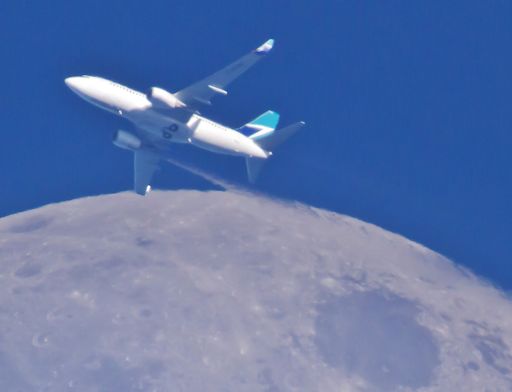
Atmospheric optics expert Les Cowley explains what happened: "The turbulent exhaust stream of the 'moonside' engine is refracting and scattering light from the Moon, creating a 'moondust-colored contrail.' The trail can be seen crossing the Moon itself. Likely the other engine is producing an equally turbulent exhaust trail. However, its angular distance from the Moon's limb is too large for any lunar light to be scattered towards the camera."
The Moon will be full on Jan. 23-24. According to folklore, it is the "Wolf Moon." Monitor the realtime photo gallery for moonshots as more cameras turn toward the dusty orb in the days ahead.