WOLF MOON: Can you hear them howl? According to folklore, tonight's full Moon is the "Wolf Moon," named long ago by Native Americans after the singing packs of wolves they heard during the winter month of January. Look east at sunset and enjoy the Wolf moonlight. [photo gallery]
AURORAS AT 60 MPH: Working as a wilderness guide in Inari, FInland, Ville Heimonen has photographed auroras from the motionless solitude of countless natural settings. Last night, he decided to try something different--shooting from the window of a rollicking, fast-moving car:

"One hour before this photo was taken, we saw the brightest aurora of this winter," says Heimonen. "It was incredibly bright, red and fast moving. I took this shot while I was driving home from work. It was little tricky with the bumpy road, but the moonlight helped keep the shutter speed relatively fast."
The display was caused by a stream of solar wind, which has been buffeting Earth's magnetic field for several days. The auroras should subside this weekend as Earth exits the stream. NOAA forecasters have downgraded the odds of a polar geomagnetic storm on Jan. 23rd to 20%. Aurora alerts: text or voice.
STORM HALOS: A massive winter storm is barreling up the east coast of the United States. Heralding the storm's advance, icy clouds are wafting over some states, producing spectacular halos around the sun. Chris Cook photographed this specimen from Cape Cod, Massachusetts, on Jan. 22nd:
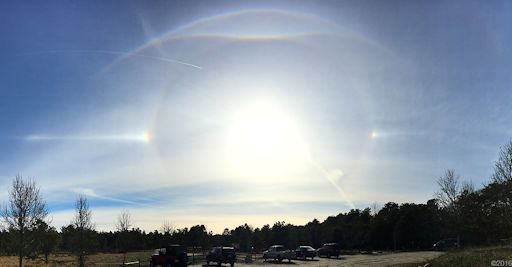
These luminous structures around the sun are caused by sunlight shining through ice crystals in "the high cloud shield of this weekend's east coast winter storm," says Cook. "It was a nice display including a 46° halo, 22° halo, a pair of sundogs, a parhelic circle, an upper tangent arc and a Parry arc. A circumzenithal arc was also visible but off the top of the frame in this horizontal panorama."
Observers along the storm track should be alert for such halos before the opaque snow clouds arrive. Ice halos can appear not only around the sun, but also around the full Moon. According to folklore, this weekend's full Moon is the "Wolf Moon." However, "Storm Moon" might be more apropos. Monitor the photo gallery for sightings.
Realtime Spaceweather Photo Gallery
SOLAR ECLIPSE BALLOON NETWORK: Spaceweather.com and the students of Earth to Sky Calculus have developed a balloon payload that can photograph solar eclipses from the stratosphere. This sets the stage for a one-of-a-kind photography experiment: On August 21, 2017, the Moon will pass in front of the sun over the USA, producing a total eclipse visible from coast to coast. We will launch balloons to record the event from a dozen points along the path of totality:

Floating more than 100,000 feet above the clouds, the balloons will have an unobstructed view of the eclipse. From each of a dozen payloads, one camera will point up to record the sun's ghostly corona while another camera points down to record the passage of the Moon's dark shadow across the landscape below. When the eclipse is finished, we will combine the footage to create a unique video portrait of an eclipse sweeping across the American continent.
The payload has already photographed a partial solar eclipse in Oct. 2014: images. To test the payload under conditions of totality, a team of students and parents from Earth to Sky Calculus will travel to Indonesia six weeks from now to observe the March 9, 2016, total eclipse: animated map. Stay tuned for news from their expedition!
Readers, would you like to join the Solar Eclipse Balloon Network? Starting now we are recruiting teams of citizen scientists who we will train in the art of high-altitude ballooning to become members of the solar eclipse launch crews. Schools, scout troops, home school families and others are welcome to apply. This is a great way for novices to learn ballooning and to participate in authentic science. We will also be seeking sponsors for the 12 payloads. Contact Dr. Tony Phillips to register your interest.