ARCTIC AURORAS: NOAA forecasters estimate a 45% chance of minor geomagnetic storms on Jan. 25th as Earth passes through a stream of solar wind flowing from a coronal hole on the sun. Arctic sky watchers should be alert for auroras mixed with bright moonlight. Solar flare alerts: text or voice.
PLASMA TORNADO: Solar activity is low, but it is not zero. On Jan. 24th, a curled plume of magnetized plasma near the sun's southeastern limb untwisted itself and exploded. NASA's Solar Dynamics Observatory recorded the tornado action:

The mouth of the twister was wide enough to swallow two planets Earth. As powerful as the storm was, however, it was overcome by the gravity of the sun. Debris from the helical explosion fell back to the stellar surface and did not form a CME. Solar flare alerts: text or voice.
Realtime Spaceweather Photo Gallery
THE GREAT NAKED-EYE PLANET SHOW: The mainstream media is buzzing with news about astronomy: From now until Feb. 20th, anyone who wakes up before sunrise can see Mercury, Venus, Mars, Saturn and Jupiter all at once, no telescope required. These are the five brightest planets, and they are a beautiful sight lined up from east to west in the predawn sky.

Although the planets can be seen any morning for the next 4 weeks, there are some dates of special interest. As January ends and February unfolds, the Moon will hop from planet to planet, acting as a can't-miss guide for novice sky watchers. The action begins on Jan. 27th when the waning full Moon passes less than 5o from Jupiter: sky map. Next, on Feb. 1st, the half Moon is only a few degrees from the red planet Mars in the constellation Libra: sky map. Two mornings later, on Feb. 3rd, a fat crescent Moon passes by Saturn, only a few degrees away: sky map. And finally, best of all, on Feb. 6th, the slender cresent Moon forms a lovely triangle with Venus and Mercury just ahead of the morning twilight: sky map.
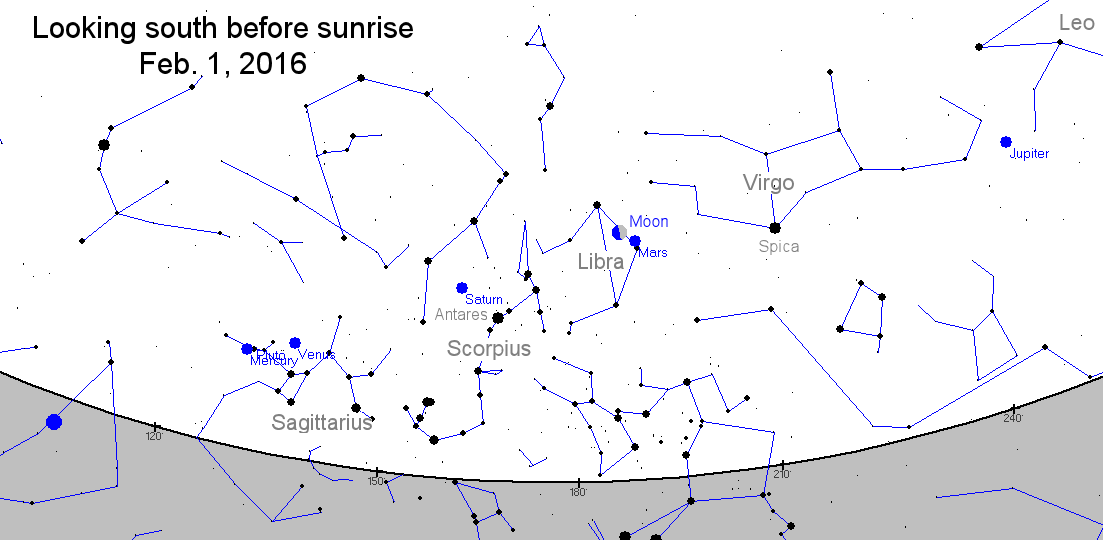


Circle these dates on your calendar--and set your alarm for dawn. The Great Naked-eye Planet Show is a great way to start the day.
Realtime Spaceweather Photo Gallery
SOLAR ECLIPSE BALLOON NETWORK: Spaceweather.com and the students of Earth to Sky Calculus have developed a balloon payload that can photograph solar eclipses from the stratosphere. This sets the stage for a one-of-a-kind photography experiment: On August 21, 2017, the Moon will pass in front of the sun over the USA, producing a total eclipse visible from coast to coast. We will launch balloons to record the event from a dozen points along the path of totality:

Floating more than 100,000 feet above the clouds, the balloons will have an unobstructed view of the eclipse. From each of a dozen payloads, one camera will point up to record the sun's ghostly corona while another camera points down to record the passage of the Moon's dark shadow across the landscape below. When the eclipse is finished, we will combine the footage to create a unique video portrait of an eclipse sweeping across the American continent.
The payload has already photographed a partial solar eclipse in Oct. 2014: images. To test the payload under conditions of totality, a team of students and parents from Earth to Sky Calculus will travel to Indonesia six weeks from now to observe the March 9, 2016, total eclipse: animated map. Stay tuned for news from their expedition!
Readers, would you like to join the Solar Eclipse Balloon Network? Starting now we are recruiting teams of citizen scientists who we will train in the art of high-altitude ballooning to become members of the solar eclipse launch crews. Schools, scout troops, home school families and others are welcome to apply. This is a great way for novices to learn ballooning and to participate in authentic science. We will also be seeking sponsors for the 12 payloads. Contact Dr. Tony Phillips to register your interest.