MOON-HOPPING: Five planets are lined up in the morning sky, and the Moon is hopping from one to the next. On Monday morning, Feb. 1st, the Moon visits Mars. Wake up an hour before dawn and look east for a loose lunar conjunction with the Red Planet: sky map.

This weekend, Rob Ratkowski woke up early and caught the Moon hopping from Jupiter to Mars. He sends this picture from the Haleakala Summit of Maui in the Hawaiian island chain:
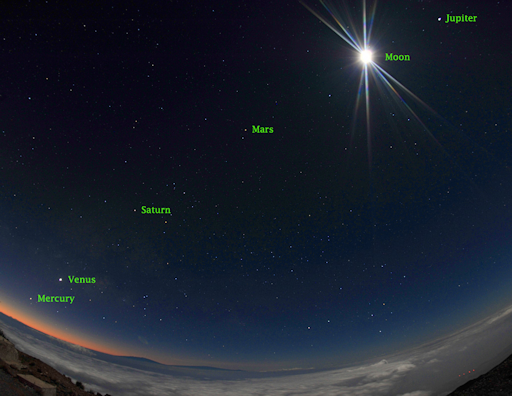
"The line up was quite nice and, along with mild temperatures and winds, the brightening sky showed Mauna Kea and Mauna Loa on the Big Island in silhouette," says Ratkowski.
To take the picture, Ratkowski used a Nikon D700 digital camera with a 16mm Fisheye lens set at iso800 (f5.6) for a 15 second exposure. Other photographers may wish to take note of those settings, because the photo-ops are just beginning.
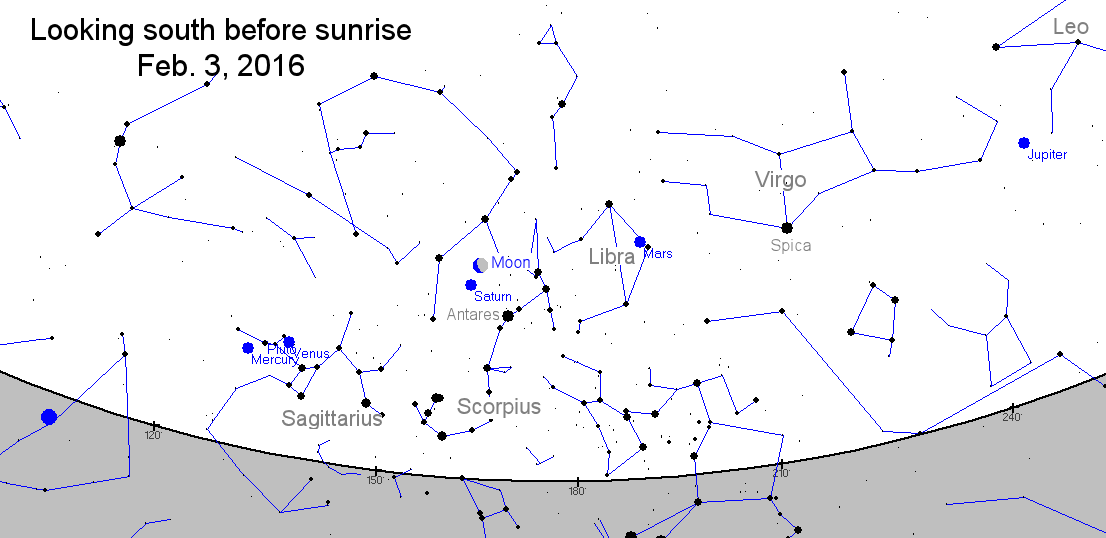
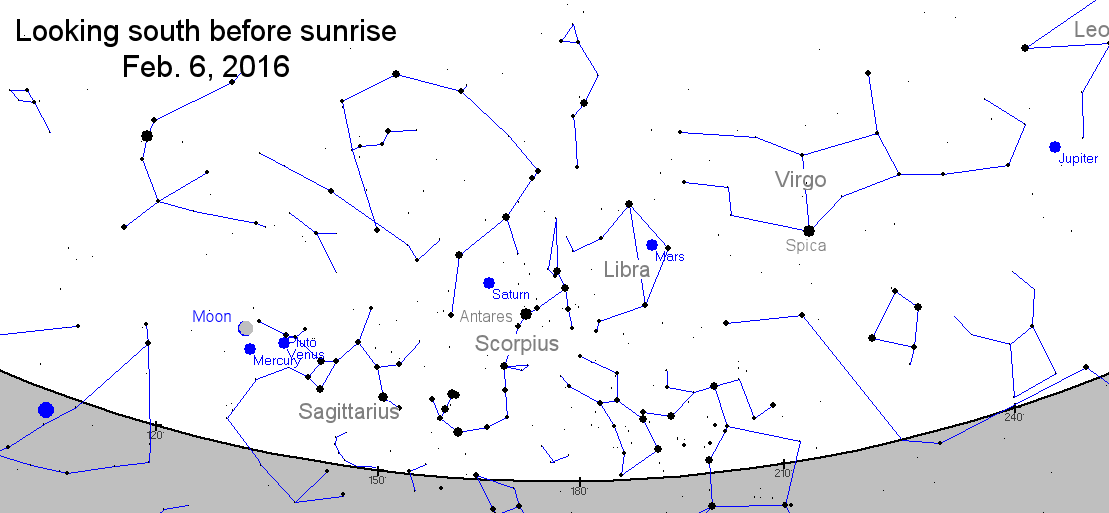
On Feb. 1st the half Moon is only a few degrees from Mars in the constellation Libra: sky map. Two mornings later, on Feb. 3rd, a fat crescent Moon passes by Saturn, only a few degrees away: sky map. And finally, best of all, on Feb. 6th, the slender crescent Moon forms a lovely triangle with Venus and Mercury: sky map. Circle these dates on your calendar--and set your alarm for dawn. The Great Naked-eye Planet Show is a great way to start the day.
Realtime Spaceweather Photo Gallery
ENORMOUS PROMINENCE, POISED TO ERUPT: Around the world, astronomers are monitoring a prominence of jaw-dropping proportions hovering over the sun's southeastern limb. It is located in the lower left corner of this picture, taken by Jim Fakatselis of Huntington, NY:
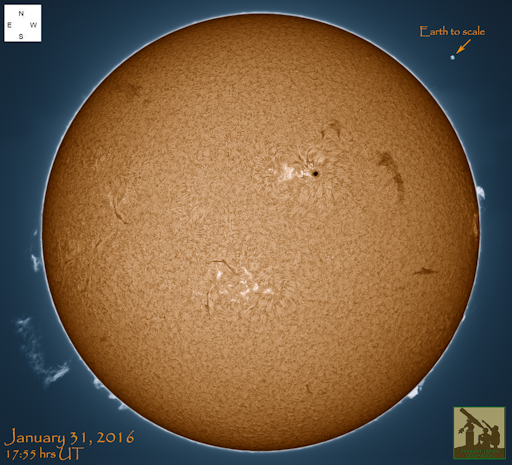
Earth, inserted for comparison in the upper right, is a veritable speck!
"I was really floored by the massive size of the prominence," says Larry Alvarez of Flower Mound, TX, who also photographed the structure. "It looked like a giant smoke stack billowing out solar material."
Fakatselis made a two hour video,which captures the smokey motions of plasma trapped inside the prominence's magnetic walls: play it.

Prominences like this one are highly unstable. Astronomers with backyard solar telescopes should train their optics on the sun's southeastern limb. An eruption may be imminent. Solar flare alerts: text or voice
Realtime Spaceweather Photo Gallery
POLAR STRATOSPHERIC CLOUDS OVER THE UK: An outbreak of polar stratospheric clouds (PSCs) is underway--but not around the poles. Sky watchers are reporting the beautifully-colored clouds over the UK. David Porter photographed this specimen on Jan. 29th from his home in Turriff, Aberdeenshire:
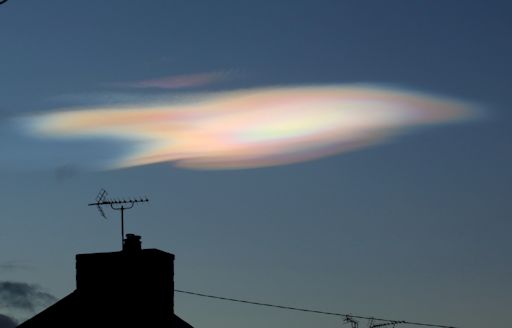
"I saw it just before sunrise," says Porter. "The cloud was colorful and highly reflective." Rob Powell of Stonehaven, Scotland, saw them, too. "It was a lovely sunrise," he says.
Also known as "nacreous" or "mother of pearl" clouds, icy PSCs form in the lower stratosphere when temperatures drop to around minus 85ºC. High-altitude sunlight shining through tiny ice particles ~10µm wide produce bright iridescent colors by diffraction and interference. Once thought to be mere curiosities, some PSCs are now known to be associated with the destruction of ozone.
"Nacreous clouds far outshine and have much more vivid colours than ordinary iridescent clouds, which are very much poor relations and seen frequently all over the world," writes atmospheric optics expert Les Cowley. "Once seen they are never forgotten."