QUIET SUN: With no sunspots actively flaring, the sun's X-ray output has flatlined. The quiet is likely to continue for at least the next 24 hours. NOAA forecasters say there is no more than a 1% chance of strong flares on Feb.1st. Solar flare alerts: text or voice
COLORFUL CLOUDS IN THE STRATOSPHERE: The stratosphere of our planet is not a cloudy place. More than 80,000 feet above Earth's surface, the thin air tends to be very clear. Nevertheless, sometimes clouds do form in the stratosphere, and when they do, they are fantastically colorful. Øistein Hansen saw these polar stratospheric clouds (PSCs) on Jan. 31st over Eidsvoll, Akershus, Norway:
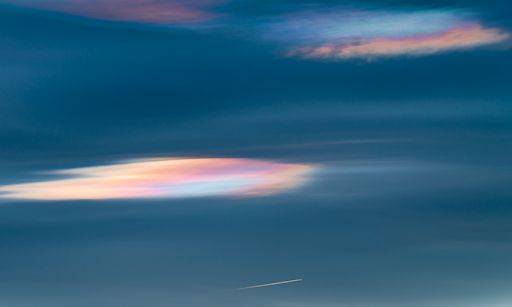
Also known as "nacreous" or "mother of pearl" clouds, icy PSCs form in the lower stratosphere when temperatures drop to around minus 85ºC. High-altitude sunlight shining through tiny ice particles ~10µm wide produce bright iridescent colors by diffraction and interference.
"Nacreous clouds far outshine and have much more vivid colours than ordinary iridescent clouds, which are very much poor relations and seen frequently all over the world," says atmospheric optics expert Les Cowley. "Once seen they are never forgotten."
These clouds are rare, yet they have been frequently sighted in the past few days. A "stratospheric cloud event" is underway with reports of the colorful puffs coming from places as far south as the UK. High-latitude sky watchers should be alert for PSCs. The best time to see them is just before sunrise or after sunset.
Realtime Stratospheric Cloud Photo Gallery
UNEXPECTED AURORAS SHINE THROUGH CLOUDS: Solar activity is very low. Nevertheless, sky watchers around the Arctic Circle are reporting Northern Lights. "I just saw the brightest and fastest-moving aurora I've seen in the past 4 years," says Oliver Wright of Abisko, Sweden. The auroras were so intense, they could be seen through heavy clouds:
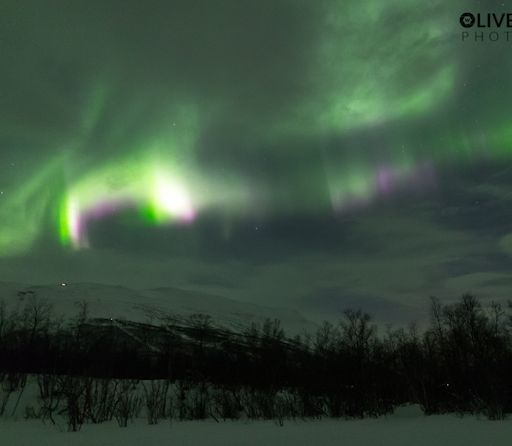
"With solar activity so low, what triggered this amazing display?" asks Wright.
Answer: The interplanetary magnetic field (IMF) near Earth has tipped south, opening a crack in Earth's magnetosphere. Solar wind is pouring in to fuel the display. Arctic sky watchers should remain alert for more auroras on Feb. 1st. Aurora alerts: text or voice
Realtime Spaceweather Photo Gallery