ANOTHER DAY OF LOW SOLAR ACTIVITY: With no sunspots actively flaring, the sun's X-ray output has flatlined. The quiet is likely to continue for at least the next 24 hours. NOAA forecasters say there is no more than a 1% chance of strong flares on Feb. 2nd. Solar flare alerts: text or voice

COLORFUL CLOUDS IN THE STRATOSPHERE: Clouds in the stratosphere are very rare. Yet for the past week they have been seen every day. "Yesterday, Feb 1st, about 30 minutes after sunset, I just happened to look out of the window and there they were!" says Andrew Greenwood of Marshchapel, UK. "I grabbed my camera and started taken photos of these beautiful stratospheric clouds."

These fantasticaly-colored clouds are floating more than 80,000 feet above Earth's surface. Normally, the thin air up there is crystal clear. Not this week. Water molecules are crystalizing in the lower stratosphere and the resulting ice crystals are assembling into polar stratospheric clouds (PSCs).
Also known as "nacreous" clouds, PSCs form in the lower stratosphere when temperatures drop to a staggeringly-cold -85ºC. High-altitude sunlight shining through tiny ice particles ~10µm wide produce bright iridescent colors by diffraction and interference.
Because these clouds require extreme cold, they are most often seen around the Arctic Circle. In recent days, however, they have been spotted as far south as the UK. Indeed, a "stratospheric cloud event" appears to be underway. Monitor the gallery for more sightings:
Realtime Stratospheric Cloud Photo Gallery
SET YOUR ALARM FOR DAWN: The Great Naked-Eye Planet Show of 2016 is reaching its peak. For the next week, the five brightest planets in the solar system can be seen, all at once, in a great line stretched across the pre-dawn sky. Denis Crute photographed the quintet on Feb. 2nd just before daybreak at Woolgoolga, Australia:
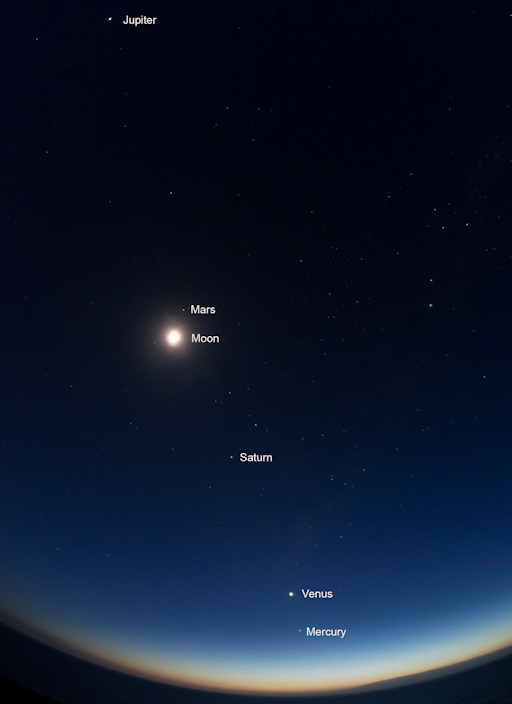
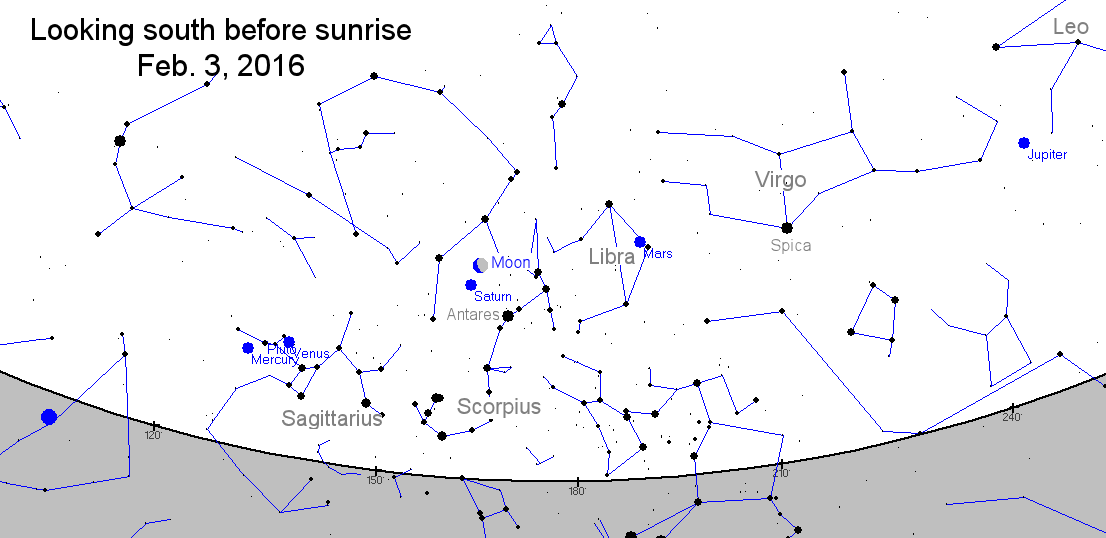
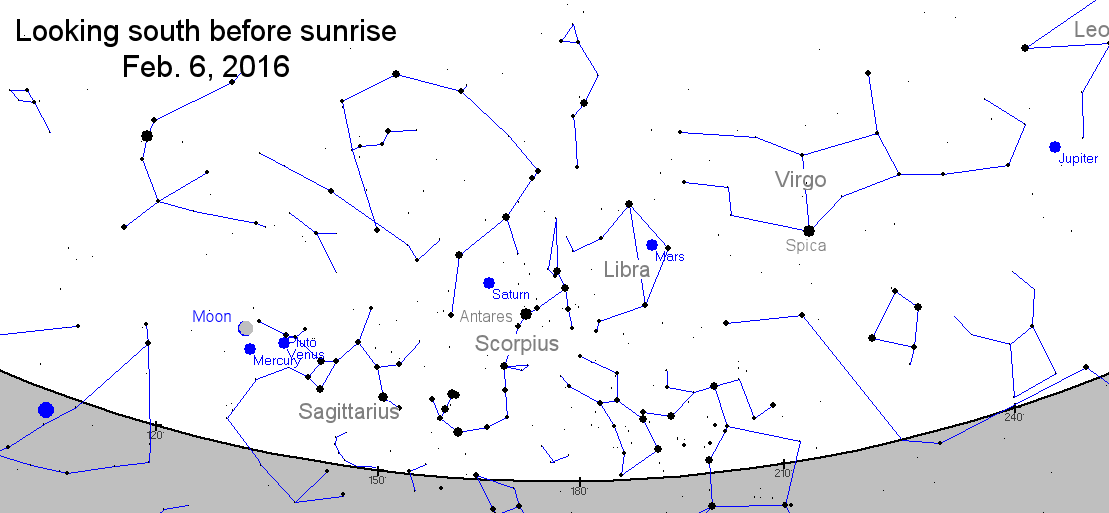
Crute took the picture using a Nikon D5200 digital camera set to ISO 3200 (f3.5) for a 2 sec exposure. Other photographers may wish to note those settings, because there are some excellent photo-ops in the mornings ahead. On Feb. 3rd, the Moon will pass by Saturn in the constellation Scorpius: sky map. On Feb. 6th and 7th, the slender crescent Moon will form a lovely shape-shifting triangle with Venus and Mercury: sky map.
Set your alarm for dawn. There's a lot to see.
Realtime Spaceweather Photo Gallery