ASTEROID TO BUZZ EARTH: A small asteroid named "2013 TX68" will fly by Earth on March 5th, and NASA says it could come as close as 17,000 km to our planet's surface. That would put it well inside the Clarke Belt of geosynchronous satellites. The space rock is about 30 meters wide, or 50% larger than the asteroid that broke up in the atmosphere over Chelyabinsk, Russia, three years ago. If an asteroid the size of 2013 TX68 were to enter Earth's atmosphere, it would likely produce an air burst with twice the energy of the Chelyabinsk event. Get the full story from NASA.
OZONE HOLE FORMS OVER THE UK: For the past week, sky watchers in the UK have witnessed a rare apparition of polar stratospheric clouds (PSCs). Normally restricted to the Arctic Circle, the fantastically colorful clouds have appeared over the British Isles almost every day since Jan. 31st. Colin Fraser photographed the display over Edinburgh, Scotland, on Feb. 2nd:

PSCs form in the lower stratosphere when temperatures drop to a staggeringly-cold -85ºC. High-altitude sunlight shining through tiny ice particles ~10µm wide produce bright iridescent colors by diffraction and interference.
But there is more to PSCs than ice. Some polar stratospheric clouds contain very small droplets of naturally occurring nitric and sulphuric acids. These droplets destroy ozone. Indeed, atmospheric optics expert Les Cowley points out that a temporary ozone hole has formed over Ireland and the UK. It is the blue patch in this Feb. 1st ozone map from NASA's Arctic Ozone Watch:

"The acid droplets destroy the stratospheric ozone layer that protects us from harmful solar ultra-violet rays," says Cowley. "They catalyse unreactive forms of man-made chlorine into active free radicals (for example ClO, chlorine monoxide). The radicals destroy many ozone molecules in a series of chain reactions.."
This outbreak of PSCs is truly unusual. "Prior to this outbreak I have seen PSCs over the UK only twice in the last 20 years!" says Cowley. "This episode is exceptional at such low latitudes. If it goes on any longer my camera will be worn out."
UPDATE: On Feb. 5th, the outbreak of PSCs has subsided, and so has the UK ozone hole. Click here for updates.
Realtime Stratospheric Cloud Photo Gallery
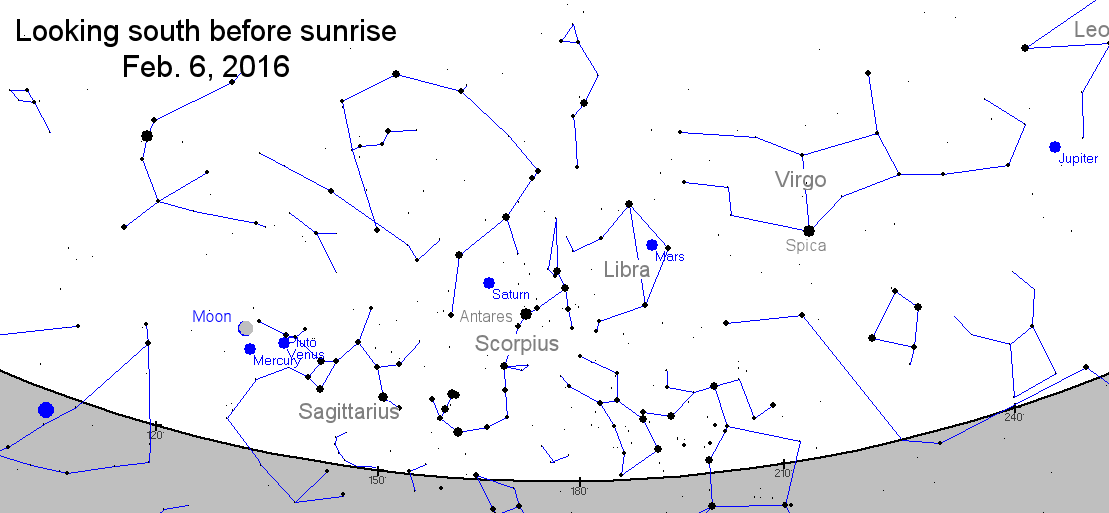
MORNING PLANETS: Something special is about to happen in the morning sky. On Feb. 6th and 7th, the crescent Moon will join Mercury and Venus, forming a bright triangle in the rosy glow of dawn. This morning, Tom J. Martinez of Pueblo West, Colorado, photographed the Moon en route to the convergence:

"I created a nine-panel panorama which shows all five planets now visible in the morning sky: Mercury, Venus, Saturn, Mars and Jupiter," says Martinez. "It was a beautiful view."
And the view is about to improve. Set your alarm for dawn and look east into the sunrise. It's a great way to start the day. [sky map]
Realtime Spaceweather Photo Gallery