SOLAR SECTOR BOUNDARY CROSSING: NOAA forecasters estimate a 40% chance of polar geomagnetic storms on Feb 8th when Earth crosses through a fold in the heliospheric current sheet. This is called a "solar sector boundary crossing," and it could spark bright auroras around the Arctic Circle. Aurora alerts: text or voice
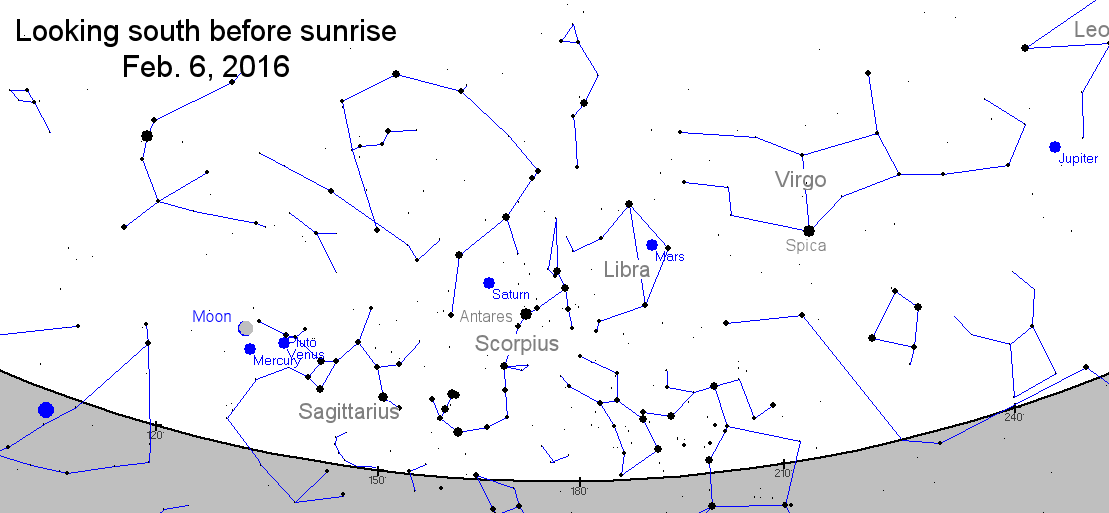
MORNING PLANETS: Waking up before sunrise can be hard to do. This weekend it has its rewards. Venus, Mercury and the slender crescent Moon have converged in the pre-dawn sky for a beautiful conjunction. Bill Metallinos photographed the gathering over Corfu, Greece, on Feb. 6th:

"Venus was almost directly above the old Fortress of Corfu, while little Mercury hovered over the urban lights of Igoumenitsa," says Metallinos. "Waking up to this was a pleasure indeed."
Set your alarm for about 1/2 hour before dawn, and look east for a beautiful view: sky map, photo gallery.
Realtime Spaceweather Photo Gallery
SEA LAUNCH OF A SPACE WEATHER BALLOON: For the first time, a space weather balloon has been launched from the deck of a moving boat. Led by Earth to Sky Calculus graduate Aaron Lamb, students at the California State University Maritime Academy did it on Feb. 3rd:

"It was a complicated launch, but we pulled it off," says Midshipman Lamb. "We sailed with the wind to nullify the effect of wind gusts on the balloon. This allowed us to release it in a controlled manner. A second boat followed us to photograph the launch and to provide any necessary rescues in case of 'men overboard.'"
This sea launch is good training for next year's Solar Eclipse Balloon Network: In Aug. 2017 there will be a total eclipse of the sun across the continental United States. Spaceweather.com and the students of Earth to Sky Calculus plan to launch a dozen balloons from the path of totality to record the eclipse from the stratosphere, creating a unique movie of the Moon's shadow sweeping across the American continent. To fully capture the eclipse from coastal areas in Oregon and South Carolina, a sea launch may be necessary.
"We are also working on a sea landing," adds Lamb. "That is, we plan to build a payload that can land in water and float after returning from the stratosphere."
The flexibility to launch and/or land in water could open new doors for experiments in space weather ballooning. Congratulations to the students of Earth to Sky Maritime for their innovative work!