EARTH-DIRECTED FLARE: Sunspot AR2497 erupted on Feb. 11th (2103 UT), producing a C9-class solar flare and, very likely, an Earth-directed coronal mass ejection (CME). Extreme UV radiation from the flare ionized the top of Earth's atmosphere. That caused a minor shortwave radio blackout over the Pacific Ocean: map. Stay tuned for updates about the CME. Solar flare alerts: text or voice

LOW SOLAR ACTIVITY, BRIGHT NORTHERN LIGHTS: Solar activity was low on Feb. 10th. Nevertheless, an outburst of auroras appeared over Tromso, Norway. Michael Zawadzki photographed the explosion of green from the aurora-shadow of the EISCAT radar:

The EISCAT radar pings the upper atmosphere, looking for disturbances related to geomagnetic activity. The antenna must have been getting good data when Zawadzki took this picture.
More auroras are in the offing. On Feb. 12th, a CIR is expected to hit Earth. CIRs, or "co-rotating interaction regions," are transition zones between fast and slow-moving solar wind streams. Solar wind plasma piles up in these regions, producing density gradients and shock waves that do a good job of sparking auroras. NOAA forecasters say there is a 35% chance of polar geomagnetic storms when the CIR arrives. Aurora alerts: text or voice
SPY SATELLITE, LAUNCHED AND SPOTTED: On Feb. 10th, just a few hours before sunrise in California, a Delta 4 rocket blasted off from the Vandenberg AFB carrying a spy satellite for the US National Reconnaissance Office. "It was thrilling to see the launch from the Marin Headlands near San Francisco," reports Kenneth Sperber. "The engine plume outshone the stars, disappearing after about 3 minutes." He stacked a series of 10 second exposures to create this launch tableau:
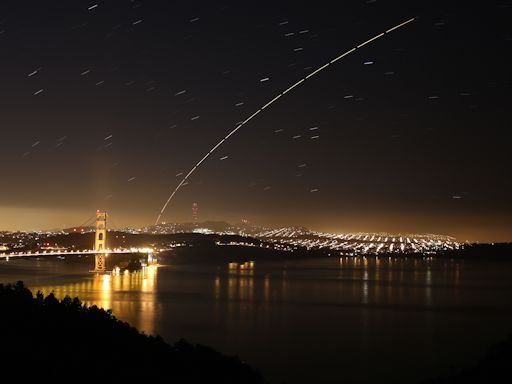
The rocket's payload (officially designated NROL-45) is believed to be a Topaz radar-imaging satellite. It is a successor to the line of Lacrosse spy satellites, which use synthetic aperture radar (SAR) to map the Earth with a resolution comparable to optical cameras. Unlike optical cameras, however, synthetic aperture radar can penetrate clouds--a big advantage for a spysat.
Approximately, 18 hours after it was launched, NROL-45 was spotted racing among the stars over Leiden, the Netherlands:
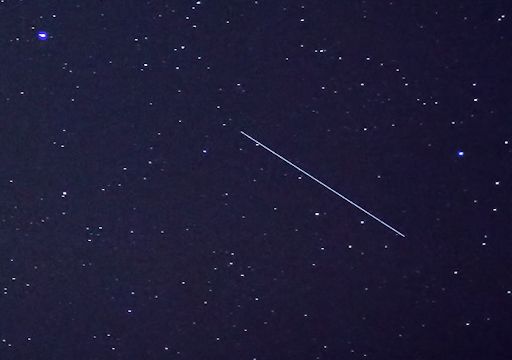
"I could not see it with the naked eye (it was too faint even though the sky was very clear)," says photographer Marco Langbroek. "In a few days from now, after the SAR antenna has been unfolded, it will become brighter and visible with the naked eye on a good night."
Langbroek is one of a network of international observers who have sighted NROL-45. Combining their data, they will be able to calculate the satellite's orbit and keep track of it as it circles our planet. (So much for stealth.) More information about this may be found on Langbroek's web site.
Realtime Spaceweather Photo Gallery
SOUTHERN NOCTILUCENT CLOUDS: The 2015-2016 season for noctilucent clouds (NLCs) over the southern hemisphere may soon be coming to a close. NASA's AIM spacecraft is monitoring the clouds, and their electric-blue glow appears to be fading. This plot shows the frequency of occurrence of NLCs over Antarctica for the past nine winters; the current season is color-coded red:

"In past years of CIPS data, the southern hemisphere seasons have ended sometime between 18 February and 23 February," says Cora Randall, a member of the AIM science team from the University of Colorado's Laboratory for Atmospheric and Space Physics. "This means the end of the current season is probably near."
NLCs are Earth's highest clouds. Seeded by meteoroids, they float at the edge of space more than 80 km above the planet's surface. The clouds are very cold and filled with tiny ice crystals. When sunbeams hit those crystals, they glow electric-blue: photo gallery.
Previous research shows that NLCs are a sensitive indicator of long-range teleconnections in Earth's atmosphere, which link weather and climate across hemispheres. The seasonal behavior of noctilucent clouds, and how it changes from year to year, could reveal new linkages, previously unknown.
When will the last wisps of electric blue vanish? You can monitor the action right here on Spaceweather.com.

Realtime Noctilucent Cloud Photo Gallery