AURORAS FOR VALENTINE'S DAY? NOAA forecasters estimate a 50% chance of G1-class geomagnetic storms on Valentine's Day. This in in response to a CME, expected to strike Earth's magnetic field during the late hours of Feb. 14th. Sunday could bring a romantic evening to the Arctic Circle.

Last night, Feb. 13th, a rosy display of auroras appeared over Thule, Greenland:

"We were out exploring some old buildings and got surprised by some nice pink auroras," says photographer Shane Martin. "These were different as they were north and directly overhead. Thule's lights are usually south of our base."
More pink lights could be in the offing on Feb. 14th as the CME approaches. High latitude sky watchers should remain alert for auroras. Aurora alerts: text or voice
ACTIVE SUNSPOT: Today, Feb. 13th, on the Isle of Anglesey in Wales, Mark Townley bent over the eyepiece of his backyard solar telescope, then stood up in surprise. "I couldn't believe my eyes," he says. "Sunspot AR2497 was shining brightly as an M1.8 solar flare was taking place. It looked fantastic!" He captured the event in this picture:

Actually, catching this sunspot in mid-flare is not as surprising as one might suspect. AR2397 is crackling with explosions in its unstable magnetic canopy. Pulses of UV radiation from the site are causing minor shortwave radio blackouts, and it has already hurled one CME toward Earth (due to arrive on Feb. 15th).
NOAA forecasters estimate a 35% chance of additional M-class flares in the next 24 hours, so monitoring is encouraged. Solar flare alerts: text or voice
Realtime Spaceweather Photo Gallery
SPY SATELLITE, LAUNCHED AND SPOTTED: On Feb. 10th, just a few hours before sunrise in California, a Delta 4 rocket blasted off from the Vandenberg AFB carrying a spy satellite for the US National Reconnaissance Office. "It was thrilling to see the launch from the Marin Headlands near San Francisco," reports Kenneth Sperber. "The engine plume outshone the stars, disappearing after about 3 minutes." He stacked a series of 10 second exposures to create this launch tableau:
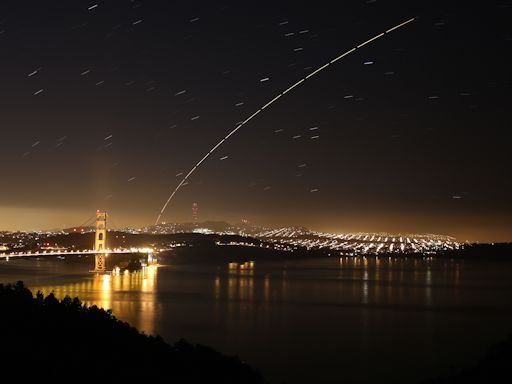
The rocket's payload (officially designated NROL-45) is believed to be a Topaz radar-imaging satellite. It is a successor to the line of Lacrosse spy satellites, which use synthetic aperture radar (SAR) to map the Earth with a resolution comparable to optical cameras. Unlike optical cameras, however, synthetic aperture radar can penetrate clouds--a big advantage for a spysat.
Approximately, 18 hours after it was launched, NROL-45 was spotted racing among the stars over Leiden, the Netherlands:
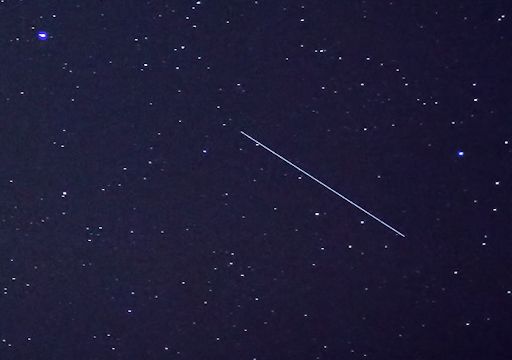
"I could not see it with the naked eye (it was too faint even though the sky was very clear)," says photographer Marco Langbroek. "In a few days from now, after the SAR antenna has been unfolded, it will become brighter and visible with the naked eye on a good night."
Langbroek is one of a network of international observers who have sighted NROL-45. Combining their data, they will be able to calculate the satellite's orbit and keep track of it as it circles our planet. (So much for stealth.) More information about this may be found on Langbroek's web site.
Realtime Spaceweather Photo Gallery