VERY QUIET SUN: Today, NOAA forecasters say there is a scant 5% chance of M-class solar flares. That might be an overestimate. There are only two small spots on the sun, and neither has the type of unstable magnetic field harbors energy for strong explosions. The sun is likely to remain quiet on Feb. 24th. Solar flare alerts: text or voice
AURORA SURPRISE: There was no geomagnetic storm last night, but sometimes geomagnetic storms are not required for bright auroras. "On Feb. 23rd we witnessed a mind-glowingly beautiful display," reports aurora tour guide Sarah Skinner of Abisko, Sweden. "At first the auroras were faint. Gradually they increased in intensity until--BOOM!--the sky was filled was rapidly dancing lights."
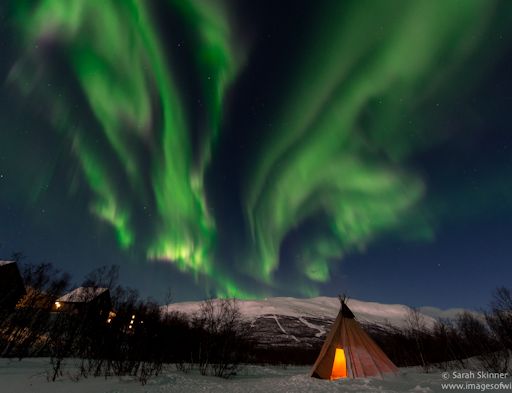
"The shapes and colours were amazing," continues Skinner. "Guests literally screamed with excitement, as did I!"
The cause of the outburst was not a CME or other solar storm. Instead, the interplanetary magnetic field (IMF) near Earth tilted south. This gentle event opened a crack in Earth's magnetosphere. Solar wind poured in to fuel the display.
More auroras are in the offing. A solar wind stream is expected to hit Earth's magnetic field on Feb. 24th or 25th. The impact could spark a G1-class geomagnetic storm around the Arctic Circle and--BOOM!--another display. Stay tuned. Aurora alerts: text or voice

CATS IN SPACE: On Feb. 16th, Spaceweather.com and the students of Earth to Sky Calculus launched a space weather balloon to monitor cosmic rays in Earth's atmosphere. A pair of cats went along for the ride:
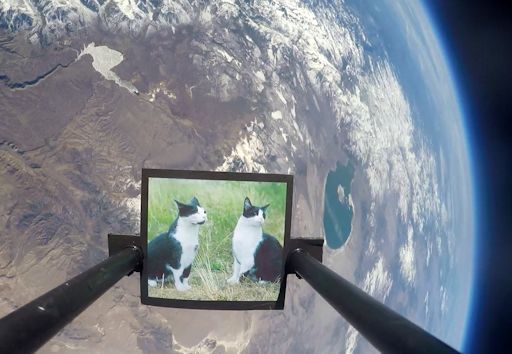
"They belong to me," says reader Matt Comerford, who sponsored the flight. "It was great to see them 107,000 feet above Earth!"
The payload landed in a remote canyon on the east side of California's rugged White Mountains. A recovery team had to hike 19 miles to find the radiation sensors. Students are reducing the data now, and it looks like cosmic rays are still intensifying. Stay tuned for updates from the flight.
Realtime Spaceweather Photo Gallery
SNOW MOON HALO: According to folklore, Monday night's full Moon was the "Snow Moon," named after the heavy snows of February. "There was no snow falling in Stockholm," reports photographer Peter Rosén, "but a magnificent halo formed in the drifting clouds." Click on the Moon to set the scene in motion:
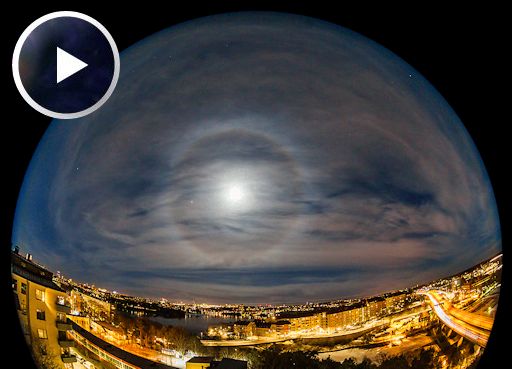
Maybe there was no snow, but the spectacle Rosén photographed was caused by a close relative of snowflakes--that is, ice crystals floating in high freezing clouds. Pencil-shaped ice crystals catch the moonlight and bend it into a 22o ring, as shown above. When you see such a halo, be alert for moondogs and moon pillars, too. They are formed by plate-shaped ice crystals that often accompany their pencil-shaped cousins.
Many ice halos surrounded last night's Snow Moon. Browse the photo gallery for more sightings:
Realtime Spaceweather Photo Gallery