ALMOST NO CHANCE OF FLARES: Solar activity remains very low. There are only a few small sunspots on the solar disk, and none of them has an unstable magnetic field that harbors energy for strong explosions. NOAA forecasters say there is no more than a 1% chance of M- or X-class flares on Feb. 25th. Solar flare alerts: text or voice
SOLAR ECLIPSE TODAY: This morning, Feb. 25th, the sun blacked out during an hour-long solar eclipse. You had to be in space to see it. Orbiting high above Earth, NASA's Solar Dynamics Observatory caught the sun in mid-eclipse:

The black shape in front of the sun is Earth itself. Twice every year, around the time of the equinoxes, Earth can pass directly between the Sun and NASA's Solar Dynamics Observatory (SDO). This produces a series of beautiful eclipses, underway now.
For the next three weeks these eclipses will repeat once a day around 07:00 UT, briefly hiding events on the sun from the usually uninterrupted gaze of SDO. Eclipse season ends in late March. Between now and then, stay tuned for some rare blackouts.
Realtime Spaceweather Photo Gallery
PYRAMIDS OVER CALIFORNIA: People who pay attention to the daytime sky often notice a luminous ring surrounding the sun. It's called an ice halo, caused by sunlight shining through ice crystals in wispy cirrus clouds. On Feb. 23rd, San Francisco photographer Mila Zinkova looked up and saw not one, but "four wondrous circles around the sun." She quickly moved into the shadow of a totem pole and snapped this picture:

About 100 miles away in Ballico, California, Richard Sears witnessed a similar display. "I've been photographing sun halos here in California for years. I must say, this is the first," says Sears. "I wonder what is going on here?"
The answer: The air was filled with tiny pyramids of ice.
Atmospheric optics expert Les Cowley explains: "These are magnificent and rare displays of pyramidal crystal halos. Ordinary halos are made by six-sided column- or plate-shaped crystals in high and cold cirrus clouds. Over California their ends were capped with pyramids. The pyramids always have fixed angles set by planes of atoms in the ice. Light passing through them form 'odd radius halos' 9, 18, 20, 23, 24 and 35 degrees from the sun. On Mila's image I can see a bright 9 degree ring, an 18 degree one and then a clump of twenty-something radius halos."
Realtime Spaceweather Photo Gallery
CATS IN SPACE: On Feb. 16th, Spaceweather.com and the students of Earth to Sky Calculus launched a space weather balloon to monitor cosmic rays in Earth's atmosphere. A pair of cats went along for the ride:
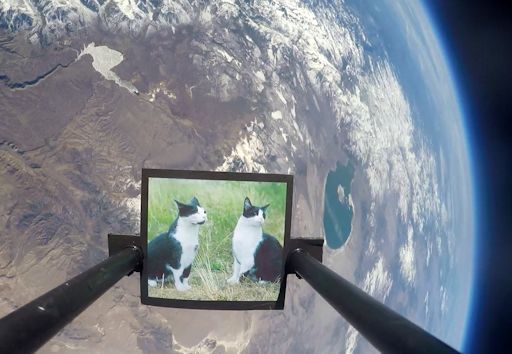
"They belong to me," says reader Matt Comerford, who sponsored the flight. "It was great to see them 107,000 feet above Earth!"
The payload landed in a remote canyon on the east side of California's rugged White Mountains. A recovery team had to hike 19 miles to find the radiation sensors. Students are reducing the data now, and it looks like cosmic rays are still intensifying. Stay tuned for updates from the flight.
Realtime Spaceweather Photo Gallery