VERY QUIET SUN: Solar activity remains very low. Only a few small sunspots are visible on the solar disk, and none of them has the type of unstable magnetic field that harbors energy for strong explosions. NOAA forecasters say there is no more than a 1% chance of M- or X-class flares on Feb. 26th. Solar flare alerts: text or voice
COSMIC RAYS CONTINUE TO INTENSIFY: Researchers have long known that solar activity and cosmic rays have a yin-yang relationship. As solar activity declines, cosmic rays intensify. Lately, solar activity has been very low indeed. Are cosmic rays responding? The answer is "yes." Spaceweather.com and the students of Earth to Sky Calculus have been using helium balloons to monitor cosmic rays in the stratosphere. Their latest flight on Feb. 16th measured the highest values yet:
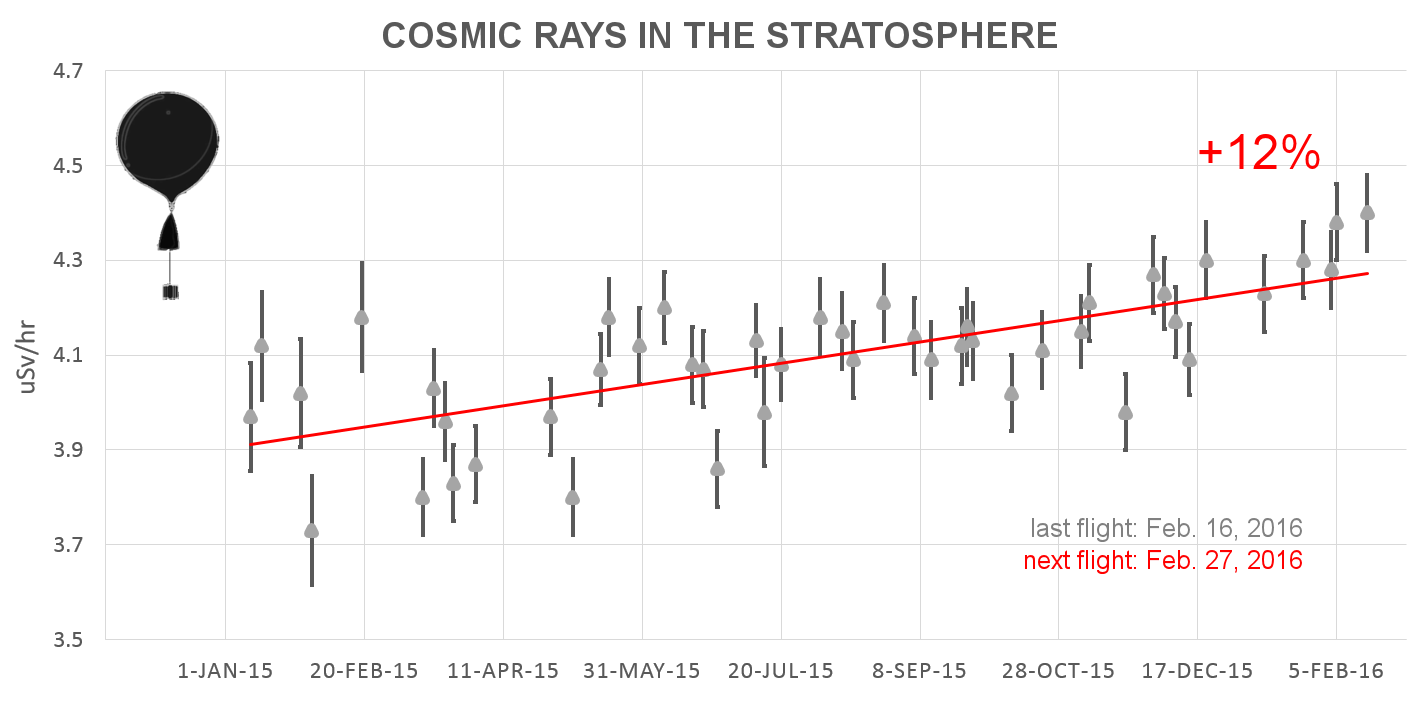
The data show that cosmic rays in the mid-latitude stratosphere now are approximately 12% stronger than they were one year ago.
Cosmic rays, which are accelerated toward Earth by distant supernova explosions and other violent events, are an important form of space weather. They can seed clouds, trigger lightning, and penetrate commercial airplanes. Furthermore, there are studies linking cosmic rays with cardiac arrhythmias and sudden cardiac death in the general population. Among patients who have an implanted cardioverter - defibrillator (ICD), the aggregate number of life-saving shocks appears to be correlated with the number of cosmic rays reaching the ground. References: #1, #2, #3, #4.
Why do cosmic rays increase when solar activity is low? Consider the following: To reach Earth, cosmic rays have to penetrate the inner solar system. Solar storms make this more difficult. CMEs and gusts of solar wind tend to sweep aside cosmic rays, lowering the intensity of radiation around our planet. On the other hand, when solar storms subside, cosmic rays encounter less resistance; reaching Earth is a piece of cake.
Forecasters expect solar activity to drop sharply in the years ahead as the 11-year solar cycle swings toward another deep minimum. Cosmic rays are poised to increase accordingly. Our next balloon flight is scheduled for Feb. 27th. Stay tuned for updates.
Bonus: Balloon flights to the stratosphere produce not only scientific data, but also beautiful imagery. A camera onboard the Feb. 16th payload took this picture from an altitude of 107,500 ft:

The photo frames two lakes in California's eastern Sierra mountain range. Take a closer look. Crowley Lake, on the left, is crusted with large rafts of cracked ice. Mono Lake, on the right, is liquid blue. What's the difference? Mono Lake is one of the saltiest lakes in the western USA, and that lowers its freezing point, allowing it to remain fluid even during the coldest months of winter. More high-altitude photos from our cosmic ray research may be found here.

Realtime Spaceweather Photo Gallery
PYRAMIDS OVER CALIFORNIA: People who pay attention to the daytime sky often notice a luminous ring surrounding the sun. It's called an ice halo, caused by sunlight shining through ice crystals in wispy cirrus clouds. On Feb. 23rd, San Francisco photographer Mila Zinkova looked up and saw not one, but "four wondrous circles around the sun." She quickly moved into the shadow of a totem pole and snapped this picture:

About 100 miles away in Ballico, California, Richard Sears witnessed a similar display. "I've been photographing sun halos here in California for years. I must say, this is the first," says Sears. "I wonder what is going on here?"
The answer: The air was filled with tiny pyramids of ice.
Atmospheric optics expert Les Cowley explains: "These are magnificent and rare displays of pyramidal crystal halos. Ordinary halos are made by six-sided column- or plate-shaped crystals in high and cold cirrus clouds. Over California their ends were capped with pyramids. The pyramids always have fixed angles set by planes of atoms in the ice. Light passing through them form 'odd radius halos' 9, 18, 20, 23, 24 and 35 degrees from the sun. On Mila's image I can see a bright 9 degree ring, an 18 degree one and then a clump of twenty-something radius halos."
Realtime Spaceweather Photo Gallery