CO-ROTATING INTERACTION REGION: NOAA forecasters estimate a 50% chance of polar geomagnetic storms on March 6th when a co-rotating interaction region (CIR) is expected to hit Earth's magnetic field. CIRs are transition zones between slow- and fast-moving solar wind streams. Solar wind plasma piles up in these regions, producing density gradients and shock waves that do a good job of sparking auroras. Aurora alerts: text or voice
ATMOSPHERIC RADIATION EXPERIMENT IN PROGRESS: Today, the students of Earth to Sky Calculus are flying from Los Angeles to Indonesia to observe the March 9th solar eclipse. Onboard, they are carrying a cosmic ray balloon payload with GPS tracking and 4 radiation sensors. This allows them to measure radiation inside the airplane. Scroll past their flight path to learn more about the experiment:

During the trip, the students will be crossing both the Arctic Circle and the equator in the same 24 hour period, allowing them to gather radiation data rapidly over a wide range of latitude. This will build upon their ongoing study of aviation radiation which, before now, has been limited to latitudes in the continental USA.
Radiation inside airplanes comes from deep space. Galactic cosmic rays are accelerated toward our planet by supernova explosions and other violent events in the cosmos. They penetrate the walls of aircraft with ease and have prompted the International Commission on Radiological Protection (ICRP) to classify pilots as occupational radiation workers. Today's experiment will probe how Earth's magnetic field at different latitudes protects pilots and passengers from aviation radiation. Stay tuned for results!
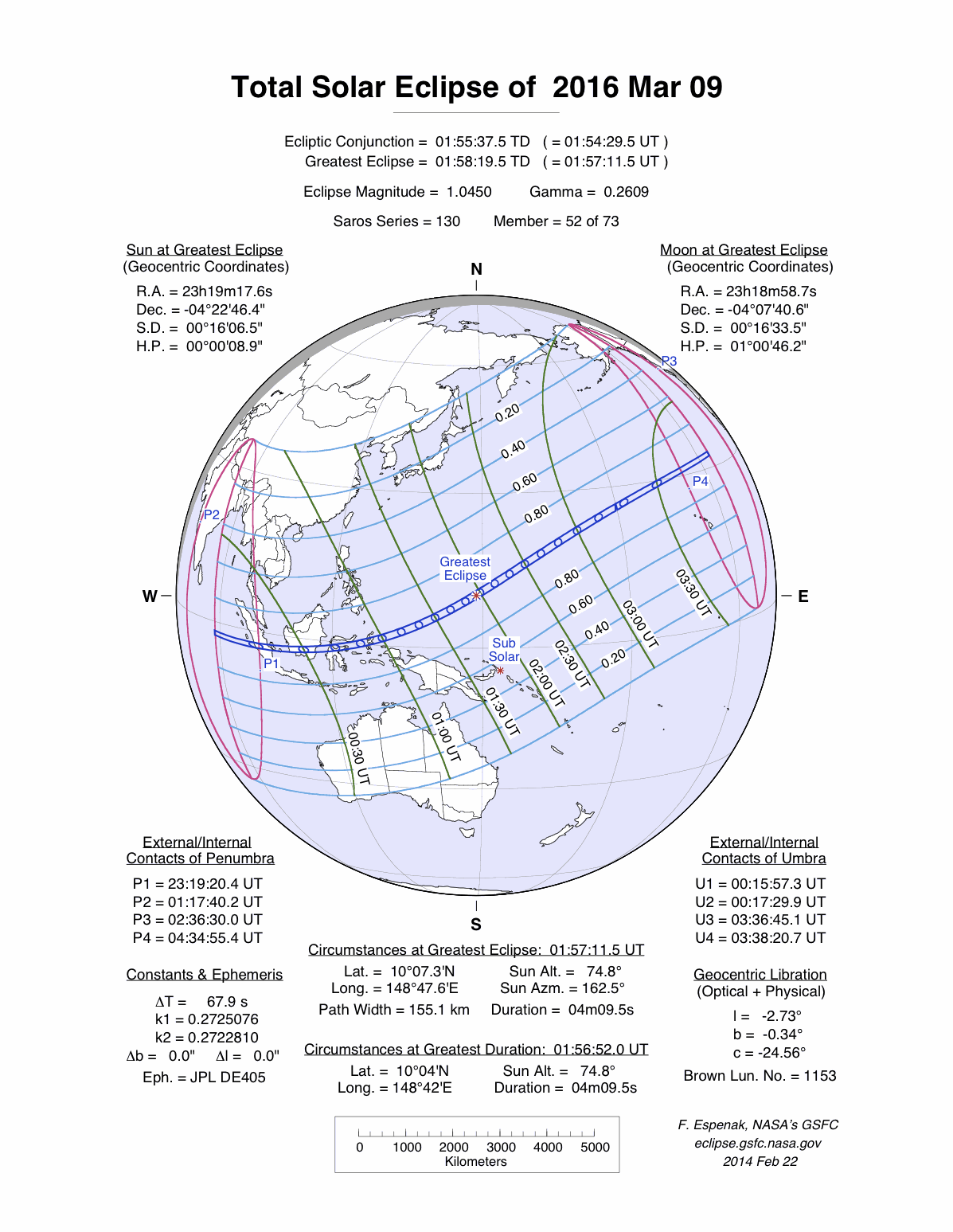
DON'T FORGET THE PARTIAL ECLIPSE: Mainstream media attention is focused on next week's total eclipse of the sun. On March 9th, sky watchers in a narrow strip that cuts across Indonesia and the Pacific Ocean can feel the Moon's cool shadow and witness the sun's ghostly corona--a transformative experience. Check out this animated eclipse map created by Larry Koehn of Shadow and Substance:
There more to the eclipse, however, than totality. While millions of people experience totality, a hundred times more will witness a fractional coverage of the sun with many delights of its own. And that's good, because a partial eclipse is total fun.
The first thing to remember about a partial eclipse is don't stare at it. Even the tiniest sliver of sun left uncovered by the Moon can hurt your eyes. Instead, look at the ground. Beneath a leafy tree, you might be surprised to find hundreds of crescent-shaped sunbeams dappling the grass. Overlapping leaves create a natural array of pinhole cameras, each one casting an image of the crescent-sun onto the ground beneath the canopy.

No trees? Try this trick: Criss-cross your fingers waffle-style and let the sun shine through the matrix of holes. You can cast crescent suns on sidewalks, driveways, friends, cats and dogs—you name it. Hand shadows are fun, too, like the crescent-eyed turkey shown above.
The partial eclipse zone covers almost half of the Earth, touching places as far apart as Alaska (20% coverage), Hawaii (65%), Australia (0% to 60%), China (0% to 40%), Japan (20%), and Papua New Guinea (70%). Because the partial eclipse lasts for more than an hour, there is plenty of time for shadow play and photography using safely-filtered telescopes and cameras. The view from Hawaii and Alaska, where the eclipse occurs near sunset, should be especially beautiful.
Realtime Spaceweather Photo Gallery
AURORA SPRING: What are the signs of Spring? They are as familiar as a blooming Daffodil, a songbird at dawn, a surprising shaft of warmth from the afternoon sun. And, oh yes, don't forget the aurora borealis. Spring is aurora season. For reasons not fully understood by scientists, the weeks around equinoxes tend to bring Northern Lights, like these photographed two nights ago by Alan Dyer of Churchill, Manitoba:


"After a week of very quiet and dim auroras, March 3rd brought a fine all-sky display at the Churchill Northern Studies Centre in northern Manitoba," says Dyer. "My photo shows the lights over the boreal forest on the edge of the Arctic tundra on the shore of Hudson Bay."
"The temperature was -25° C," he adds.
That doesn't sound like Spring, but in fact the northern vernal equinox is barely two weeks away (March 20, 2016). At this time of year even a gentle gust of solar wind can spark a bright display. Such a gust, and more, is in the offing. NOAA forecasters estimate a 50% chance of polar geomagnetic storms on March 6th when a negative-polarity solar wind stream arrives in the wake of a CIR (co-rotating interaction region). Aurora alerts: text or voice