CLOSE ENCOUNTER WITH JUPITER: On March 8th, Earth and Jupiter will have a close encounter. The giant planet will be "up all night," soaring almost overhead at midnight and not setting until the sky brightens with the twilight hues of sunrise on March 9th. Get the full story from Science@NASA.
GEOMAGNETIC STORM LIGHTS UP EUROPE AND THE USA: A stream of high-speed solar wind is buffeting Earth's magnetic field, and this is causing geomagnetic storms around the Arctic Circle. So far, Northern Lights have descended as far south as Germany in Europe and Massachusetts in the USA. Skies over much of England turned green, too. Sian Louise Gordon sends this picture from Saltburn-by-the-Sea:

"It was an absolutely amazing display here in the north of England," reports Gordon. "The entire northern skyline was lit up! You could clearly make out pillars by eye, which was amazing."
NOAA forecasters say there is a 50% chance of more geomagnetic storms on March 7th as Earth moves deeper into the solar wind stream. The magnetic polarity of the stream is negative--a condition which favors auroras. High-latitude sky watchers should be alert for Northern Lights. Aurora alerts: text or voice
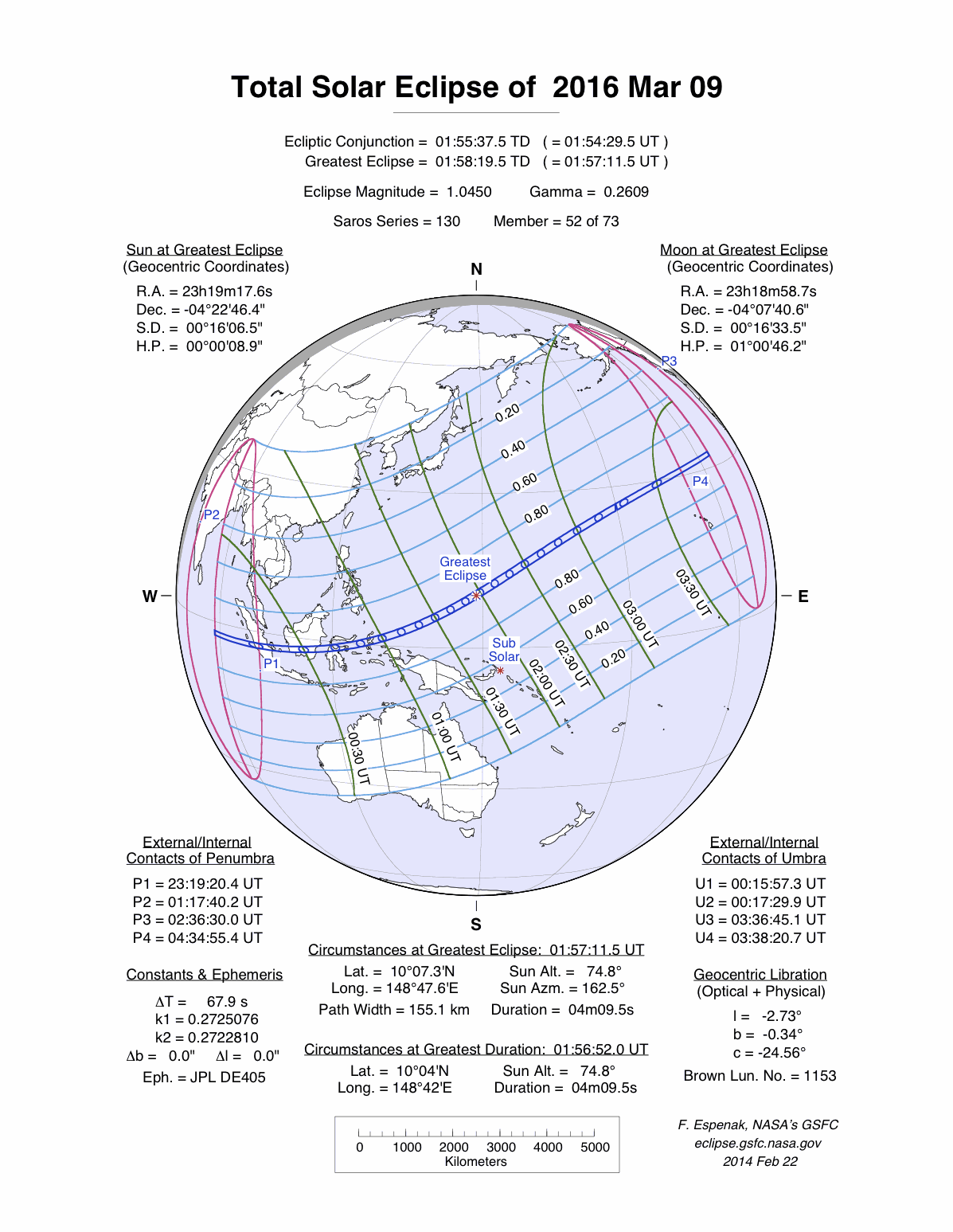
DON'T FORGET THE PARTIAL ECLIPSE: Mainstream media attention is focused on this week's total eclipse of the sun. Fair enough. The touch of the Moon's cool shadow and the sight of the sun's ghostly corona is a transformative experience. But don't forget the partial eclipse. As this animated map created by Larry Koehn of Shadow and Substance shows, the sun will be partially covered over almost half of the planet:
Unlike the path of totality, which is very narrow, the partial eclipse zone is huge. It touches places as far apart as Alaska (20% coverage), Hawaii (65%), Australia (0% to 60%), China (0% to 40%), Japan (20%), and Papua New Guinea (70%). This is good, because a partial eclipse is total fun.
The first thing to remember about a partial eclipse is don't stare at it. Even the tiniest sliver of sun left uncovered by the Moon can hurt your eyes. Instead, look at the ground. Beneath a leafy tree, you might be surprised to find hundreds of crescent-shaped sunbeams dappling the grass. Overlapping leaves create a natural array of pinhole cameras, each one casting an image of the crescent-sun onto the ground beneath the canopy.

No trees? Try this trick: Criss-cross your fingers waffle-style and let the sun shine through the matrix of holes. You can cast crescent suns on sidewalks, driveways, friends, cats and dogs—you name it. Hand shadows are fun, too, like the crescent-eyed turkey shown above.
Because the partial eclipse lasts for more than an hour, there is plenty of time for shadow play and photography using safely-filtered telescopes and cameras. The view from Hawaii and Alaska, where the eclipse occurs near sunset, should be especially beautiful.
Realtime Spaceweather Photo Gallery
ATMOSPHERIC RADIATION EXPERIMENT IN PROGRESS: The students of Earth to Sky Calculus are flying from Los Angeles to Indonesia to observe the March 9th solar eclipse. Among other things, they are carrying a cosmic ray balloon payload with GPS tracking and 4 radiation sensors. This allows them to measure radiation inside the airplane. Scroll past their flight path to learn more about the experiment:

During the trip, the students will be crossing both the Arctic Circle and the equator in the same 24 hour period, allowing them to gather radiation data rapidly over a wide range of latitude. This will build upon their ongoing study of aviation radiation which, before now, has been limited to latitudes in the continental USA.
Radiation inside airplanes comes from deep space. Galactic cosmic rays are accelerated toward our planet by supernova explosions and other violent events in the cosmos. They penetrate the walls of aircraft with ease and have prompted the International Commission on Radiological Protection (ICRP) to classify pilots as occupational radiation workers. Today's experiment will probe how Earth's magnetic field at different latitudes protects pilots and passengers from aviation radiation. Stay tuned for results!
ANTI-CREPUSCULAR RAYS: The sun was setting yesterday in the Sierra Nevada mountains of central California when a fan of shadowy rays sprang up from the horizon. They looked like ordinary sunset rays except for one thing--"the sun was on the opposite side of the sky," says Katharine Allen, who witnessed the display and photographed it while she was walking her dogs:

"What was it?" she asks. The answer: Anti-crepuscular rays.
Behind Allen's back, the setting sun dipped behind some ragged clouds. The edges of those clouds cast shadows--immense tubes of darkness--that arced all the way across the sky to converge on the opposite horizon. Such shadows are called "anti-crepuscular rays."
Anti-crepuscular rays are not rare, but they are delicate and often go unnoticed. The next time you see shadows emerging from the sunset, turn around. There may be something beautiful waiting right behind your back.
Realtime Spaceweather Photo Gallery