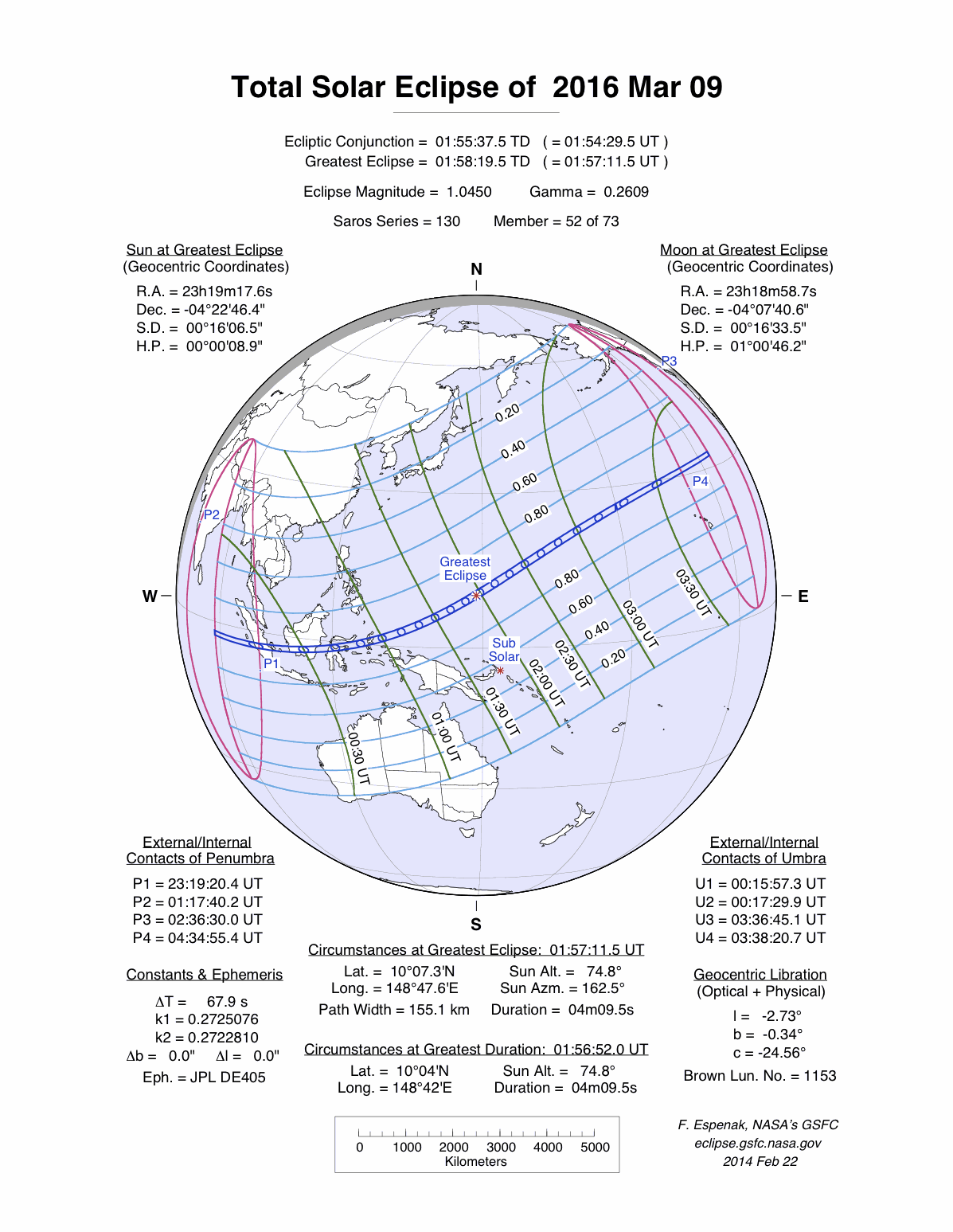
THE SOLAR ECLIPSE IS ABOUT TO BEGIN: Later today, there's going to be a total eclipse of the sun. It begins at sunrise on March 9th over the islands of Indonesia. That's the afternoon of March 8th in the United States. Sky watchers inside the narrow path of totality, which cuts across the Pacific Ocean from Sumatra to the waters north of Hawaii, can feel the touch of the Moon's cool shadow and behold the sun's corona. Stay tuned to the realtime photo gallery for the first sightings.
DON'T FORGET THE PARTIAL ECLIPSE: Mainstream media attention is focused on today's total eclipse of the sun. Fair enough. Totality is a mesmerizing experience that turns ordinary people into lifelong eclipse chasers. But don't forget about the partial eclipse. As this animated map created by graphic artist Larry Koehn shows, the sun will be partially covered over almost half of the planet:
Unlike the path of totality, which is very narrow, the partial eclipse zone is huge. It touches places as far apart as Alaska (20% coverage), Hawaii (65%), Australia (0% to 60%), China (0% to 40%), Japan (20%), and Papua New Guinea (70%). This is good, because a partial eclipse is total fun.
The first thing to remember about a partial eclipse is don't stare at it. Even the tiniest sliver of sun left uncovered by the Moon can hurt your eyes. Instead, look at the ground. Beneath a leafy tree, you might be surprised to find hundreds of crescent-shaped sunbeams dappling the grass. Overlapping leaves create a natural array of pinhole cameras, each one casting an image of the crescent-sun onto the ground beneath the canopy.

No trees? Try this trick: Criss-cross your fingers waffle-style and let the sun shine through the matrix of holes. You can cast crescent suns on sidewalks, driveways, friends, cats and dogs—you name it. Hand shadows are fun, too, like the crescent-eyed turkey shown above.
Because the partial eclipse lasts for more than an hour, there is plenty of time for shadow play and photography using safely-filtered telescopes and cameras. The view from Hawaii and Alaska, where the eclipse occurs near sunset, should be especially beautiful.
Realtime Spaceweather Photo Gallery
MAGNETIC REVERBERATIONS: Here on Spaceweather.com, we often say that Earth's magnetic field is "reverberating" from the impact of a CME or a solar wind stream. This is what we mean:

This plot shows the response of a magnetometer in England to a strong geomagnetic storm on March 6th and 7th. The east-west vector of Earth's magnetic field was swinging back and forth, "reverberating" as a stream of solar wind passed by our planet.
"My magnetometer went wild on March 6th as Earth entered a fast flowing and highly geoeffective solar wind stream, creating bright aurora even down to lower latitudes over Europe," reports Stuart Green of Preston, Lancashire, UK. "This is the largest response I've measured so far this year."
Magnetic fields cannot be seen by the human eye, but the magnetic reverberations were anything but invisible. This is what the sky looked like overhead:

Colin Cooper took the picture from Tynemouth, UK, barely 150 miles away from Green's magnetometer. "An incredible display rarely seen this far south," says Cooper. "There were some of the brightest rays and fastest movement I've ever seen for auroras in the UK."
The display was also seen in Scandinavia, Iceland, Canada, several US states, and even in the Southern Hemisphere. Browse the gallery for more reverberations:
Realtime Spaceweather Photo Gallery