ALMOST NO CHANCE OF FLARES: NOAA forecasters say there is no more than a 1% chance of strong solar flares today. The sun is peppered with spots, but none of them has the type of unstable magnetic field that poses a threat for explosions. Solar activity remains low. Solar flare alerts: text or voice
AURORA SEASON HAS ARRIVED: Green is a sign of spring. Green in the skies, that is. For reasons that are only partially understood, geomagnetic storms favor the weeks around equinoxes, giving Arctic skies a verdant hue just as Northern spring takes hold. Oliver Wright sends this picture of the phenomenon, taken March 9th, from Abisko, Sweden:
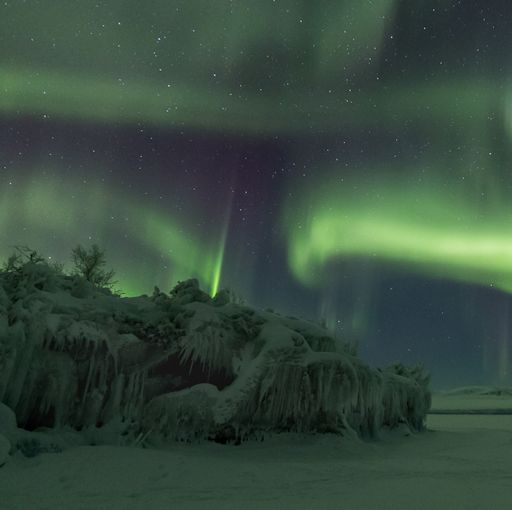
Wright is an aurora tour guide for Lights over Lapland. "Last night, after work, I met up with fellow guide (Sarah Skinner) and we headed down to the lake to see if we could photograph the aurora with the impressive ice cliffs," he says. "The aurora didn't disappoint whilst we had to listen to the ice groan and crack as the 70 km frozen lake spoke to us. Amazing experience to be visually and audibly blown away like that. If not a little spooky... "
More auroras are in the offing as the equinox approaches on March 20th. Stay tuned for green. Aurora alerts: text or voice
TOTAL ECLIPSE OF THE SUN: The March 9th solar eclipse is over--"and it was incredible," says Dana Crom of Earth to Sky Calculus, who witnessed the event from a beach on Belitung Island, Indonesia. "At first we thought we would not be able to see the eclipse, but morning clouds parted just in time for totality."
Indeed, all over Indonesia, observers spied the eclipse between and, more often, straight through clouds. Janne Pyykkö sends this picture from the nearby island of Terante:
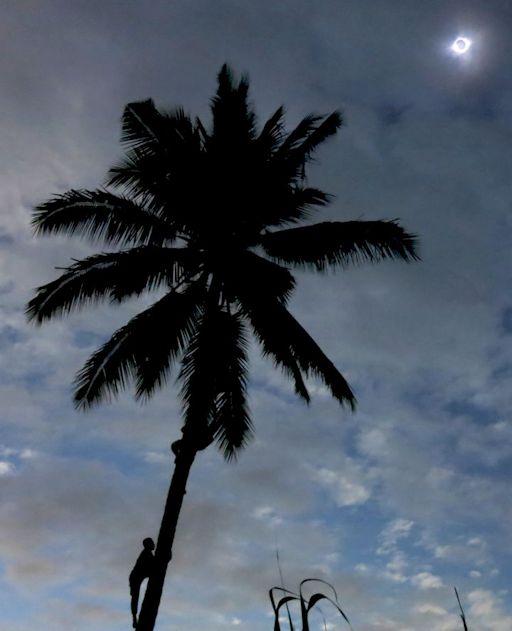
"With the help of local friends, I was able to find a coconut palm standing alone and two brave men willing to climb it for the photo," says Pyykkö. "During totality, high clouds muted the best sky colors. Even so, it was a fantastic experience."
On Belitung Island, Earth to Sky Calculus student Ginger Perez recorded a must-see video of totality. (Turn up the volume to hear the reaction of the crowd and the sound of ocean waves.) "It was hot when the sun rose this morning," says Ginger, "but the temperature dropped when the shadow of the Moon swept over us. It felt so nice! The slight ocean breeze made the eclipse sweeter still."
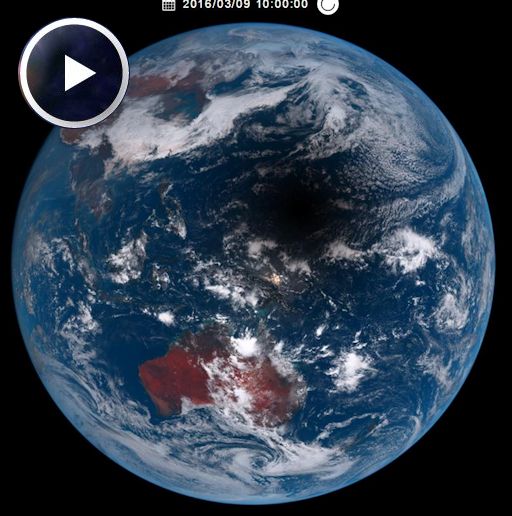
Japan's Sunflower-8 meteorological satellite saw the Moon's shadow from Earth orbit. Here it is racing across the Pacific on March 9th:
When the shadow engulfed Ternate, Indonesia, "the temperature dropped from 91.3F to 82.5F and the humidity increased from 73% to 85%," reports photographer Donald S. Gardner. "Roosters were crowing after totality."
Meanwhile, 30,000 feet above the Pacific, Alaska Airlines flight 870 from Anchorage to Honolulu diverted to fly through the path of totality. "I took photos every 2 seconds beginning 2 minutes before totality and ending 2 minutes after totality," reports passenger Evan Zucker who, fortunately, had a window seat:
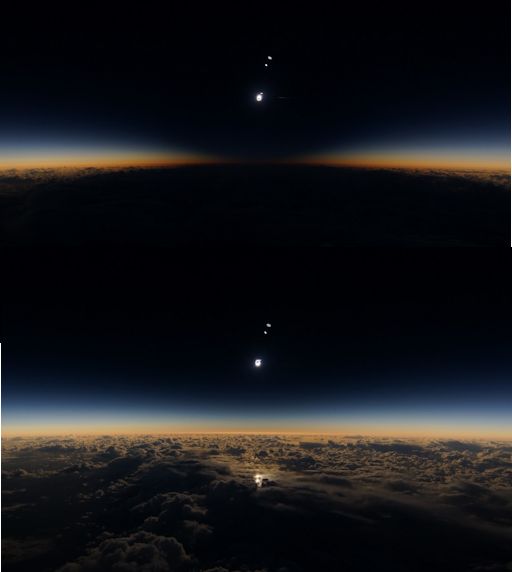
The top frame shows the view from the plane as it crossed the middle of the Moons shadow. The bottom frame shows light returning to the cloudtops as the plane began to exit. More of Zucker's airborne photos may be found here.
Browse the photo gallery for more tales from the eclipse zone:
Realtime Spaceweather Photo Gallery
Realtime Spaceweather Photo Gallery